
The Context Shift Principle in CAT RC
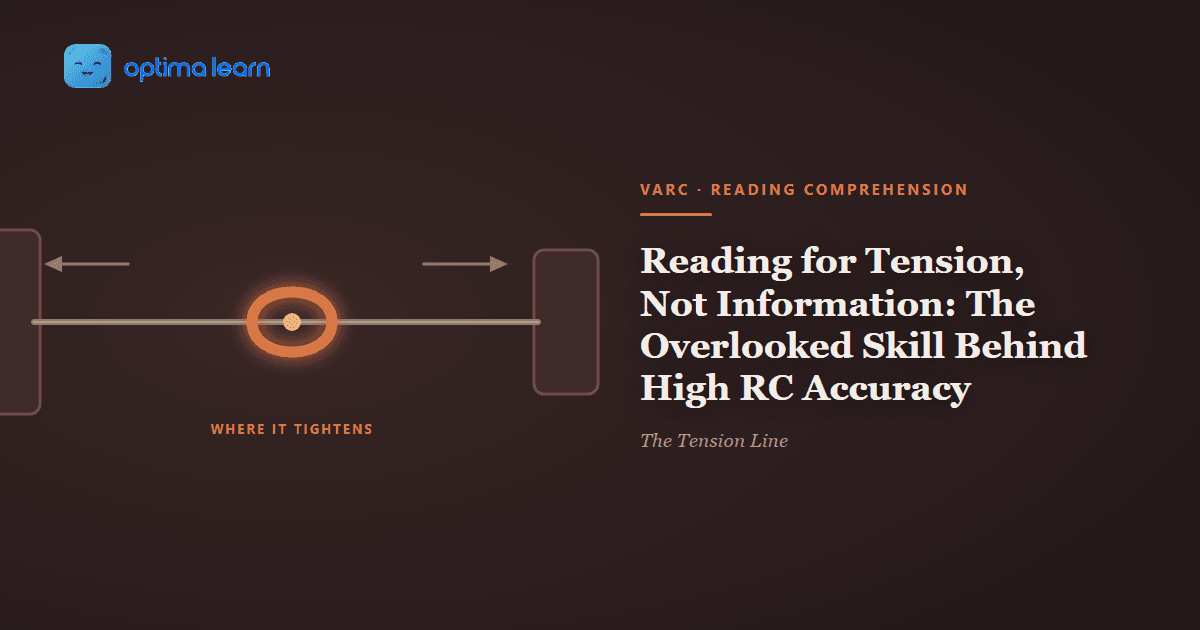
Ask an aspirant what an RC passage was about and you usually get a list. It discussed urban planning, mentioned three cities, cited a study from the nineties, ended with a point about zoning.
All accurate, and close to useless for answering the questions. Because a passage worth setting is never a list of things. It is an argument held under strain: someone disagrees with someone, or a finding sits awkwardly with a belief, or a policy has a cost nobody wants to name. Reading for tension means finding that strain. Reading for information means collecting facts that were never the point.
A wire lying loose on a table and the same wire stretched between two posts contain identical material. Only one of them has a shape you can read, and only one of them tells you where it will break.
- CAT passages are built around a tension, and the questions are almost always about the tension rather than the facts.
- Reading for information produces an accurate summary that answers very few questions.
- The Tension Line asks three things: what is the disagreement, where does it tighten, and is it resolved.
- A passage you can state as a tension in one sentence is a passage whose questions become substantially easier.
- The skill is not reading more closely. It is reading for a different thing.
Why Passages Are Built Around Strain
Nobody publishes an article to list facts. Serious non-fiction gets written because something is unresolved: a received view looks shaky, two pieces of evidence conflict, an accepted practice has a cost that has gone unexamined. The tension is the reason the piece exists.
Setters choose extracts on exactly that basis, because a passage without a tension cannot generate good questions. You cannot ask about tone, purpose, inference or the author's attitude in a text where nothing is at stake.
Which means the two ways of reading produce very different returns:
- Reading for information gives you what the passage mentioned. Useful for one or two detail questions.
- Reading for tension gives you why it was written. Useful for nearly everything else.
- Detail questions can be looked up in seconds, so retaining details has low value.
- Stance questions cannot be looked up, because they depend on a structure you either built while reading or did not.
The Tension Line: Three Questions to Read For
All three are answerable by the end of a first read, and holding them changes what you notice while reading rather than adding a step afterwards.
The Tension Line
- What is the disagreement? Name the two sides. They may be two schools, a finding against a belief, or an intention against its consequence.
- Where does it tighten? Find the paragraph where the stakes are highest. That is where most questions will be drawn from.
- Is it resolved? Does the author settle it, decline to settle it, or dissolve it by reframing? Each produces a different set of correct answers.
Naming the disagreement is the step that does most of the work, and it has to be specific:
- "Economists disagree about growth" is not a tension. "Growth models assume mobility that the data does not show" is.
- Look for two things that cannot both be comfortably true, then say what makes them incompatible.
- If you cannot name two sides, look again for an implicit one. The absent side is often the received view.
Finding where it tightens tells you where to concentrate, which matters when time is short:
- The tightest paragraph usually contains the strongest language in the passage.
- It is often where the author gives most ground before pushing back hardest.
- Detail in that paragraph is worth retaining; detail elsewhere is worth locating rather than remembering.
Checking resolution determines what kinds of answers can be correct at all:
- Resolved in favour of one side: strong statements of that side can be correct.
- Left open: any option that settles the matter is wrong, however reasonable it sounds.
- Dissolved by reframing: the correct answer usually describes the reframing rather than either original side.
Put the Tension Line to Work
Reading for strain is a change of attention, and attention changes only with repetition. Optima Learn's VARC sets follow genuine CAT sources, so the tensions are as understated as the exam makes them.
Practise CAT VARC QuestionsWhat Tensions Usually Look Like
They come in a small number of recognisable shapes, and knowing the shapes makes them much faster to spot.
| Shape | What it sounds like | Typical resolution |
|---|---|---|
| Received view versus evidence | Long assumed, but recent work suggests | Author sides with the evidence |
| Two schools | One tradition holds, another argues | Often left open, or reframed |
| Intention versus consequence | Designed to do one thing, in practice does another | Author names the gap, rarely solves it |
| Part versus whole | True of individual cases, not of the system | Author distinguishes the levels |
| Definition dispute | The argument turns on what a term means | Dissolved by reframing the term |
The last two rows are the ones that produce the hardest questions, because the correct answer is neither of the positions the passage seemed to be arguing between. Recognising the shape early is what stops you choosing a side the author never took.
How Reading for Tension Changes the Answer Options
The payoff arrives at the options, where a tension-shaped reading eliminates faster than a fact-shaped one:
- Options that settle an open tension are wrong, and you can see it without re-reading.
- Options that state one side too strongly fail when the author only leaned that way.
- Options that are true but unstressed are the classic trap: accurate content, wrong emphasis.
- Options describing the reframing are usually right when the passage dissolved rather than settled the dispute.
- Options that name the tension itself are frequently correct on main-idea questions, and they read as vague to a reader who collected facts.
That third bullet is where most careful readers lose marks, and it is covered from the answer side in the live piece on the difference between understanding and selecting.
Common Mistakes When Reading for Information
Related habits:
- Retaining detail. Memorising figures and names that could have been located in five seconds.
- Missing the second side. Reading a passage as one continuous argument when it was a dispute.
- Assuming resolution. Deciding the author settled a matter they deliberately left open.
- Choosing the truest option. Picking an accurate statement over the one that carries the passage's emphasis.
- Reading evenly. Spending the same attention on the setup paragraph as on the paragraph where the tension tightens.
A Practice Drill for Reading Tension
The drill withholds the questions, which is what forces the change in attention.
- Take fifteen RC passages. Cover the questions completely.
- For each, write one sentence in the form "X, but Y", plus the paragraph where the tension is tightest, plus whether it is resolved.
- Now uncover the questions. Mark how many could be answered from your three notes alone, without re-reading.
- For the ones that could not, check whether your tension statement was wrong or merely too vague.
What aspirants typically find:
- Most main-idea, purpose and tone questions are answerable from the three notes alone.
- Early attempts are too vague rather than wrong, and specificity is the thing that improves.
- The tightest paragraph supplies a disproportionate share of the questions.
- Accuracy on inference questions moves first, usually within a fortnight.
The Bottom Line
Two people can read the same passage with equal care and come away with different objects. One has a summary of what it said. The other has the shape of what it was arguing about. The questions were written by someone looking at the second thing, which is why careful reading alone has a ceiling and reading for tension does not.
The Tension Line, Recap
- Name the disagreement: two things that cannot both be comfortably true.
- Find where it tightens: strongest language, highest stakes, most questions.
- Check resolution: settled, left open, or dissolved by reframing.
Build the Habit on Timed CAT VARC
Under pressure, attention defaults to content, so reading for tension has to be trained on the clock. Work through CAT previous year questions in timed blocks, or sit full CAT mock tests and past papers so the habit holds through real fatigue. More reading method sits in the CAT VARC blog archive, and if accurate reading keeps producing inaccurate answers it is worth having your approach reviewed honestly.
Read for the Strain in CAT 2026
The facts in a passage are the least useful thing in it. Build the habit of finding the argument underneath on real CAT-style passages.
Start Practising CAT VARCFrequently Asked Questions
What does reading for tension mean in CAT RC?
It means reading for the disagreement a passage is built around rather than the facts it contains. Serious non-fiction is written because something is unresolved, and CAT setters choose extracts on that basis, so the tension is what nearly every question is actually about.
Why is my comprehension good but my RC accuracy poor?
Usually because you are reading the wrong layer of the text. An accurate summary of content answers a couple of detail questions and very little else, while purpose, tone and inference questions all depend on the conflict. More reading practice reinforces the layer already being read rather than changing it.
How do I find the tension in a passage?
Look for two things that cannot both be comfortably true and name what makes them incompatible. Common shapes are a received view against new evidence, two schools of thought, an intention against its actual consequence, and a dispute that turns on the definition of a term.
What if the passage never resolves the tension?
That is common and it is useful information. When a tension is left open, any answer option that settles it is wrong however reasonable it sounds. When it is dissolved by reframing a term, the correct option usually describes the reframing rather than either of the original positions.
Practice VARC, chapter by chapter
CAT VARC practice across reading comprehension, para-summary and para-jumbles, each with a worked solution.
More from VARC
Continue reading

Using a Study Journal for CAT Without Overdoing It
How to Stop Comparing Your CAT Prep With Everyone Else

SPJIMR Admission Process: Why the Profile Leads It
How to Solve CAT Quant Faster Without Skipping Steps
Put it into practice