
The Attention Economy of CAT: Where Your Focus Creates the Biggest Score Difference
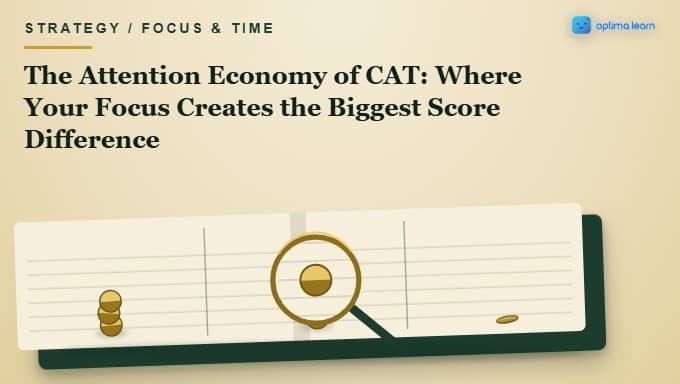
The biggest score differences in CAT don't come from time management alone. They come from where you spend your limited attention: a scarce resource that runs out faster than the clock and recovers unevenly across a section. The Attention Ledger sorts every question into three tiers, so your focus goes where it actually earns marks.
Picture the moment after a mock ends. The timer shows four minutes still unused, yet your score report shows three questions where you simply guessed. You don't run out of time. You run out of something else, and most aspirants never learn its name.
That something is attention, and it behaves less like a stopwatch and more like a currency. You don't get a fixed amount refunded every minute the way you do with time. You spend it, and once a question drains it on a dead end, that portion of your focus is gone for the rest of the section, even though the clock keeps ticking evenly.
Have you ever noticed how the fourth or fifth easy question in a row somehow takes longer than it should? That's not physical fatigue. That's an account running low, and the Attention Economy is the discipline of noticing it before it empties.
- The Attention Ledger sorts every CAT question into three tiers: Must-Fund, Worth Funding, and Bad Trade.
- Attention is a currency you spend, not a clock that refills evenly every minute.
- Must-Fund questions with a clear entry point deserve first claim on your focus, every time.
- Bad Trade questions drain concentration for an uncertain return, recognize them fast and move on.
- Tier recognition is a trainable skill, most aspirants sharpen it within four to six mocks of deliberate review.
This piece is for aspirants who already track their time carefully, sectional splits, per-question averages, yet still watch their percentile stall. If you've already read our piece on the CAT Attention Budget, which explains how much total mental energy you actually have across an exam day, think of this post as its companion: that piece covers the size of your account, this one covers where you spend from it.
Why Are Attention and Time Not the Same Budget?
Time and attention look identical on a mock's summary page, both measured in minutes. They behave nothing alike inside a live section. A CAT section runs on a fixed clock, but attention drains unevenly across that same window, spiking on familiar questions and emptying long before the timer does.
Here's where the market framing helps. Every question you attempt is a transaction: you pay attention, and the question pays back either a mark, partial progress, or nothing at all. Some transactions are safe bets. Others quietly cost you far more than they return, even when you eventually get the answer right.
This is a different conversation from time management, and a different one again from energy management. Our piece on the CAT Attention Budget explains how much total mental energy you're working with across an exam day. Assume you already know that number. The real question here is different: once you know your balance, where should it actually go?
Once you start noticing that gap, the natural next step is deciding, in advance, which questions are worth funding with your full attention and which ones you should refuse to fund at all. That decision needs a system more than a gut feeling in the moment, which is exactly what the Attention Ledger below gives you. Build that decision into a personalized CAT study plan and it stops being a one-off insight and becomes a habit.
What Is the Attention Ledger?
The Attention Ledger is a three-tier framework for deciding where focused concentration goes inside a CAT section: Must-Fund, Worth Funding, and Bad Trade. Each tier is a pre-decided rule for how much attention a question earns before you even start reading it closely, so the decision happens fast, not mid-solve.
Think of it the way a careful investor thinks about capital, not every opportunity deserves the same size of bet. Time tells you how long you have left in a section. The Ledger tells you where it's worth spending your sharpest focus.
The Attention Ledger
"Time tells you how long you have. The Ledger tells you where it's worth spending."
- Must-Fund: questions where a small amount of focused attention returns a near-certain mark, a familiar question type, a clean data set, an unambiguous RC line. Fund these first, every time.
- Worth Funding: questions that cost more attention but still return marks reliably if you commit, a longer DILR set, a multi-step Quant problem you can see a path through. Fund these if the Must-Fund questions are already covered.
- Bad Trade: questions that consume heavy attention for an uncertain or low return, a set you cannot find an entry point into, a question that is more guess than solve. Recognize these fast and stop funding them.
Why three tiers rather than a simple yes-or-no filter? Because most CAT questions don't sort neatly into attempt or skip. The middle tier, Worth Funding, is where real percentile gains hide: questions that look expensive but pay back reliably once you commit the effort. Treat them like Bad Trades, and you leave marks on the table. Treat them like Must-Fund questions, and you burn time you needed elsewhere.
What Does Each Tier Actually Look Like Inside a CAT Section?
Must-Fund, Worth Funding, and Bad Trade stop being abstract labels once you see them against real question types. A clean successive-discount percentage question is almost always Must-Fund. A multi-worker time-and-work problem with a visible setup is usually Worth Funding. A DILR set with no obvious starting clue is frequently a Bad Trade, at least on a first pass.
Consider a Must-Fund question: a shop marks up its cost price by 60 percent, then applies two successive discounts of 10 percent and 5 percent. The net multiplying factor is 1.60 times 0.90 times 0.95, which works out to 1.368, an overall profit of 36.8 percent. The method is familiar, the numbers are clean, and the attention cost is maybe twenty seconds. This is exactly the kind of question our CAT Quant practice sets are built to make instantly recognizable, so the classification itself becomes close to automatic.
Now a Worth Funding question: A can finish a piece of work in 12 days, B in 15 days. They work together for 4 days, then A leaves and B finishes the rest alone. Combining rates gives 1/12 plus 1/15, which is 3/20 of the work per day. Four days of combined work clears 4 times 3/20, or 3/5 of the total. That leaves 2/5 of the work for B alone, and at B's rate of 1/15 per day, that remaining share takes B six more days. More steps than the discount question, but every step is visible before you commit, which is what earns it Worth Funding rather than Must-Fund or Bad Trade.
And a Bad Trade: a DILR set with eight variables, three overlapping conditions, and no clue that fixes even one value on a first read. Ten or fifteen seconds of scanning should tell you whether an entry point exists. If it doesn't, the honest move is deferring the set, not grinding through it hoping a pattern surfaces eventually.
| Panic Move | Pro Move |
|---|---|
| Treating every question as worth full effort because skipping feels like giving up | Naming the tier within the first ten to fifteen seconds and committing to that call |
| Pouring more focus into a Bad Trade hoping persistence will crack it | Marking a Bad Trade for later and moving straight to the next Must-Fund question |
| Rushing through a Must-Fund question to save time for harder ones | Giving Must-Fund questions full, unhurried attention since the return is close to guaranteed |
| Avoiding Worth Funding questions entirely out of fear they'll turn into Bad Trades | Committing to Worth Funding questions once the Must-Fund tier is cleared for the section |
None of this shows up on a static study schedule. A schedule tells you what to study and when. It says nothing about which questions, inside a live section, deserve your best thinking versus your fastest exit. That's a decision problem more than a scheduling one, and our piece on why you should stop optimizing your schedule and start optimizing your decisions goes deeper into that distinction.
How Do You Train Your Tier Instinct Before Exam Day?
Tier recognition is trainable, and it typically sharpens within four to six mocks of deliberate review, not from reading about the framework once. The habit is simple: tag every question you struggled with by its tier in hindsight, then compare that tag against how quickly you actually recognized it while solving.
Here's a simple drill. After every mock, before you look at explanations, go back through every question you attempted and write one word next to it, Must-Fund, Worth Funding, or Bad Trade, based on how it actually played out. Then compare that word against how you treated the question in real time. The mismatches are the entire point of the exercise.
Why does this work? Tier recognition is a pattern-matching skill, and pattern-matching improves through repeated, labeled exposure, not through willpower alone. When should you use it? Immediately after each mock, while the memory of each question is still fresh enough to judge honestly. How do you do it? The one-word tagging pass above, followed by a five-minute scan for repeated mismatches across your last three mocks.
Skip this review, and the same mistake repeats invisibly. You'll keep overfunding a question type that looks familiar but rarely pays off, and keep underfunding a type that looks intimidating but is actually cheap once you've seen the pattern. Without the tagging step, that blind spot has nothing forcing it into view.
What would change if you trusted your first ten-second read of a question as much as you trust a full worked solution? For most aspirants, that trust has to be earned, one reviewed mock at a time.
Turn Tier Recognition Into a Weekly Habit
Reading about the Attention Ledger is one thing. Building it into your actual mock review, week after week, is what moves your percentile. A personalized CAT study plan can fold this review into your existing routine instead of adding one more thing to remember.
Build Your CAT PlanThe Bottom Line: Spend Attention Like It's Scarce, Because It Is
The Attention Economy of CAT is not a new thing to learn. It's a different lens on something you're already spending anyway, just without a plan for where it should go. The Attention Ledger doesn't add work. It reorders the split-second decision you make on every question, so your sharpest focus lands on Must-Fund and Worth Funding questions instead of leaking into Bad Trades that were never going to pay you back.
Psychologists sometimes describe the mental residue left behind after switching tasks as attention residue, the trace of a previous problem that keeps eating into focus on the next one. Bad Trade questions are attention residue generators: even after you mark one for review, part of your mind stays stuck on it unless you consciously close the loop and move to the next question.
The Attention Ledger, Recap
- Must-Fund: familiar, clean, near-certain marks. Fund first, every time.
- Worth Funding: costs more, still pays back reliably once you commit.
- Bad Trade: heavy attention, uncertain return. Recognize fast, stop funding.
Ready to Spend Your Attention on Purpose?
A generic checklist won't tell you which questions are draining your focus for nothing. A personalized CAT study plan, built around your own mock data, will.
Get Your Personalized CAT Study PlanFrequently Asked Questions
Is the Attention Economy the same thing as time management?
No. Time management asks how many minutes you have left. The Attention Economy asks which questions are worth spending your limited focus on, since attention runs out faster than the clock does and does not recover evenly across a 40-minute section.
How do I know which questions deserve my full attention?
Use the Attention Ledger's three tiers. If a question type is familiar and the data is clean, it is Must-Fund, attempt it immediately. If it needs real effort but you can already see a path through it, it is Worth Funding. If ten seconds in you still cannot find an entry point, it is a Bad Trade, mark it and move on.
Can I train myself to spot low-return questions faster?
Yes, through deliberate mock review. After every mock, tag each question you struggled with as Must-Fund, Worth Funding, or Bad Trade in hindsight, then check how quickly you actually recognized the tier while solving. That gap closes with repetition, usually within 4 to 6 mocks.
Does the Attention Ledger framework apply to VARC and DILR too?
Yes, arguably more than Quant. A DILR set can look Worth Funding from its first two clues and turn into a Bad Trade by the fifth. A VARC passage can look dense and be a Must-Fund question once you spot the one line the questions actually hinge on. The tiers apply across all three sections.
Build your CAT 2026 study plan
Personalised daily plan that adapts to your section-wise mock scores.
More from Strategy
Continue reading
XLRI Admission Process: The Exam Nobody Ever Checks
Why Do Some CAT DILR Sets Feel Totally Unsolvable?
Why School Level Quant Feels Hard in the CAT Paper
Why Do Non Engineers Struggle in CAT VARC As Well?
Put it into practice