
Reading for Tension in CAT RC
You finish an RC passage confident you followed it, and then the questions ask about a position you are sure the author rejected. You go back, read again, and find the sentence where the argument changed direction. It was there the whole time. It just did not announce itself.
Authors of the kind of prose CAT uses do not signpost the way textbooks do. They shift position inside a subordinate clause, or by changing a tense, or by attributing the previous paragraph to someone else in four words. The direction changes; the volume does not.
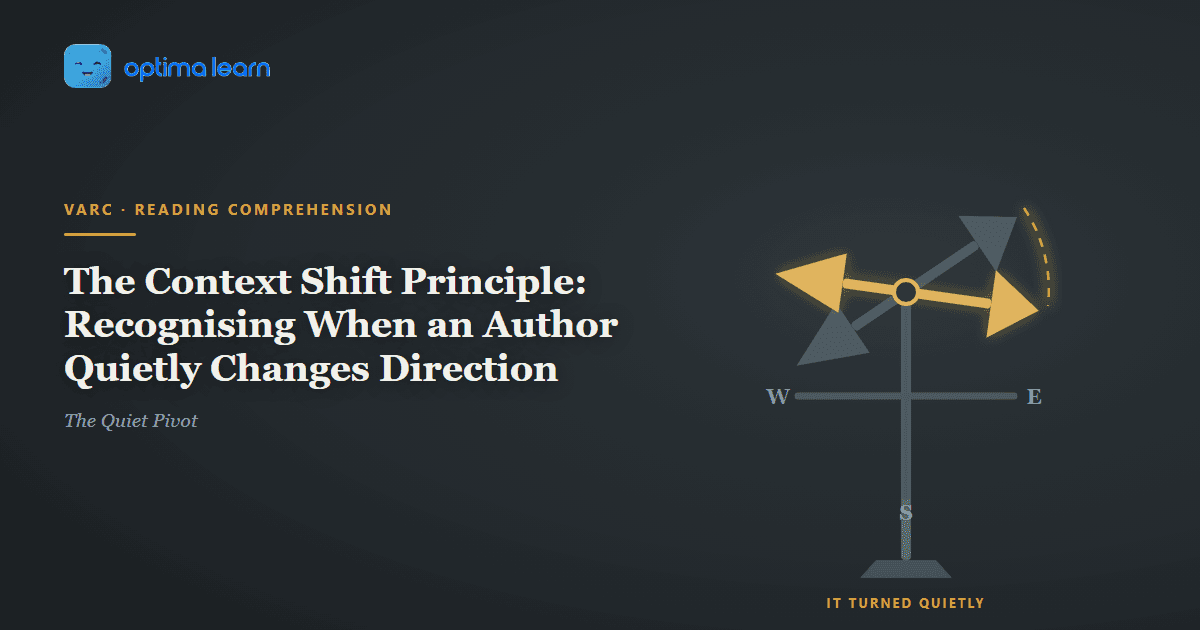
A weathervane turning is silent. Nothing about the movement draws attention to itself, and unless you were watching the vane rather than the sky, you will keep describing a wind that stopped blowing that way some time ago.
- CAT passages change direction without announcing it, often inside a subordinate clause or a single verb.
- The Quiet Pivot has three reliable markers: unaccompanied concessions, shifts in tense or modality, and shifts in attribution.
- Missing a pivot means answering questions about a position the author has already left, which feels like careful reading and is not.
- The loudest signals, such as "however", are the ones you already catch. The costly ones are quiet by design.
- Marking pivots as you read costs nothing and makes tone, purpose and inference questions substantially easier.
Why Context Shifts Are Quiet in CAT Prose
The passages CAT draws from are written for readers who already know the field. In that context, heavy signposting reads as condescending, so competent writers minimise it. A shift that a textbook would introduce with "However, this view has been challenged" appears instead as a change of verb.
This is not the setter being difficult. It is the natural register of serious non-fiction, and the exam is testing whether you can read it at speed.
The result is that direction changes hide in ordinary grammar:
- Inside a subordinate clause, where the main clause carries the older position and the subordinate one undercuts it.
- In a change of tense, which quietly relocates a claim into the past.
- In a modal verb, where "is" becomes "might be" and the claim loses its footing.
- In attribution, where a position picks up an owner and stops being the narration.
The Quiet Pivot: Three Markers Worth Watching
These are not the obvious contrast words. Those you already catch. These are the three that reliably slip past.
The Quiet Pivot
- The unaccompanied concession. "Granted", "of course", "admittedly", "to be sure" — a concession always precedes a reversal, even when no "but" arrives to mark it.
- The tense or modality shift. "Was long held" or "might be argued" relocates a claim into the past or into doubt without contradicting it directly.
- The attribution shift. A position that was being narrated suddenly acquires an owner. The moment a view belongs to someone, the author has stepped away from it.
The unaccompanied concession is the most reliable of the three, because the grammar guarantees what follows:
- Concession words exist to grant ground before taking it back. There is always a reversal, marked or not.
- The reversal can arrive a sentence or two later, which is why the concession is the thing to mark.
- "It is true that" and "no doubt" behave identically and are easier to read past.
Tense and modality shifts are the quietest and the most commonly missed:
- "Has been understood as" places a view in the past and signals that the present differs.
- Hedges such as "appears", "seems" and "is often taken to be" withdraw commitment without denial.
- A single conditional can convert a claim into a hypothesis the author is about to test.
Attribution shifts are the ones that decide answers, because they relocate a whole position:
- "For the classical school" or "on this reading" retroactively assigns everything preceding it.
- Once a view has an owner, the author is no longer inside it, whatever the tone suggested earlier.
- Attribution can be applied to a paragraph you read three minutes ago, and it reaches backwards.
Put the Quiet Pivot to Work
Quiet markers only become visible with repetition against real prose. Optima Learn's VARC sets follow genuine CAT sources, so the pivots are as understated as they will be in the exam.
Practise CAT VARC QuestionsHow Loud a Signal Is, and How Much It Costs
It helps to see the range explicitly, because attention naturally goes to the top of this table and the marks sit at the bottom.
| Signal | How loud | How often missed |
|---|---|---|
| However, but, yet | Loud | Almost never |
| Nevertheless, on the contrary | Clear | Rarely |
| Granted, of course, admittedly | Quiet | Often |
| Tense shift, hedging modal | Very quiet | Usually |
| Attribution phrase | Silent | Almost always |
The pattern is unfortunate and consistent: the signals that matter most for tone and inference questions are the ones written to be least noticeable. Reading harder does not fix this. Reading for these specific forms does.
How to Mark Pivots While Reading
The technique has to be almost free, or it will not survive a timed section. Five rules keep it that way:
- One mark, not notes. A small arrow in the margin at the pivot sentence. Nothing else.
- Mark the concession, not the reversal. The reversal is easy to find once you know a concession preceded it.
- Circle attribution phrases. Four words that assign a whole position deserve two seconds.
- Note the direction, not the content. An arrow up or down for whether the author moved toward or away from the claim.
- Do not re-read at the pivot. Mark it and continue; the passage will confirm it shortly.
Once marked, the arrows become a map of the argument, and questions about the author's view resolve by looking at the last arrow before the relevant paragraph rather than by re-reading.
Common Mistakes When the Argument Turns
Related errors:
- Reading only for content. Tracking what is claimed while ignoring who is claiming it.
- Waiting for a contrast word. Assuming a direction change must be marked, when the quiet forms are the ones that matter.
- Missing retroactive attribution. Failing to notice that a phrase has just reassigned two earlier paragraphs.
- Over-marking. Treating every hedge as a pivot, which produces a page of arrows and no map.
- Fixing tone from the opening. Deciding the author's attitude early and never updating it as the argument moves.
A Practice Drill for Spotting Pivots
The drill deliberately separates finding pivots from answering questions.
- Take twelve RC passages. Do not look at the questions.
- Mark every sentence where the argument changes direction, using an arrow for the direction of the shift.
- For each mark, note which of the three markers triggered it: concession, tense or modality, or attribution.
- Now read the questions and count how many depend on a pivot you marked.
What usually emerges:
- Attribution shifts are missed most often, followed closely by tense shifts.
- Passages with the most pivots are not the hardest; passages with the quietest ones are.
- A large share of tone and author's-view questions sit within two sentences of a marked pivot.
- Accuracy on stance questions moves within about three weeks, well before overall reading speed changes.
The Bottom Line
Following a CAT passage is not the same as following its author. Content is easy to track and stance is what the questions are usually about, and stance moves at moments deliberately written not to attract attention. Reading for those moments is a different skill from reading well, and it is the one being tested.
The Quiet Pivot, Recap
- Unaccompanied concession: granted, of course, admittedly. A reversal always follows.
- Tense or modality shift: a claim moved into the past or into doubt.
- Attribution shift: once a view has an owner, the author has stepped away from it.
Build the Habit on Timed CAT VARC
Marking pivots is the first thing dropped when the clock is running, so it has to be built against one. Work through CAT previous year questions in timed blocks, or sit full CAT mock tests and past papers so the habit survives real fatigue. More reading method sits in the CAT VARC blog archive, and if stance questions keep costing you marks it is worth having your preparation reviewed honestly.
Catch the Pivot in CAT 2026
The sentence that changes a passage's direction is written not to be noticed. Train for it on real CAT-style prose under a clock.
Start Practising CAT VARCFrequently Asked Questions
What is a context shift in a CAT RC passage?
It is the point where the author changes direction: moving away from a position, attributing it to someone else, or withdrawing commitment to it. In CAT prose these shifts are usually unmarked, appearing inside a subordinate clause, a change of tense or a short attribution phrase.
How do I spot an unmarked shift in direction?
Watch three forms rather than reading harder. Concession words such as "granted" and "admittedly" always precede a reversal. Tense shifts and hedging modals relocate a claim into the past or into doubt. Attribution phrases assign a position to someone, which means the author has left it.
Why do I keep getting tone and author's-view questions wrong?
Usually because you are reading for content rather than for stance. Tracking what is claimed is straightforward; tracking who is claiming it is the harder skill and the one most questions test. Missing a quiet pivot leaves you reasoning from a position the author had already abandoned.
Does marking pivots slow down your reading?
Not if the mark is a single arrow rather than a note. It costs roughly a second per pivot and saves far more at the questions, because the arrows become a map of the argument and stance questions resolve by checking the nearest one rather than by re-reading the passage.
Practice VARC, chapter by chapter
CAT VARC practice across reading comprehension, para-summary and para-jumbles, each with a worked solution.
More from VARC
Continue reading
Using a Study Journal for CAT Without Overdoing It
How to Stop Comparing Your CAT Prep With Everyone Else
SPJIMR Admission Process: Why the Profile Leads It
How to Solve CAT Quant Faster Without Skipping Steps
Put it into practice