
Reading a CAT Author's Assumptions
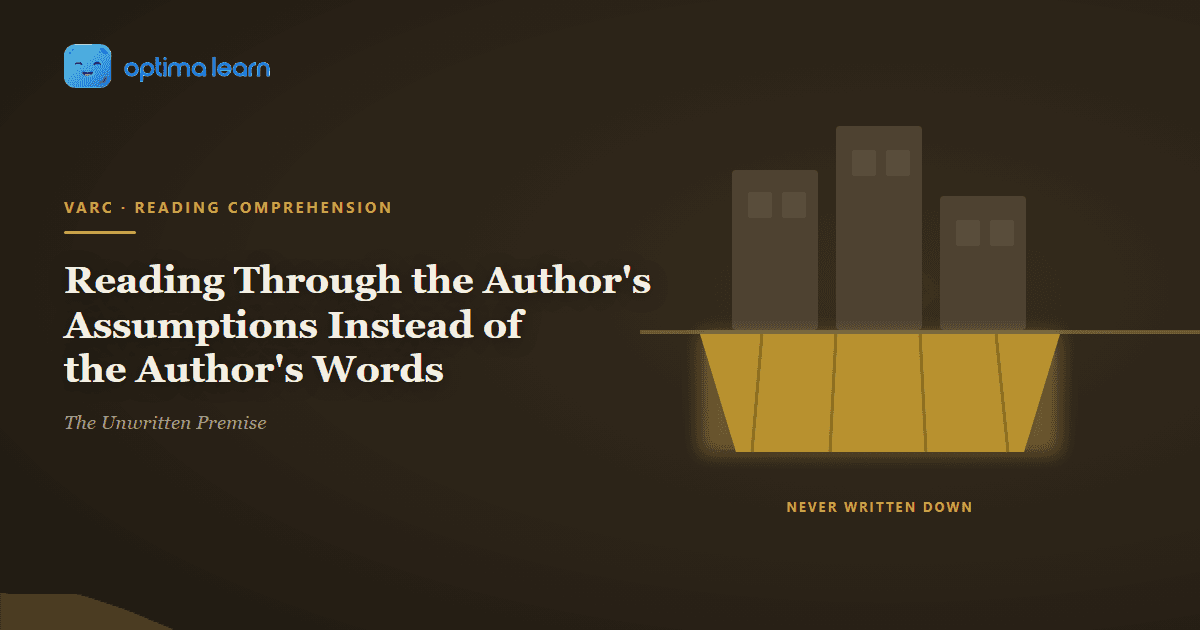
An author writes: productivity in the sector rose 12 percent after the reforms, so the reforms worked. Two claims, one conclusion, and something invisible holding them together.
Nothing else caused the rise. That sentence is nowhere in the passage. It is not argued, not evidenced, not mentioned. And the conclusion collapses without it, which makes it load-bearing despite never having been written down.
Assumptions are the foundations of an argument. They are underground by design, and questions about strengthening, weakening, or what the author takes for granted are asking about the part of the building nobody can see.
- Every argument rests on claims it never states, and those claims are what strengthen and weaken questions target.
- The Unwritten Premise hides in three places: the gap between evidence and conclusion, the comparison class, and the value judgement.
- An assumption is not something the author probably believes. It is something the argument requires in order to work.
- The negation test is the reliable check: deny the assumption and the conclusion should fail.
- Reading for assumptions is a different operation from reading for claims, and it has to be done deliberately.
Why Arguments Leave Premises Unstated
Nobody writes out every premise. An author who spelled out that no other factor caused the productivity rise, that the measurement was reliable, and that twelve percent is a meaningful amount would produce something unreadable.
So writers state what is contestable and leave what seems obvious. The trouble is that "seems obvious" is doing a lot of work, and the assumptions that look most obvious to the author are frequently the ones most worth attacking.
Which is exactly what the question types are built around:
- Assumption questions ask you to name an unstated premise directly.
- Weaken questions usually work by denying one.
- Strengthen questions usually work by confirming one.
- Flaw questions point at an assumption that does not hold.
The Unwritten Premise: Three Places to Look
All three are found by examining the structure of the argument rather than its content, which is what makes them findable at speed.
The Unwritten Premise
- The gap between evidence and conclusion. Write both down and ask what must be true for one to license the other. That is the assumption.
- The comparison class. Any "better", "more" or "improved" implies a comparison. What it is being compared against is often unstated and often contestable.
- The value judgement. Any claim that something is desirable smuggles in a standard. The standard is rarely argued for.
The evidence-conclusion gap is the most productive and the most mechanical:
- State the evidence in one line and the conclusion in another, then look at the space between them.
- Causal conclusions from correlational evidence always assume no third factor and no reverse causation.
- A conclusion about a group drawn from evidence about a sample assumes the sample represents the group.
The comparison class is the one most often missed because comparatives read as complete sentences:
- "More efficient" than what? The alternative is frequently unnamed and doing real work.
- "Improved" compared with when? A favourable baseline can carry an entire argument.
- "Most" implies a field of candidates, and which candidates were included is usually assumed.
The value judgement is the subtlest and the most common in humanities passages:
- Calling an outcome a success assumes a criterion for success that has not been defended.
- Treating efficiency as the relevant measure assumes efficiency is what matters here.
- Describing a change as progress assumes a direction, and the direction is the assumption.
Put the Unwritten Premise to Work
Finding what an argument requires is a habit built against real arguments. Optima Learn's VARC sets follow genuine CAT patterns, so the gaps sit where the exam puts them.
Practise CAT VARC QuestionsThe Negation Test, and What It Settles
The one reliable check on a candidate assumption is to deny it and see whether the argument survives.
| Deny the option and... | What it means | Verdict |
|---|---|---|
| The conclusion clearly fails | The argument needed it | It is the assumption |
| The conclusion is weakened slightly | Helpful but not required | Strengthener, not assumption |
| Nothing changes | Irrelevant to the reasoning | Wrong |
| The conclusion still holds | The argument did not rely on it | Wrong |
| The evidence itself becomes false | You negated a premise, not an assumption | Wrong |
The second row is where most near-miss answers sit. A statement that helps the argument is not the same as one the argument requires, and assumption questions ask for the second.
How Assumptions Differ by Passage Type
Knowing where to look first saves time, because different subjects hide their premises in different places:
- Economics and policy: almost always the causal gap. Correlational evidence, causal conclusion, no other factor assumed away.
- Science: usually the sample. A finding from a narrow context generalised to a wide one.
- History: usually the comparison class. A period described as unusual, with the baseline unstated.
- Philosophy and criticism: usually the value judgement. A standard applied without being defended.
- Business cases: usually the alternative. A course of action recommended without the alternatives being examined.
This is the same reading discipline that separates what a passage says from what it takes for granted, which sits alongside the difference between understanding and selecting at the answer stage.
Common Mistakes With Assumptions
Related errors:
- Picking what the author probably believes. Plausible but not required by the reasoning.
- Accepting a strengthener. Choosing something that helps rather than something the argument needs.
- Ignoring the comparison class. Reading "more effective" as a complete claim.
- Missing the value standard. Accepting "success" without asking by what measure.
- Skipping the negation test. Choosing on feel when a five-second check would have settled it.
A Practice Drill for Finding Unstated Premises
The drill separates locating the gap from choosing among options.
- Take twenty argument-based questions. Cover the options entirely.
- For each, write the evidence and the conclusion on separate lines, then write what must be true to connect them.
- Uncover the options and find the one closest to your sentence.
- Where you were wrong, apply the negation test to both your choice and the key, and note which category of error it was.
What usually emerges:
- Most errors are strengtheners chosen in place of assumptions.
- Causal gaps are found reliably; comparison classes and value judgements are missed far more often.
- Writing the conclusion first eliminates a large share of errors on its own.
- The negation test settles nearly every case where two options survive.
The Bottom Line
Reading an argument for what it says gives you its claims. Reading it for what it needs gives you its structure, and the structure is where the difficult questions live. The sentences that decide those questions were never written, which is why finding them is a separate skill from reading well.
The Unwritten Premise, Recap
- The evidence-conclusion gap: what must be true for one to license the other.
- The comparison class: better, more and improved all imply an unstated alternative.
- The value judgement: calling something a success assumes an undefended standard.
Build the Habit on Timed CAT VARC
Writing the conclusion before reading options is the first step dropped under pressure. Work through CAT previous year questions in timed blocks, or sit full CAT mock tests and past papers so the habit survives fatigue. More reading method sits in the CAT VARC blog archive, and if argument questions keep costing you marks it is worth having your approach reviewed honestly.
Read the Foundations in CAT 2026
The claims that decide argument questions are the ones nobody wrote down. Build the habit of finding them on real CAT-style passages.
Start Practising CAT VARCFrequently Asked Questions
What is an assumption in a CAT verbal question?
Something the argument requires in order to work, but never states. It is narrower than a belief the author might hold: if denying it leaves the conclusion standing, it was not an assumption however plausible it sounds.
How does the negation test work?
Deny the candidate assumption and check the argument. If the conclusion clearly fails, you have found it. If the conclusion is only slightly weakened, the option is a strengthener rather than an assumption. If nothing changes, the option is irrelevant to the reasoning.
Why do I keep choosing options that restate the evidence?
Because they are unambiguously supported by the passage, which feels safe. But an assumption is unstated by definition, so anything you can point at in the text is automatically wrong. Being able to locate an option in the passage is a reason to eliminate it, not to choose it.
Where are unstated premises usually hidden?
Three places. In the gap between evidence and conclusion, especially where correlational evidence supports a causal claim. In an unstated comparison, wherever "better" or "more" appears. And in a value judgement, wherever something is called a success without the standard being defended.
Practice VARC, chapter by chapter
CAT VARC practice across reading comprehension, para-summary and para-jumbles, each with a worked solution.
More from VARC
Continue reading

XLRI Admission Process: The Exam Nobody Ever Checks

Why Do Some CAT DILR Sets Feel Totally Unsolvable?
Why School Level Quant Feels Hard in the CAT Paper

Why Do Non Engineers Struggle in CAT VARC As Well?
Put it into practice