
Predicting the Next Idea in CAT RC
Predicting the next idea is what strong readers do without being told to. Watch one work through a difficult paragraph and something odd is happening. They are not only taking in what is on the page. They are running slightly ahead of it, expecting the next move, and reading the actual sentence partly as a check on that expectation.
This is not a technique anyone taught them. It is what fluent reading is, and it explains a difference in speed that has nothing to do with how fast anyone's eyes move. A sentence you were half-expecting takes almost no effort to absorb. A sentence that arrives with no expectation attached has to be processed from nothing.
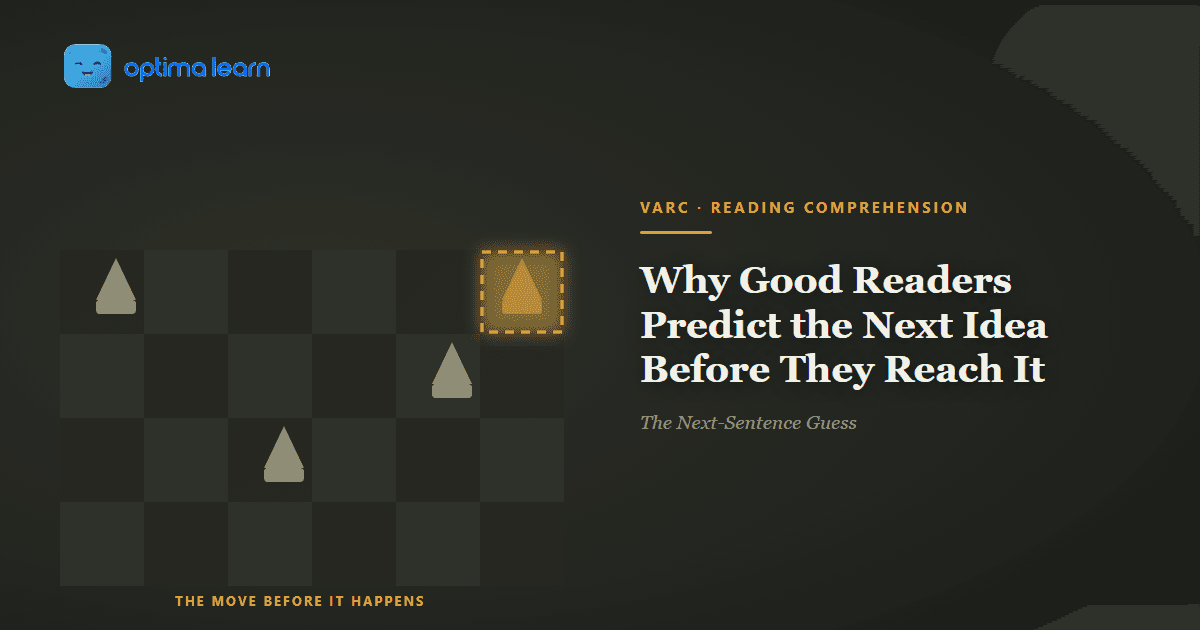
A chess player does not evaluate a position from scratch each turn. They have a candidate move in mind before the opponent has finished making theirs, and the actual move is read against that prediction.
- Fluent reading is partly predictive: strong readers expect the next move and read the sentence as a check on it.
- Argumentative prose is predictable because it follows conventional shapes, which makes prediction reliable rather than lucky.
- The Next-Sentence Guess makes three predictions: evidence after a claim, reversal after a concession, application after a definition.
- A wrong prediction is more useful than a right one, because it flags the exact point where the passage did something unexpected.
- Prediction costs nothing and makes reading faster, because expected text is far cheaper to process.
Why Predicting the Next Idea Works on CAT Prose
The passages CAT uses are not experimental writing. They are conventional non-fiction, and conventional means patterned: a claim gets support, a concession gets reversed, a definition gets applied, a general statement gets an instance.
Those patterns are strong enough that a reader who knows them can usually name the function of the next sentence, even without knowing its content. Not the words, but the job the words will do.
That distinction is what makes prediction practical:
- Predicting content is hard and usually wrong.
- Predicting function is easy and usually right.
- Knowing a sentence's job before reading it makes the sentence much cheaper to absorb.
- When function and prediction disagree, you have found a structural moment worth noticing.
The Next-Sentence Guess: Three Predictions Worth Making
Each covers a common junction in argumentative prose, and together they account for most sentence-to-sentence transitions.
The Next-Sentence Guess
- After a claim, expect evidence. A statement offered without support will be supported next, usually by an example, a study or a comparison.
- After a concession, expect a reversal. Ground granted is ground about to be taken back, so read forward for the recovery.
- After a definition, expect an application. A term introduced carefully is introduced in order to be used, and its first use is usually the point.
Claim then evidence is the most frequent pattern and the easiest to run:
- An unsupported assertion at the end of a sentence almost always gets support in the next one or two.
- If the support does not arrive, the claim was a premise rather than a conclusion, which is itself worth registering.
- Knowing that an example is coming lets you read it at example speed rather than at claim speed.
Concession then reversal is the prediction that most improves accuracy on stance questions:
- Once you expect the reversal you will not mistake the concession for the author's position.
- If the reversal is delayed by a sentence or two, the expectation holds it in place until it arrives.
- A concession that never reverses usually means you misread a genuine agreement as a concession.
Definition then application tells you where the passage is going before it gets there:
- A term defined carefully is going to do work; the first place it is used is usually the passage's point.
- If a definition is contested, expect the dispute rather than an application.
- Expansions and technical terms follow the same rule and are easier to spot.
Put the Next-Sentence Guess to Work
Prediction becomes automatic only across many passages of the same conventional kind. Optima Learn's VARC sets follow genuine CAT sources, so the patterns are the ones the exam actually uses.
Practise CAT VARC QuestionsWhy Being Wrong Is the Useful Part
The instinct is to treat a failed prediction as a small failure. It is the opposite: a prediction that misses has located something.
| You predicted | You got | What it means |
|---|---|---|
| Evidence | A qualification | The author is narrowing their own claim. Worth marking. |
| Evidence | A contrast | The passage has turned. This is a structural moment. |
| Reversal | More concession | The author is granting more than usual, so the reversal will be strong. |
| Application | A second definition | The passage is building apparatus. The point is still ahead. |
| Anything | A new subject | A paragraph boundary in function if not in layout. |
Every row in that table is information you would not have had without the prediction. Reading passively, those moments pass unmarked; reading predictively, they announce themselves as surprises.
How Prediction Changes Reading Speed
The speed gain is not from reading faster. It is from most of the text costing less:
- Expected sentences are cheap. Confirming a prediction takes a fraction of the effort of building understanding from nothing.
- Examples become skimmable. Knowing an illustration is coming means you can read it for its side rather than its detail.
- Attention concentrates on surprises. Which are the sentences worth the attention.
- Re-reading falls. Most re-reading happens because a sentence arrived without context, and prediction supplies the context in advance.
- Structure builds itself. By the end you have the argument's shape rather than a set of remembered facts.
That last point connects directly to how questions get answered, since the shape is what main-idea, purpose and structure questions are asking about.
Common Mistakes When Reading Predictively
Related errors:
- Holding on to a failed prediction. Bending the sentence to fit rather than treating the mismatch as a signal.
- Predicting on unconventional prose. Literary or experimental passages follow fewer patterns, and prediction is weaker there.
- Stopping to predict. The guess should take under a second and run alongside reading, not interrupt it.
- Ignoring the surprise. Noticing a mismatch and not marking it, which wastes the most useful part.
- Predicting every sentence. Junctions are worth predicting; the middle of an example is not.
A Practice Drill for Predictive Reading
The drill makes an ordinarily invisible process explicit, which is the only way to improve it.
- Take ten RC passages. Read each one sentence at a time, covering what follows.
- Before uncovering, write one word for what the next sentence will do.
- Uncover, mark hit or miss, and for every miss write what the sentence did instead.
- Collect the misses. They cluster, and the cluster is a pattern you do not yet recognise.
What usually emerges:
- Hit rates start around half and reach two-thirds or better within ten passages.
- Misses cluster on qualifications, which most readers under-predict badly.
- The sentences you mispredicted are disproportionately the ones questions are drawn from.
- Reading speed rises noticeably once prediction is running, without any change in eye speed.
The Bottom Line
Reading is usually taught as receiving. Skilled reading is closer to a conversation in which you keep guessing what the other person is about to say and are mildly interested when you are wrong. The guesses cost nothing, the right ones make the text cheap, and the wrong ones tell you exactly where the passage did something worth noticing.
The Next-Sentence Guess, Recap
- After a claim: expect evidence.
- After a concession: expect a reversal.
- After a definition: expect an application.
Build the Habit on Timed CAT VARC
Prediction is the first thing that stops under pressure, when reading reverts to passive absorption. Work through CAT previous year questions in timed blocks, or sit full CAT mock tests and past papers so the habit survives fatigue. More reading method sits in the CAT VARC blog archive, and if reading speed is the bottleneck it is worth having your approach reviewed honestly.
Read a Step Ahead in CAT 2026
Expected text is cheap to read and surprises are where the marks are. Build the prediction habit on real CAT-style passages.
Start Practising CAT VARCFrequently Asked Questions
What does predicting the next idea mean in RC?
Naming what the next sentence will do rather than what it will say. Argumentative prose follows conventional patterns, so a claim is usually followed by evidence, a concession by a reversal, and a definition by an application. Predicting function is reliable; predicting content is not.
Doesn't predicting risk seeing what I expect rather than what is there?
Only if you predict content. Predicting function does the opposite: an expectation makes a mismatch stand out, whereas passive reading absorbs everything at one level and notices nothing. The surprises a prediction generates are the most useful thing it produces.
How does prediction make reading faster?
Confirming an expectation takes far less effort than building understanding from nothing, so most of the text becomes cheap to process. Re-reading also falls sharply, because most re-reading happens when a sentence arrives with no context and prediction supplies that context in advance.
Which sentences are worth predicting?
Junctions rather than every sentence. Paragraph breaks are the highest-value points, followed by the sentence after a claim, a concession or a definition. The middle of a worked example is not worth a prediction, because its function is already known.
Practice VARC, chapter by chapter
CAT VARC practice across reading comprehension, para-summary and para-jumbles, each with a worked solution.
More from VARC
Continue reading

XLRI Admission Process: The Exam Nobody Ever Checks

Why Do Some CAT DILR Sets Feel Totally Unsolvable?
Why School Level Quant Feels Hard in the CAT Paper

Why Do Non Engineers Struggle in CAT VARC As Well?
Put it into practice