
Is CAT Quant Really Getting Easier or Harder Every Year?
Every result season produces the same two claims, usually from the same forums within hours of each other. Quant has been getting steadily harder. Quant has been getting noticeably easier. Both are argued confidently, with examples, and both are describing something real without describing what they think they are.
The problem is that difficulty in CAT is not a property you can read off a paper. It is a relationship between the paper and the people sitting it, and the mechanism that converts marks to percentile absorbs most of the movement anyway. A year-wise difficulty trend, stated as a trend, is almost always an artefact of how it was measured.
The trend you can control is your own. Track accuracy across a term of CAT quant practice chapters and you will have a real curve to read.
- Difficulty is a relationship between a paper and its cohort, not a fixed property you can measure from the paper alone.
- Percentile and normalisation absorb much of the year to year movement, which is exactly what they exist to do.
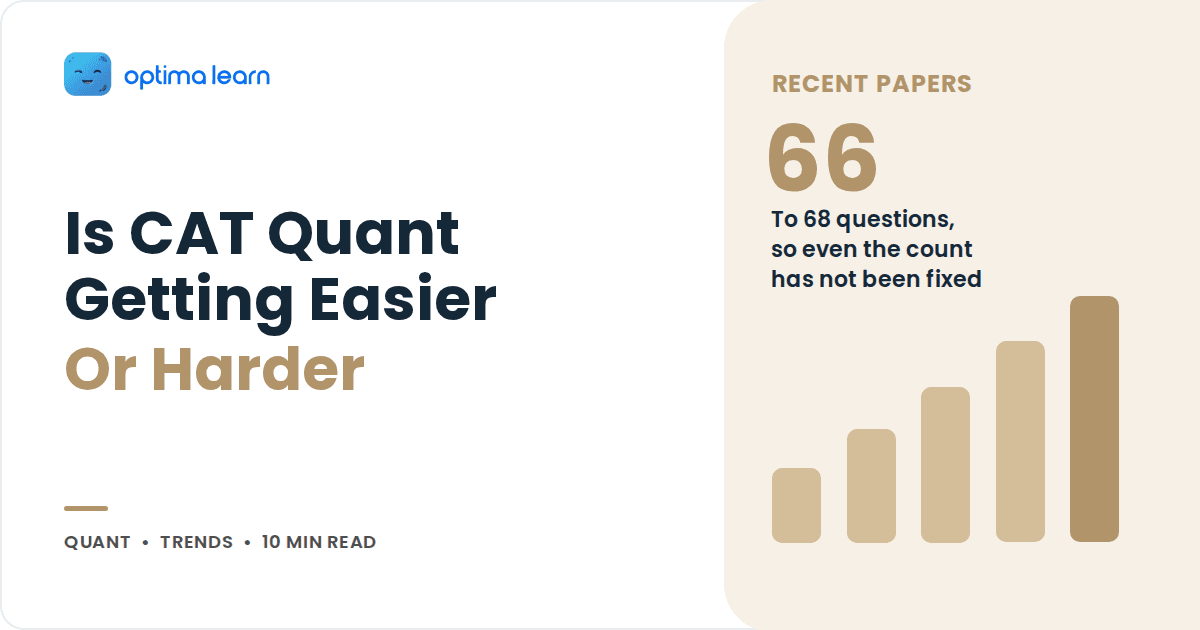
- Recent papers have run roughly 66 to 68 questions in total, so even the count is not fixed across years.
- What has visibly shifted is the flavour of questions rather than a clean easier or harder direction.
- Preparing for a predicted difficulty level is a bet. Preparing for range is not.
Why Difficulty Is Not a Property of the Paper
Start with what people mean when they say a paper was hard, because there are at least three meanings in play.
The first is that individual questions required more steps or more insight. That is a statement about the questions and it is at least in principle checkable, though reasonable people disagree about it constantly.
The second is that scores came out lower. That is a statement about the cohort, not the paper, and it depends on preparation levels across everyone who sat it as much as on the questions themselves.
The third, and the most common, is that it felt hard. That is a statement about the experience of sitting it, and it is heavily influenced by whether the first three questions happened to be from your comfortable chapters. The same paper produces both verdicts depending on where a candidate opened it.
Reading forum consensus in the week after the exam as evidence about difficulty. That sample is drawn from people motivated enough to post, which skews toward both the delighted and the devastated. The quiet middle, which is most of the cohort, is absent from every one of those threads.
What Percentile Does to the Question
Here is the part that makes most difficulty debates beside the point.
Your percentile is your position relative to everyone else who sat the exam. If the quant section is brutal, most candidates score poorly, and a modest raw score sits high in the distribution. If it is gentle, the same raw score sits lower. The difficulty affects everyone in the room at once, so the position you finish in moves far less than the marks do.
Normalisation adds another layer. CAT runs multiple slots and those slots do not receive identical papers, so a process exists to make scores comparable across them. Its entire purpose is to stop slot difficulty from deciding outcomes.
| If the paper is | Your raw marks | Everyone's raw marks | Your percentile |
|---|---|---|---|
| Harder than usual | Lower | Also lower | Roughly unchanged |
| Easier than usual | Higher | Also higher | Roughly unchanged |
| Harder in your slot only | Lower | Higher in other slots | Normalisation adjusts for this |
None of that makes difficulty irrelevant. It makes difficulty far less consequential to you individually than it feels on the day, because you are not being scored against the paper. You are being scored against the room.
The Three Reasons Difficulty Trend Claims Keep Failing
Whenever someone charts CAT difficulty across years, one of three things has usually gone wrong.
- The measure is a proxy. Cutoffs, average scores or topper counts are used as difficulty readings, but each of those moves with cohort size and preparation quality too.
- The sample is memory. Comparisons are built from what people recall of old papers, and memory keeps the distinctive questions and discards the routine ones.
- The paper itself changes shape. Question counts have moved, the MCQ and TITA split has moved, and sectional composition has moved. Comparing raw difficulty across differently shaped papers is not a like for like reading.
The Proxy Problem in Detail
A falling cutoff looks like a harder paper. It can also mean more candidates sat the exam, or that a particular section dragged the composite down, or that the cohort's preparation shifted. Without separating those, a cutoff chart is a difficulty chart only by assumption.
The TITA Split Quietly Changes Everything
This is the most underrated variable. TITA questions carry no negative marking, so a paper with more of them is materially more forgiving to attempt even if the questions themselves are no easier. A shift in that split changes scoring behaviour across the whole cohort while leaving the question difficulty untouched.
What Actually Seems to Have Moved
The more defensible observation is about flavour rather than direction. Arithmetic has stayed central and the questions there reward fluency and careful reading rather than exotic technique. That is why steady work on averages and the rest of arithmetic has held its value regardless of which way any difficulty argument ran.
Treat every paper as having a difficulty you cannot predict and a structure you can. You know there will be arithmetic and algebra, you know a wrong MCQ costs a mark and a TITA does not, and you know selection decides more than speed. Those hold whatever the paper turns out to be.
What This Means for How You Prepare
If you cannot forecast difficulty, the sensible response is to prepare for range instead of for a level.
Preparing for a level looks like this: assume the paper will be moderate, build a plan that works at moderate difficulty, and discover on the day that the plan has no gear for a harder section. Preparing for range means practising at both ends deliberately, so that neither an easy section nor a brutal one is unfamiliar territory.
In practice that means your practice sets should include questions you cannot solve, and your timed sections should sometimes be harder than you expect the real thing to be. An aspirant who has only ever practised at comfortable difficulty has no experience of the decision making a hard section demands.
Mentors notice that candidates who report a paper as unfair are usually the ones whose preparation had a narrow difficulty band. They had rehearsed one kind of section thoroughly. Candidates who had practised across the range described the same paper as hard but workable, which is a completely different position to be in with forty minutes on the clock.
Prepare for Range, Not for a Forecast
You cannot know the difficulty. You can make sure neither end of it is unfamiliar.
Work Through CAT Quant ChaptersHow to Use Past Papers Properly
Past papers are genuinely valuable, just not as evidence for a trend.
Their real use is calibration. Sitting an old section under time tells you how your current selection and accuracy behave against real questions rather than curated practice, and that is information no difficulty chart can give you.
Their second use is exposure to variety. Working across several years puts you in front of more question shapes than a single year can, which is precisely the breadth that protects you against an unexpected paper.
What they cannot do is tell you what November holds. A candidate who concludes from three papers that the trend is toward easier arithmetic, and reallocates hours accordingly, has made a bet on a sample of three.
The One Comparison Worth Making
Rather than comparing papers to each other, compare yourself across papers. Sit sections from different years and track your own accuracy and selection quality. If those improve across a term, your preparation is working, and that conclusion is safe regardless of how the papers differed.
Building the Range Into a Week
Include one deliberately hard timed block a fortnight, where you expect to be uncomfortable and the goal is decision quality rather than score. Our guide on building speed and accuracy together covers how to keep that from turning into demoralising practice.
Why the Debate Is So Persistent
The difficulty question outlives every attempt to settle it, and the reason has more to do with how exams feel than with how they are built.
A candidate sits exactly one CAT quant section in their life, in one slot, on one day, in one emotional state. That single experience is the entire personal dataset, and it arrives with enormous weight attached. Comparing it to other years means comparing a lived forty minutes against secondhand accounts of forty minutes that other people lived, which is not a comparison at all. The asymmetry guarantees disagreement.
There is also a comfort in the framing. If the paper was harder than usual, a disappointing section was the exam's doing. If it was easier, a good section was earned in spite of the field. Both readings let the outcome mean something tidier than the truth, which is that a great deal of it came down to which questions you chose in the first ten minutes.
The Answer, Such as It Is
Is CAT quant getting easier or harder? The honest response is that the question is built on an assumption that does not hold.
Papers vary. The shape of the paper has moved, with recent papers running around 66 to 68 questions and the MCQ to TITA split changing between years. Individual sections have felt harsher in some years than others. None of that assembles into a direction, and the mechanism that turns marks into percentiles was designed specifically to keep such variation from deciding your outcome.
What this should change about your preparation is nothing, and that is the useful conclusion rather than a disappointing one. The work that pays off in a hard quant section is the same work that pays off in an easy one: depth in the recurring areas, honest error review, and selection you have practised rather than improvised.
- Does your practice include questions you expect to fail?
- Have you sat a timed section from more than one past year?
- Are you tracking your own accuracy trend rather than the exam's difficulty?
- Do you have a plan for a section that turns out harder than expected?
If your scores swing between mocks and you are attributing it to paper difficulty, it is worth testing that assumption. A CAT preparation strategy review separates paper variance from your own, and a personalised CAT preparation plan can build the harder blocks into your fortnight.
The Work Does Not Change With the Forecast
Depth, review and selection pay off at every difficulty level. That is why they are worth building.
Build My Weekly PlanFrequently Asked Questions About CAT Quant Difficulty Trends
Is CAT quant getting harder every year?
There is no reliable trend. Difficulty is a relationship between a paper and its cohort rather than a measurable property, and the proxies people chart, such as cutoffs and average scores, move with cohort size and preparation quality too.
Does a harder paper lower my percentile?
Not by much. Percentile is your position relative to everyone who sat the exam, so a harder paper lowers scores across the room at once. Normalisation additionally exists to make scores comparable across slots that did not get identical papers.
Has the CAT paper structure changed across years?
Yes. Recent papers have run roughly 66 to 68 questions, and the split between MCQ and type-in-the-answer questions has moved between years. That alone makes raw difficulty comparisons across years less like for like than they appear.
Should I prepare differently if the paper might be hard?
Prepare for range instead. Include deliberately hard timed blocks so that a difficult section is familiar rather than shocking, and keep the core work the same, since depth, error review and selection pay off at every difficulty level.
Practice these Quant concepts, chapter by chapter
Thousands of CAT Quant practice questions by chapter and difficulty, each with a worked solution.
More from Quant
Continue reading

Will CAT 2026 Have More Test Takers Than CAT 2025?

Why Do Toppers Deliberately Skip Entire DILR Sets?
Why Do Engineers Struggle More With CAT VARC Than Quant?

Which CAT Quant Topics Have the Most Questions Now?
Put it into practice