
How Sentence Placement Reveals Structure
Two sentences in an RC paragraph can say almost the same thing and be worth completely different amounts. One is the claim the paragraph exists to make. The other restates it with an example attached.
Aspirants who read every sentence at the same weight end up with a passage that is uniformly dense and uniformly forgettable. Aspirants who read positionally know that a paragraph is a small structure, and structures have parts that carry load and parts that fill space.
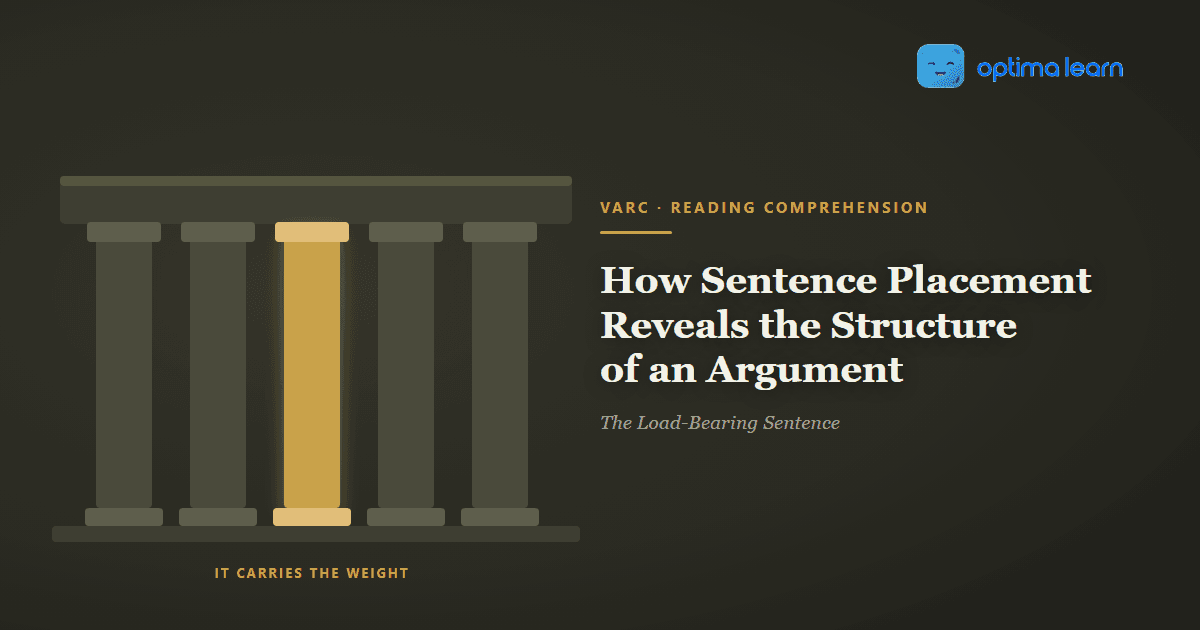
A colonnade makes this obvious. Five columns, one lintel, and only some of those columns are actually holding anything up. Remove a decorative one and nothing happens. Remove the load-bearing one and the whole thing comes down.
- Sentences in a CAT paragraph carry very different amounts of argumentative weight, and position predicts which.
- The Load-Bearing Sentence sits in three reliable places: the end of a paragraph, immediately after a concession, and immediately after a paragraph break with a connector.
- Examples, restatements and elaborations are structural filler. Locate them, do not memorise them.
- Reading positionally is faster than reading evenly, because most of a paragraph can be read at speed once you know where the claim will land.
- Most main-idea and inference questions are answerable from load-bearing sentences alone.
Why Position Predicts Weight in CAT Prose
English paragraphs in serious non-fiction follow a small number of conventional shapes, and those conventions are strong enough to predict from. A paragraph typically raises something, works through it, and lands somewhere, and the landing is what the next paragraph will build on.
That gives position real predictive power. It is not a trick or a shortcut; it is a consequence of how argumentative prose is written, and it holds across the sources CAT draws from.
The practical consequence is that a paragraph divides into two kinds of sentence:
- Load-bearing: the claim, the qualification that limits it, and the transition that connects it forward.
- Filler: examples, restatements, elaborations, and detail that supports without adding.
- Filler is not useless, but it is retrievable. You can find it again in seconds when a question needs it.
- Load-bearing sentences are not retrievable in the same way, because their weight depends on the structure you either built while reading or did not.
The Load-Bearing Sentence: Three Positions That Carry Weight
These are positions rather than content, which is what makes them usable at speed. You can find them before you have fully understood the paragraph.
The Load-Bearing Sentence
- The last sentence of a paragraph. In argumentative prose the paragraph usually lands on its claim rather than opening with it. Read the ending closely.
- The sentence immediately after a concession. A concession exists to be reversed, and the reversal is the author's actual position.
- The first sentence of a paragraph that begins with a connector. "But", "still", "in this respect" mean the sentence is carrying the logical join, and joins are structural.
The paragraph's last sentence is the most reliable of the three, and it runs against how most people read:
- Aspirants read openings hardest and endings fastest, which is exactly backwards for this prose.
- A paragraph that opens with its claim usually spends the rest qualifying it, so the ending still matters most.
- If the last sentence contains a hedge, that hedge is the claim's real shape, not a softening of it.
After a concession is the position that most often decides tone and author's-view questions:
- Concessions grant ground briefly. What follows takes it back and is where the author stands.
- The reversal may be one or two sentences later, so read forward from the concession rather than at it.
- A concession with no reversal anywhere is a sign you have misread it as a concession.
A connector-opening sentence tells you the structure of the whole passage rather than of one paragraph:
- "But" at the start of a paragraph signals the passage has changed direction, not just the sentence.
- "For example" opening a paragraph means the entire paragraph is filler; read it fast.
- "In this respect" or "on this view" attaches the paragraph to a specific earlier claim, and identifying which one is worth two seconds.
Put the Load-Bearing Sentence to Work
Reading positionally is a habit built on real prose, not a rule to remember. Optima Learn's VARC sets follow genuine CAT sources, so the paragraph shapes behave the way the exam uses them.
Practise CAT VARC QuestionsWhat Filler Looks Like, and How Fast to Read It
Being deliberate about what to read quickly is the other half of this, and it is where the time saving comes from.
| Sentence type | How to recognise it | How to read it |
|---|---|---|
| Example | Opens with "for instance", or names a specific case | Note its existence and its side. Do not retain detail. |
| Restatement | Says the previous sentence differently | Skim. It confirms, it does not add. |
| Elaboration | Extends a point without qualifying it | Skim, unless it introduces a new term. |
| Qualification | Narrows a claim: "in most cases", "except where" | Read closely. This changes the claim's shape. |
| Attribution | Assigns a position to someone | Read closely. It can reassign whole paragraphs. |
The last two rows are load-bearing despite being short and easy to skim past, which is what makes them expensive. A qualification changes what a claim asserts, and questions are frequently written around exactly that difference.
How to Mark a Passage Positionally
The marking has to be almost free or it will not survive a timed section:
- One underline per paragraph. The load-bearing sentence, and nothing else.
- Do not underline examples, however striking. You will find them again instantly.
- Bracket qualifications rather than underlining them, so they read as modifiers of the nearby claim.
- Mark connector-opening paragraphs in the margin, since they carry the passage's shape.
- Read your underlines back before the questions. They should form a coherent argument in about fifteen seconds.
Once that habit is in place, most main-idea, purpose and structure questions resolve from the underlines rather than from re-reading, which is where the time comes back.
Common Mistakes in Reading Evenly
Related habits worth dropping:
- Underlining detail. Marking names, figures and examples, which are the most retrievable parts of the passage.
- Skimming qualifications. Passing over "in most cases" and then answering as though the claim were absolute.
- Treating every paragraph as equally important. Example paragraphs exist and can be read at double speed.
- Ignoring the connector. Missing that a paragraph opening with "but" has changed the direction of the whole passage.
- Re-reading to find the argument. Rebuilding at the questions what positional reading would have given you for free.
A Practice Drill for Positional Reading
The drill tests whether load-bearing sentences alone carry the passage, which they usually do.
- Take fifteen RC passages. For each, underline exactly one sentence per paragraph.
- Cover the passage and read only your underlines. Write the argument in two sentences from those alone.
- Now read the questions. Mark how many you could answer from the underlines without uncovering the passage.
- For the ones you could not, check whether you underlined the wrong sentence or whether the question was genuinely a detail question.
What usually emerges:
- Most main-idea, purpose and tone questions are answerable from underlines alone.
- Detail questions are not, and should not be. They are meant to be looked up.
- Wrong underlines cluster on paragraphs that opened with their claim, which is the less common shape.
- Reading time falls by a noticeable margin once filler is being read at filler speed.
The Bottom Line
A paragraph is a structure, not a block of text. Some of it holds the argument up and some of it is there so the argument does not sound bare. Reading both at the same speed is the most common reason capable readers run out of time in a section they understood perfectly well.
The Load-Bearing Sentence, Recap
- The paragraph's last sentence: where argumentative prose usually lands its claim.
- After a concession: the reversal is the author's real position.
- After a paragraph break with a connector: the sentence carrying the logical join.
Build the Habit on Timed CAT VARC
Uneven reading feels risky until it has saved you time on a real clock. Work through CAT previous year questions in timed blocks, or sit full CAT mock tests and past papers so positional reading holds under fatigue. More reading method sits in the CAT VARC blog archive, and if VARC timing keeps collapsing it is worth having your strategy reviewed honestly.
Read Positionally in CAT 2026
Some sentences hold the passage up and most do not. Build the habit of telling them apart on real CAT-style prose.
Start Practising CAT VARCFrequently Asked Questions
Which sentence in an RC paragraph matters most?
Usually the last one. Argumentative prose tends to work through a point and land on it rather than announcing it in the opening, so the paragraph's claim arrives at the end. The sentence after a concession and any paragraph opening with a connector are the other two load-bearing positions.
Should I read every sentence carefully in CAT RC?
No, and doing so is a common reason capable readers run out of time. Examples, restatements and elaborations are retrievable in seconds when a question needs them, while claims and qualifications are not. Deliberate unevenness is what makes fast reading accurate.
How do I know a sentence is filler rather than argument?
Examples name a specific case or open with a phrase like "for instance". Restatements say the previous sentence differently. Elaborations extend without qualifying. Anything that narrows a claim or assigns a position to someone is load-bearing however short it looks.
Does underlining actually help in CAT RC?
It does if you underline one sentence per paragraph and nothing else. Underlining detail is counterproductive because detail is the most retrievable part of a passage. One mark per paragraph produces a readable argument you can check in about fifteen seconds before the questions.
Practice VARC, chapter by chapter
CAT VARC practice across reading comprehension, para-summary and para-jumbles, each with a worked solution.
More from VARC
Continue reading
XLRI Admission Process: The Exam Nobody Ever Checks

Why Do Some CAT DILR Sets Feel Totally Unsolvable?
Why School Level Quant Feels Hard in the CAT Paper

Why Do Non Engineers Struggle in CAT VARC As Well?
Put it into practice