
XAT Decision Making: A Framework for Solving Dilemmas
Two options remain. One is clearly right in a moral sense: the protagonist confesses the error, accepts the consequence, and protects the aggrieved employee. The other is duller, involves consulting a committee, and does not feel like justice at all. The aspirant picks the first one, because it is obviously the ethical answer. XLRI's key says the second.
This happens to almost everyone on their first serious contact with XAT Decision Making, and it is not a moral disagreement. It is a category error. The section is not asking what a good person would do. It is asking what a competent manager would do inside a specific organisational constraint, and those two questions produce different answers often enough that the gap between them is where most marks are lost.
Decision Making rewards precise reading above all else. Sharpen it against a set of CAT caselet practice questions, where missing one stated condition costs you the whole set.
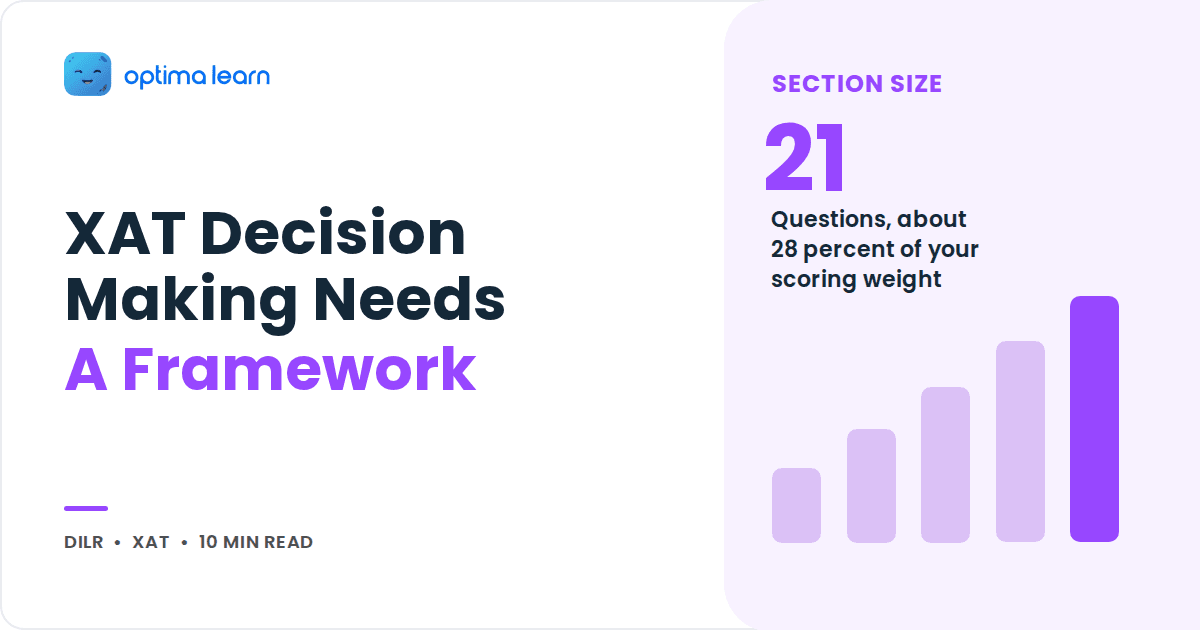
- Decision Making carries 21 questions inside XAT's 75 question scoring paper, around 28 percent of your percentile weight.
- The section rewards professional judgment inside constraints, not personal moral heroism.
- Most caselets are decided by a small number of recurring principles, chief among them stakeholder balance and feasibility.
- Extreme, punitive and covert options are near-automatic eliminations across almost every caselet.
- Quantitative decision caselets have not appeared in the last two sittings, despite still featuring in most syllabus lists.
Why This Section Carries More Weight Than You Think
XAT Part 1 runs Verbal and Logical Ability at 26 questions, Decision Making at 21, and Quantitative Ability and Data Interpretation at 28, making 75 questions in 170 minutes with no sectional time limits and free movement between sections. Part 2 adds 20 General Knowledge questions in 10 minutes, which do not count toward your percentile.
So Decision Making is 21 of the 75 questions that build your score. That is a larger share than most aspirants allocate preparation to, and unlike quant or verbal it is a section with essentially no equivalent on any other paper you are sitting.
The marking adds a further wrinkle. XAT applies plus 1 for a correct answer and minus 0.25 for a wrong one, and it also penalises excessive blanks: your first eight unattempted questions are free, and each additional one costs 0.1. Wholesale skipping is therefore not available as a strategy across the paper.
The Four Lens Method for Reading a Caselet
Applying principles only helps once you have read the case properly, and most errors happen before any principle is consulted. Run these four lenses in order.
- Who is affected. List every stakeholder the case names, including the ones mentioned once. An option that serves only some of them is usually the distractor.
- What is fixed. Company policy, a legal constraint, a stated budget, a deadline. Every such clause is load-bearing and options that violate one are eliminable immediately.
- What is the actual question. The most appropriate action, the best immediate step, and the most likely consequence are three different questions with three different answers.
- Whose decision is it. You answer as the person the case puts you in, with their authority and no more. Options requiring powers the protagonist does not have are out.
Lens 2 Is Where Most Marks Are Lost
Coaching analyses consistently identify ignored constraints as the commonest failure. A caselet says company policy prohibits a particular arrangement, and candidates select the option that arranges it anyway because it seems humane. Every fact in the stem is there deliberately. If a constraint were irrelevant, XLRI would not have spent words on it.
Lens 3 Changes the Answer More Than You Expect
Three questions can hang off one caselet and each wants something different. "What should the manager do immediately" and "what is the best long-term resolution" frequently have different correct answers within the same case. Reading the question stem carefully after each caselet is not optional.
The Principles That Decide Most Caselets
XLRI publishes no rationale document, so what follows is reverse-engineered by coaching institutes from official answer keys over many years. It is consistent enough across sources to be useful, and it should be understood as informed reconstruction rather than a stated rule.
| Principle | What it favours |
|---|---|
| Stakeholder inclusivity | Options weighing all affected parties over those serving one |
| Professional ethics | Managerial conduct inside a role, not private moral heroism |
| Root cause | Addressing why it happened over containing the symptom |
| Transparency first | Dialogue and disclosure over unilateral or covert action |
| Long-term trust | Precedent and credibility over resolving today's incident |
| Feasibility | Among acceptable options, the one actually implementable |
Feasibility is worth singling out, because it is the tiebreaker that decides most two-option finishes. When you have narrowed to two ethically defensible answers, the winner is almost always the one that works within the stated constraints with the least organisational disruption.
Assuming the most ethical option is automatically correct. XAT deliberately plants options that are morally clean and operationally impossible: the resignation, the public disclosure, the refusal that solves nothing. Ethics filters out the unacceptable options. It does not, on its own, select the winner from what remains.
The Option Types You Can Eliminate on Sight
Before weighing anything, a fast pass removes options that almost never win. This alone converts a four-option question into a two-option one on a large share of caselets.
- Extremes at either pole. Fire everyone, resign, escalate to the board. Or do nothing and wait and see. Both ends are nearly always wrong.
- Punitive options. Punishing an individual rather than fixing the system that produced the problem.
- Covert action. Anonymous complaints, going behind a stakeholder's back, quiet interventions. Almost universally penalised.
- Partial truth. Selective disclosure designed to steer an outcome rather than inform a decision.
- Blame deflection. Moving responsibility elsewhere instead of owning the problem.
- False justification. Self-interest dressed in plausible business language.
- One-sided resolution. Fully satisfying one stakeholder at another's clear expense.
The One Judgment Call Nobody Can Rule On
Whether to gather more information before acting is genuinely contested. Some analyses read the transparency principle as favouring consultation. Others argue XAT expects you to decide within the facts given, treating "seek more data" as an evasion. The sources disagree, and no official position exists. Treat it as a case-by-case judgment rather than a rule, and lean toward acting when the case supplies enough to act on.
Practise by writing your reasoning in one sentence before checking the key, not just your chosen option. When you are wrong, compare the reasoning rather than the letter. Two candidates can pick the same wrong answer for entirely different reasons, and only one of those reasons is worth correcting.
The Caselet Categories That Actually Appear
Reported taxonomies vary slightly, but the recurring categories are consistent enough to prepare against.
- Ethical dilemmas, typically rules against compassion, or short-term gain against long-term integrity.
- Business and strategic decisions, where profit and principle pull in different directions.
- Team and interpersonal conflict, covering manager and employee friction and leadership choices.
- Human resources situations, including recruitment, promotion and handling complaints.
- Resource allocation, prioritising under a stated budget or capacity constraint.
- Academic and committee cases, set outside the corporate frame entirely and frequently omitted from other guides.
One category on most syllabus lists is worth flagging as currently dormant. Quantitative decision making, involving break-even or financial viability calculations, did not appear in either of the last two sittings according to published analyses. It remains in the historical syllabus, so do not abandon it entirely, but do not build your preparation around it either.
Mentors who review Decision Making practice find the same thing: aspirants improve fastest not by solving more caselets but by articulating why the official answer beat their own. The section is one of judgment, and judgment is corrected by explanation rather than by volume.
Precision Reading Is the Foundation
Every Decision Making error starts as a reading error. Build the habit of extracting exactly what a case states and no more.
Work Through CAT DILR ChaptersHow Hard the Section Actually Is
Published analyses of the most recent sitting disagree sharply, and the disagreement is itself informative.
One analysis rated the section medium, noting genuine ambiguity where either no option seemed correct or more than one appeared to be, and put a good attempt at 12 to 13 questions with 75 to 80 percent accuracy in 50 to 55 minutes. Another rated the same paper easy to moderate and put a good attempt at 18 to 19 questions in 45 to 50 minutes.
That gap is wide enough that averaging them would be misleading. What the spread tells you is that perceived difficulty in this section depends heavily on how comfortable the reader is with ambiguity, which is a trainable disposition rather than a fixed trait.
The structural facts are firmer. The last sitting ran 21 questions as seven sets of three, with no standalone questions at all, which means a poorly handled caselet costs you three marks rather than one.
Building a Preparation Routine for Judgment
This section responds badly to the volume approach that works elsewhere. Three habits do most of the work.
Five Caselets a Week, Reviewed Properly
Five worked through slowly with written reasoning beats twenty solved quickly. You are calibrating judgment against XLRI's, and that only happens when you can see where your reasoning diverged from theirs.
Keep a Log of Your Own Biases
Most aspirants have a consistent tilt: too punitive, too idealistic, too willing to escalate, too reluctant to act. Two dozen reviewed caselets will reveal yours, and naming it is most of the correction.
Rehearse Sets, Not Single Questions
Since the section arrives as sets of three, practise reading one case and answering three questions off it under time. A personalised CAT preparation plan can hold this as a recurring weekly block so it does not get displaced by chapter work, and our guide on the differences between CAT and XAT covers where the rest of the paper diverges.
- Do you list stakeholders and fixed constraints before looking at the options?
- Are you eliminating extreme, punitive and covert options automatically?
- Do you re-read the question stem for each of the three questions in a set?
- Can you name your own recurring bias in this section?
If Decision Making is currently the section you are least sure how to prepare for, it is worth a second opinion on where it sits in your plan. A CAT preparation strategy review will show whether it is getting time proportional to the 28 percent of XAT's scoring weight it carries.
Give Judgment Its Own Place in the Week
A section with no equivalent on any other paper needs its own slot, or it gets squeezed out by chapters that feel more measurable.
Build My Weekly PlanFrequently Asked Questions About XAT Decision Making
How many questions are in XAT Decision Making?
Twenty-one questions, inside a Part 1 of 75 questions taken over 170 minutes alongside Verbal and Logical Ability and Quantitative Ability and Data Interpretation. That makes it around 28 percent of the paper that determines your percentile.
Is the most ethical option always correct in XAT Decision Making?
No, and this is the commonest misconception. Ethics eliminates unacceptable options, but the winner among the acceptable ones is usually decided by feasibility, stakeholder balance and whether the action sits within the protagonist's actual authority.
What options can I eliminate immediately?
Extremes at either pole, punitive responses aimed at individuals rather than systems, covert or anonymous action, partial disclosure, blame deflection, and any option that violates a constraint the caselet explicitly states. That pass alone usually halves the field.
Does XAT Decision Making include calculation questions?
Historically yes, but quantitative decision caselets have not appeared in the last two sittings according to published analyses. They remain in the syllabus, so stay capable of handling one, but do not centre your preparation on that category.
Practice DILR sets, chapter by chapter
CAT DILR practice across LR puzzles and DI sets, each with a worked solution.
More from DILR
Continue reading

Will CAT 2026 Be Tougher Than 2025? What Trends Show
Why You Cannot Solve DILR Sets Under Time Pressure

Why Is Your CAT VARC Score Low With Good Attempts?
What Is a Good CAT Score for a First Time Test Taker?
Put it into practice