
The Mathematics of Approximation: When Estimation Beats Exact Calculation in CAT Quant
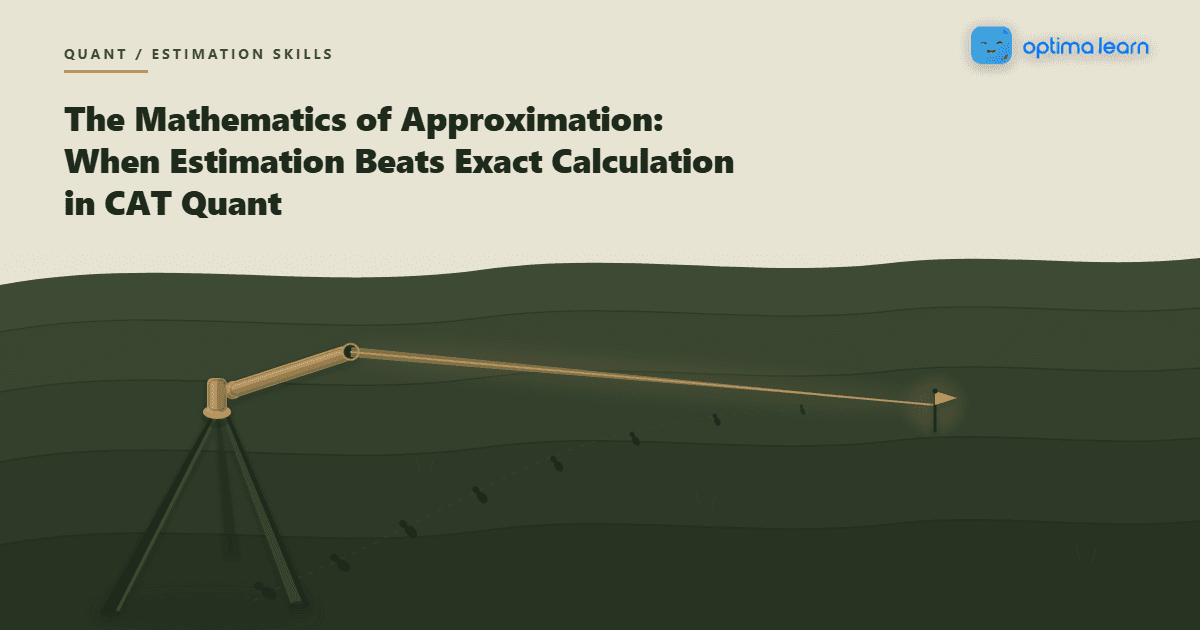
Estimation beats exact calculation whenever the answer choices sit far enough apart that a rounding error cannot flip your choice, and it fails the moment they don't. The gap between the options, not the topic or the formula, decides whether a shortcut is safe.
You're forty seconds into a percentage question, numbers crowding the margin of your scratch pad, when you finally glance up at the four options. Two of them sit barely twenty apart. By then you've already spent the ten seconds it would have taken to check whether that gap even mattered, before a single digit got written down.
That single habit, checking the terrain before choosing your tool, is worth more than any new formula you'll learn this month. This piece is about exactly that check: reading answer-choice spacing before you decide whether to estimate or calculate.
- The decision to estimate or calculate exactly in CAT Quant depends on answer-choice spacing, not on the topic or the formula involved.
- The Surveyor's Rule treats every question as one of two distances: Paced Distance, safe to approximate, or Instrumented Distance, which needs an exact value.
- Check the smallest gap between adjacent answer choices before you calculate anything; that gap tells you how much rounding error you can afford.
- The most expensive Quant mistakes usually come from misreading which distance you're standing in front of, not from a wrong formula.
- This rule is a companion to a broader shortcuts guide; it answers the narrower question of when a shortcut is even safe to use.
This isn't a list of shortcuts. A companion piece on this blog, Stop Calculating Everything, already catalogs specific estimation options and smart shortcuts you can use across CAT Quant. What that piece doesn't answer, and what this one does, is how you know a given shortcut is even safe to reach for on the question in front of you.
What Actually Decides Whether You Should Estimate in CAT Quant?
Two questions can test the identical percentage concept and still demand two different levels of precision. What decides it isn't the topic, the difficulty level, or which formula applies. It's the physical distance between the answer choices already sitting in front of you, something most aspirants never even glance at before they start calculating.
The Surveyor's Rule
Pace the easy ground. Instrument the ground that decides the answer.
- Paced Distance: an estimate walked off in confident strides, safe to approximate when the final answer only needs to fall in the right range, or when rounding cannot flip which option is correct.
- Instrumented Distance: a measurement that must be exact, any span where a small rounding error changes which answer choice is correct, or where the question explicitly asks for a precise value.
- Reading the Terrain: the actual skill: recognizing, before you calculate anything, which distance in front of you is which, since guessing wrong about that is what turns a smart approximation into a careless error.
Here's why the rule works: CAT Quant almost never grades you on process, only on which option you bubble. If two candidates land on 1,503 through different routes, one by exact multiplication and one by a fast estimate, they earn the identical three marks. The only version of estimation that costs you marks is the one applied to a question where the options were never far enough apart to survive it.
Have you ever solved a question correctly, using the exact method, and still felt like you'd wasted thirty seconds? That feeling is usually correct. It means you instrumented a distance that only needed to be paced.
Skip this check consistently, and the cost doesn't show up as one dramatic error. It shows up as a slow accumulation of seconds spent on questions that never needed them, until you're the aspirant staring at the clock with six questions left and eleven minutes on it.
How Do You Read Answer-Choice Spacing Before You Calculate Anything?
Look at the four options before you touch a single number, and find the smallest gap between any two of them. If your shortcut's likely error is smaller than half that gap, the distance is paced and safe to estimate. If it's larger, the distance is instrumented, and it needs your exact method.
This recognition step is really its own skill, separate from any single formula, and it's worth training on its own terms. A related piece, The CAT Quant Decision Tree, walks through recognizing which kind of question you're facing before you commit to any method at all; the spacing check here is a narrower version of that same habit, applied specifically to the moment right before you calculate.
Before you calculate: glance at the four options. Find the two that sit closest together. Ask what your fastest estimate could realistically be off by. If that possible error is smaller than the closest gap, estimate freely. If it's close or bigger, commit to the exact calculation.
A Paced Distance, Worked Through
Question: what is 31% of 4,850? Options: (a) 1,000 (b) 1,200 (c) 1,500 (d) 1,800.
Round 31% to 30%, and 30% of 4,850 is 1,455. Add back 1% of 4,850, roughly 49, and you land near 1,504. The exact value, 4,850 times 0.31, is 1,503.5. Either number points at the same option, because the gap between (b) and (c) is 300 and the gap between (c) and (d) is another 300. No realistic rounding error gets anywhere close to crossing either line.
| Situation | Panic Move | Pro Move |
|---|---|---|
| Options spaced far apart, a wide gap between every pair | Calculate the exact value out of habit, spending thirty extra seconds you didn't need to spend | Estimate quickly, confirm it lands clearly inside one option's range, and move on |
| Options bunched close together | Round early to save time, then pick the closest-looking option | Slow down deliberately and work the exact value, since the gap can't absorb an error |
| Unsure how close the options actually are | Guess based on gut feel and hope the rounding didn't matter | Check the smallest gap first, before calculating anything at all |
This check matters most in percentage, interest, and ratio-heavy questions, exactly the ones that tempt you to round early out of habit. Data Interpretation sets carry the same risk multiplied across several sub-questions built on the same table, so one careless rounding decision early can quietly cost you more than one mark.
When Does a CAT Quant Question Force an Exact Calculation?
A question forces exact calculation whenever two answer choices sit close enough that your fastest shortcut's likely error could cross the line between them, or when it explicitly asks for a precise figure rather than a range. In both situations, choosing to estimate produces a wrong bubble, not merely a slower right one.
The most expensive Quant errors rarely come from a wrong formula. They come from rounding 17.8% to 18% on a question where the options sit only four apart. The math was right. The habit of rounding without checking the gap first is what actually cost the mark.
An Instrumented Distance, Worked Through
Question: find the compound interest on Rs. 12,500 at 8% per annum for two years, compounded annually. Options: (a) Rs. 2,080 (b) Rs. 2,100 (c) Rs. 2,120 (d) Rs. 2,150.
The exact route: compound interest over two years equals 2Pr plus Pr-squared, where P is 12,500 and r is 0.08. That's 2 times 12,500 times 0.08, which is 2,000, plus 12,500 times 0.0064, which is 80. Total: Rs. 2,080, option (a).
Now notice the options are only 20 to 30 apart. A rough shortcut that treats this as simple interest, 2,000, happens to sit closest to the correct answer here, but only by 80, four times wider than the narrowest gap between the options. You'd have no way to know that without doing the exact math anyway. That's what an instrumented distance means: even a decent estimate can't be trusted, so it buys you nothing.
Build the habit by pausing right after you read the options, not after you've already started solving. Say the smallest gap out loud, even mentally: "twenty apart." That one habit, named early enough, changes how carefully you carry your decimals for the rest of the question.
How Do You Turn This Decision Rule Into Muscle Memory?
You build this skill the same way you build any exam instinct: by deliberately testing it against questions you've already solved, not by reading about it once. Go back through a set of previous attempts and mark, for each one, whether the gap between the options would have let you estimate.
This is exactly the kind of habit a structured revision pass should include, not a one-time reading exercise. A companion piece, Quant Revision System That Actually Works, lays out how to build recurring checks like this one into your weekly revision instead of leaving them to memory.
Pick ten questions you've already solved correctly and re-examine each one cold. For every question, note the gap between the closest two options and ask honestly whether you'd have reached for the exact method or an estimate if you'd checked first. Most aspirants find they instrumented several distances that were paced all along, and that gap is exactly where mock-test minutes quietly disappear.
Most aspirants who over-calculate aren't slow at math. They're anxious about being wrong, and exact calculation feels safer than a shortcut, even when the shortcut was never the risky choice. Reading the terrain first removes that anxiety, because you're no longer guessing whether to trust your own estimate.
Build This Into Actual Practice
Reading about the Surveyor's Rule and applying it live under a ticking clock are two different skills. Drill the second one with real, timed CAT Quant questions.
Practice CAT Quant NowThe One Question to Ask Before You Touch Your Pen
Before you calculate anything on a CAT Quant question, ask one question: how far apart are these four options? That single check, done in the first ten seconds, decides whether you're about to pace easy ground or instrument the one span the answer actually depends on.
None of this is complicated in theory. What's hard is remembering to check under the pressure of a ticking section clock, when every instinct pushes you toward writing numbers immediately. Score improvements in Quant often come less from calculating faster and more from calculating only when the question genuinely demands it.
The Surveyor's Rule, Recapped
- Paced Distance: options spaced wide, rounding can't flip the answer, estimate and move on.
- Instrumented Distance: options bunched close, or an exact value is asked for, calculate in full.
- Reading the Terrain: the habit of checking which one you're facing, before you calculate anything at all.
Next time you solve a Quant question, pause for two seconds after reading the options and before touching your pen. Ask whether the gap between them would survive your fastest estimate. That pause is the entire skill.
Put the Rule to Work
The fastest way to make this instinct automatic is repetition against real exam material, not more theory.
Explore CAT Quant Previous Year QuestionsFrequently Asked Questions
Is it ever actually safe to approximate in CAT Quant?
Yes, whenever the answer choices are spaced far enough apart that a small rounding difference cannot change which one is correct, or when a question only asks which range a value falls into rather than its exact value. In both cases, exact calculation spends time without changing the outcome.
How do I know when a question needs an exact answer instead of an estimate?
Check the spacing between the answer choices before you start calculating. If two choices are close enough that a rounding decision could tip you toward the wrong one, that distance needs to be instrumented, calculated exactly, not paced off by estimation.
Doesn't approximating risk more errors than calculating exactly every time?
Only when applied to the wrong kind of distance. Approximating an instrumented distance, one where precision actually decides the answer, is a real error. Exactly calculating a paced distance, one where a range would have done, is not an error but it is a time cost you did not need to pay.
Can this skill be practiced separately from learning new Quant formulas?
Yes, and it should be practiced separately. After solving a set of Quant questions correctly, go back and mark which ones would have been solved just as correctly with a fast approximation. Aspirants are often surprised how large that number is once they check deliberately.
Practice these Quant concepts, chapter by chapter
Thousands of CAT Quant practice questions by chapter and difficulty, each with a worked solution.
More from Quant
Continue reading
Why Word Problems Feel Harder in CAT Quant Than School

Why High Scorers Skip an Entire CAT RC Passage Fully

Why DILR Sets Take Longer to Understand Than Solve

Do Mocks in a Noisy Environment Help or Hurt CAT Prep?
Put it into practice