
MDI Gurgaon Admission Process: What Actually Counts
MDI Gurgaon sits in a part of an aspirant's list that gets researched least carefully: strong enough to matter, not famous enough to be assumed known. Candidates apply having read a cutoff number somewhere and nothing about how the school actually decides.
The useful summary is short. MDI uses CAT for shortlisting alongside overall profile, and the interview stage carries real weight in the final outcome. That places it in a different category from the schools where the entrance score dominates, and it changes where your December should go. One caution first: criteria and cutoffs are published per admission cycle and change, so read the institute's own policy for the year you are applying in.
Where profile counts alongside the score, the list matters more than the number. The CAT target percentile tool puts a target beside a real school list.
- MDI Gurgaon uses CAT for shortlisting alongside overall profile, then runs a personal interview before final selection.
- CAT gets you into the process. The profile and the later stages decide the outcome.
- Cutoffs are published per cycle by the institute and any second hand figure is unreliable.
- A qualifying cutoff is a floor for consideration, not the percentile that earns a call.
- Against IIFT's published 90 percent CAT weighting, MDI sits further along the profile-aware end of the spectrum.
What MDI Considers
Being specific about the inputs is what turns this from a reputation question into a planning one.
For shortlisting, MDI uses CAT performance alongside overall profile, which includes academic record and work experience among other components. Shortlisted candidates then go through a personal interview, and final selection reweights across those components rather than resting on the entrance score alone.
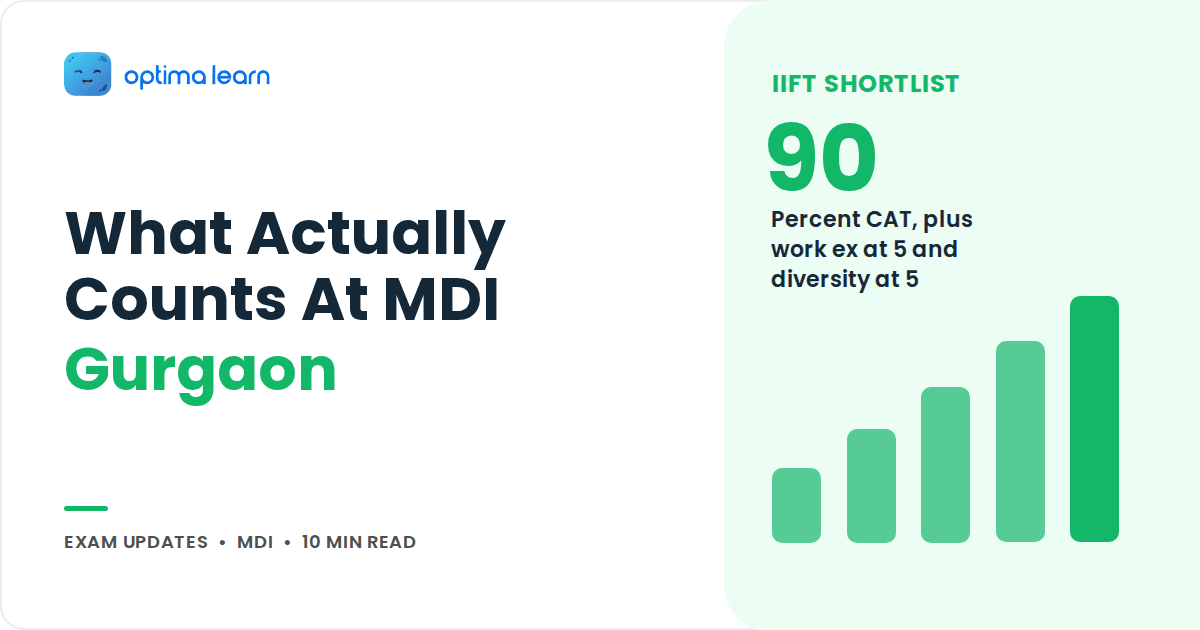
That shape is common across the stronger non-IIM schools and the weightings are not. Some schools publish theirs. IIFT's shortlist for the 2026 to 2028 batch weighted CAT at 90 percent, work experience at 5 and gender diversity at 5, and IIT Bombay's SJMSOM used 75 percent CAT, 20 percent academics and 5 percent work experience for its 2026 to 2028 personal interview shortlist. Both need re-verifying per cycle, and both show what a stated formula looks like.
MDI's published criteria for your cycle are what you should be reading, and the fact that CAT is one input among several is the planning-relevant part.
Preparing for six schools identically because they all accept CAT. The formulas differ enough that the same percentile produces different outcomes across them, and a candidate who researches this in October makes better decisions about where December goes than one who discovers it in March.
The Sequence, and What Each Stage Needs
Knowing the order tells you what to prepare and when, which is most of what this research is for.
- CAT. Taken in the November window. CAT 2026 is on Sunday 29 November, conducted by IIM Indore.
- Application. Submitted within the institute's own window, which is published independently of the CAT result date.
- Shortlisting. CAT performance alongside overall profile, including academics and work experience.
- Personal interview and final selection. The interview carries real weight, and the final decision reweights across components.
The Application Does Not Wait for Results
School deadlines are set independently of when CAT results arrive, and several across the cycle fall before results are out. Candidates who treat December as a waiting period regularly find a school they wanted had closed. Track the institute's own window rather than working backwards from the result.
Qualifying Is Not the Call
A published minimum is the floor below which you are not considered. The percentile that actually earns an interview call is higher and generally unpublished. IIM Calcutta's published CAT 2025 general category minimums of 80 sectional and 85 overall illustrate what a qualifying figure looks like, and it should never be read as a call figure.
The Interview Decides More Than People Expect
A call is not an admission. At schools where the interview carries real weight, candidates who treated the shortlist as the finish line arrive underprepared at the stage that actually determines the outcome, having spent a year preparing for the stage that only qualified them.
| School | Shortlist inputs | Selection stage |
|---|---|---|
| MDI Gurgaon | CAT plus overall profile | Personal interview |
| IIFT | CAT 90, work experience 5, gender diversity 5 (2026 to 2028) | GD and PI |
| IIT Bombay SJMSOM | CAT 75, academics 20, work experience 5 (2026 to 2028) | PI |
| FMS Delhi | CAT dominant | Selection and interview process |
| SPJIMR Mumbai | Profile-based or profile-cum-score | Interviews |
What Profile Actually Means
The word gets used vaguely, and the components are concrete enough to plan around.
Depending on the institute, a profile can include tenth and twelfth marks, graduation marks or CGPA, the entrance score and its sectional breakdown, work experience, gender diversity, academic diversity, category, professional qualifications, extracurriculars, achievements, positions of responsibility, certifications, internships and gap years, plus interview and written assessment performance. No school uses all of them and the weightings differ sharply.
Two terms are worth defining because they are misread constantly. Academic diversity means extra consideration for backgrounds underrepresented in MBA cohorts, such as humanities, commerce, medicine or law. Gender diversity means the same for genders underrepresented in that applicant pool.
Work experience is counted differently too. It generally means full time work after graduation, and institutes vary on what qualifies and how months convert into points. Assuming a uniform treatment across your list is a small research failure with a real cost at the margin.
Mentors find candidates can name their target schools and cannot name a single shortlisting input for any of them beyond the entrance score. An evening spent reading four admission policies changes more about a candidate's December than a month of additional mocks would, and almost nobody spends it.
CAT Opens the Door, the Profile Walks Through
At a school weighting profile alongside score, application quality is not administrative work.
Check My Target PercentileThe Cutoff Question, Answered Directly
This is what most aspirants arrive looking for, and it deserves a straight answer rather than a number.
Cutoffs are published per admission cycle by the institute and they change between years. A figure quoted second hand is either from a different cycle or has lost the label that said whether it was a qualifying minimum, and both failures produce plans built on something that was never true for your year.
Read the institute's current admission policy directly. Note four things: the application window, the shortlisting inputs and any published weighting, whether any stated figure is described as a qualifying minimum, and the selection stages. Four notes per school, and the whole list takes an evening.
Then plan on the assumption that a call requires more than the published floor, because it reliably does, and because the figure that would tell you how much more is not published anywhere.
What to Do With a Percentile Below Your Target
Do not rule yourself out without reading criteria. Formulas differ enough that the same score produces different outcomes, and schools that weight profile alongside score are precisely where a blanket assumption based on a percentile fails.
Preparing for the Interview From December
Shortlists arrive across January to March with rounds running through that window, and final rounds and waitlist movement continuing to roughly March to May. Starting in February leaves very little room, and the material is your own profile rather than anything requiring a percentile. Our guide on building a realistic preparation plan covers fitting that into the cycle.
What a Personal Interview Actually Tests
Candidates prepare for interviews by collecting answers, and panels are not primarily testing whether you have them.
Most of the conversation returns to material you supplied: your academic record, your work if you have any, what you studied and why, and the reasons you have given for wanting an MBA. A panel is testing whether those hold up when someone asks a second and third question about them, which is a different thing from whether you can state them once.
That has a practical consequence for December. The preparation is not a list of likely questions; it is being able to talk about your own decisions without the account falling apart. A candidate who says they chose their degree out of interest and cannot name anything within it they found interesting has just failed a question they answered confidently.
Rehearsing this out loud, with someone willing to ask the obvious follow up, is worth considerably more than reading interview guides. It is also available from December, before any percentile exists.
The Written and Group Stages Elsewhere
Worth knowing because your list will not be uniform: the stage after shortlisting differs by institute. Some schools run a written ability test alongside the interview, IIM Ahmedabad's process includes an Analytical Writing Test, IIFT runs a group discussion with the interview, and some schools centre the process on a personal interview alone.
Preparing for one shape and meeting another is an avoidable surprise, and the stages are published in each institute's admission policy alongside the shortlisting criteria you are already reading.
A written stage rewards a skill CAT preparation never builds directly, which is constructing an argument in writing under time pressure, and practising it costs an hour a week from December.
Group discussion stages add a further skill again, since being heard without dominating is a behaviour rather than a body of knowledge, and it only improves with practice in a group.
The Summary
MDI Gurgaon shortlists on CAT alongside overall profile and runs a personal interview before final selection, which places it among the schools where the entrance score qualifies you rather than deciding for you.
What this piece does not give you is a cutoff figure, because those are published per cycle by the institute and a number carried over from another year is misinformation with a decimal point attached. Read the current policy at source and treat any published minimum as a floor rather than a call-earning score.
The broader point applies across your whole list. Schools weight their shortlists differently, which is why the same percentile does different things at different institutes, and why an evening spent reading actual admission policies is worth more than any number of collected cutoff tables.
- Have you read the institute's own admission policy for your cycle?
- Do you know which schools on your list weight profile heavily?
- Is your application window noted independently of the result date?
- Have you started preparing for the interview stage?
If your list is ordered by reputation rather than by how each school would read your profile, that is worth correcting while there is time to act on it. A CAT preparation strategy review can pressure test it, and a personalised CAT preparation plan keeps the exam work moving alongside the applications.
Four Notes Per School
Window, inputs, whether a figure is qualifying, and the stages. That is the whole research task.
Build My Weekly PlanFrequently Asked Questions About MDI Gurgaon Admissions
Does MDI Gurgaon accept CAT?
Yes. MDI uses CAT for shortlisting alongside overall profile, including academics and work experience, and shortlisted candidates then go through a personal interview before final selection.
What is the MDI Gurgaon cutoff?
Cutoffs are published per admission cycle by the institute and change between years, so second hand figures are unreliable. Read the current policy at source and treat any published minimum as a qualifying floor rather than a call-earning score.
How much does profile matter relative to CAT?
CAT is one input among several rather than the whole shortlist, and the interview stage carries real weight in the final decision. That places MDI away from the schools where the entrance score dominates the shortlist.
When should I apply?
Within the institute's own published window, which is set independently of the CAT result date and can fall before results are out. Waiting for a percentile before filling forms is how candidates lose schools they wanted.
Track CAT 2026: never miss a date
Slot booking, admit cards, results, and IIM cutoffs, one timeline.
More from Exam Updates
Continue reading

XLRI Admission Process: The Exam Nobody Ever Checks

Why Do Some CAT DILR Sets Feel Totally Unsolvable?

Why School Level Quant Feels Hard in the CAT Paper

Why Do Non Engineers Struggle in CAT VARC As Well?
Put it into practice