
Let Position Do the Math
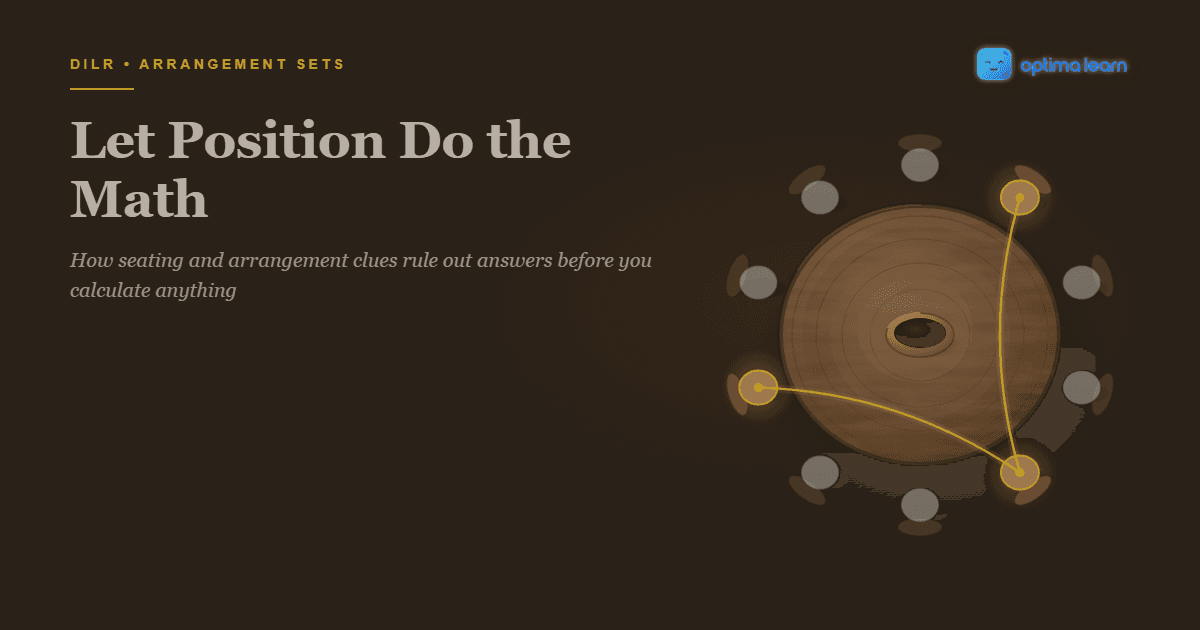
How seating and arrangement clues rule out answers before you calculate anything
An arrangement set tells you more through where someone sits than through anything you calculate about them. One clue about an end seat or an adjacency can rule out half the grid before you touch a single number. Most aspirants read that clue, nod, and go hunting for math anyway.
You've probably felt this without naming it. A set tells you "the person from marketing never sits at either end," you scribble it in the margin, and then burn two minutes chasing combinations that single line already ruled out. That's two minutes you needed for the next question.
- Positional clues, end seats, corners, adjacency, rule out possibilities with zero arithmetic.
- One ruled-out position often triggers a second one nearby, for free.
- Circular tables reward this even more than straight rows do.
- Calculate last: resolve everything geometry can give you first.
The habit that wastes free information
Most arrangement sets take longer than they should because of one habit. You treat every clue as raw data for a name, instead of asking what it rules out first. A single position clue can eliminate half the possible seatings on its own, before you do any math.
Picture the moment a clue drops: "The person who studies commerce sits second from the left." The instinct is to write commerce under seat two and move on.
But that same line also tells you who can no longer sit at either end, and who's no longer next to seat one. Skip that second read, and you end up solving the same set twice.
That's the gap the Empty Chair Rule closes: a simple way to notice what a position clue rules out beyond the seat it names, before you calculate anything.
The Empty Chair Rule
The Empty Chair Rule treats every arrangement set as a room full of chairs, some already ruled out before anyone sits down. It has three linked parts: the fact a clue hands you directly, the echo that fact sends outward, and the discipline of calculating last.
The Empty Chair Rule
Some seats are ruled out before anyone sits down.
- The Physical Fact: a position clue, like an end seat, a corner, or an adjacency, that rules out possibilities through geometry alone, no arithmetic involved.
- The Echo: how one ruled-out position quietly rules out others connected to it. If one seat is fixed, anyone who needs to sit a set distance from it narrows down too.
- Calculating Last: the habit worth building. Let geometry narrow things down as far as it can before you calculate anything. By then, only a few configurations are usually left.
None of this needs a formula. The Physical Fact and the Echo are both pure geometry, which is exactly why they're easy to miss when your brain is already hunting for a calculation to do.
One ruled-out seat triggers the next
The Echo is what turns one ruled-out seat into a second one. Fix a single seat at a circular table of eight, and several other configurations can vanish instantly, since every remaining distance clue now has fewer places left to land.
Take a circular table of six seats. One clue says a person sits directly opposite another. On its own, that doesn't look like much.
Then a second clue says a third person sits two seats from the first. In a circle of six, "two seats from seat one" has only two possible meanings, clockwise or counterclockwise. A third clue naming who sits next to either of those two seats is usually enough to settle which direction is correct, without a single calculation. For a closer look at how this plays out across a more layered set, this guide to double circular arrangements is worth working through.
Circular seats carry more weight than rows
A position clue in a circular arrangement usually rules out more than the same clue would in a straight row, simply because a circle has far fewer true ends. "Not at either end" rules out two seats in a row. The equivalent circular clue can rule out a much larger share of the table.
| Clue type | In a linear row | In a circular table |
|---|---|---|
| "Not at either end" | Rules out exactly two seats | Rarely applies, since circles have no true ends |
| "Sits next to X" | Rules out most non-adjacent seats | Rules out the same seats, but adjacency wraps in both directions |
| "Sits opposite X" | Not usually a defined position | Fixes exactly one seat outright |
Linear rows still reward the same habit. In a parallel-row seating set, a clue like "the person facing the accountant sits at position four" can rule out an entire column of possibilities across both rows at once, not just one seat. This walkthrough of parallel-row linear arrangements shows the same logic applied to rows instead of circles.
Put this to work on real sets
Practice spotting these positional wins across timed CAT DILR sets, not just this one example.
Practice CAT DILR SetsBottom line
The habit worth building here isn't a new formula, it's a delay. Hold off on calculating until you've squeezed every geometric fact a clue offers. By the time arithmetic is actually needed, very few configurations are usually still standing.
This only becomes automatic with repetition against real questions, not by reading about it once. Work through real DILR arrangement sets, pause after every clue before filling in a single name, and the Empty Chair Rule turns from an idea into a habit that survives exam pressure.
The Empty Chair Rule, in short
- The Physical Fact: read what a position clue rules out on its own.
- The Echo: check what it rules out elsewhere before moving on.
- Calculating Last: do the math only once geometry has done its share.
Ready to test this on real DILR sets?
Put the Empty Chair Rule to work on timed, full-length CAT DILR arrangement sets.
Start Practicing DILRFrequently Asked Questions
Does this apply to circular arrangements as well as linear ones?
Yes, and often more, since circular arrangements have fewer true 'ends,' which means every position clue carries more weight than the same clue would in a straight row.
What's an example of 'the echo' in a real arrangement set?
If a clue fixes one person at seat 3, and a second clue says another person sits exactly two seats from the first, that second person's position is now geometrically limited to two options, without a single calculation.
Why do most aspirants miss these positional eliminations?
Because the instinct is to start filling in names as soon as a fact appears, rather than pausing to ask what that fact also rules out elsewhere in the arrangement before moving on.
Is this method only useful for hard arrangement sets?
It saves the most time on sets that look hard because there seem to be many possibilities, since positional elimination is often what narrows a seemingly open set down to just one or two configurations fast.
Practice DILR sets, chapter by chapter
CAT DILR practice across LR puzzles and DI sets, each with a worked solution.
More from DILR
Continue reading

Why Aspirants Misjudge Which DILR Sets Are Really Doable

Should You Reattempt CAT After a Disappointing Score?
How to Stop Second Guessing on Para Summary Questions

SCMHRD Pune and the Deadline That Actually Binds You
Put it into practice