
IIFT Admission Process: The One Published Formula Now
IIFT is unusual among CAT accepting schools in one specific and useful way: it publishes its shortlisting formula. Most institutes describe what they consider without saying in what proportion, which leaves aspirants guessing. IIFT has stated a split, and that makes it one of the few schools you can actually plan against with numbers.
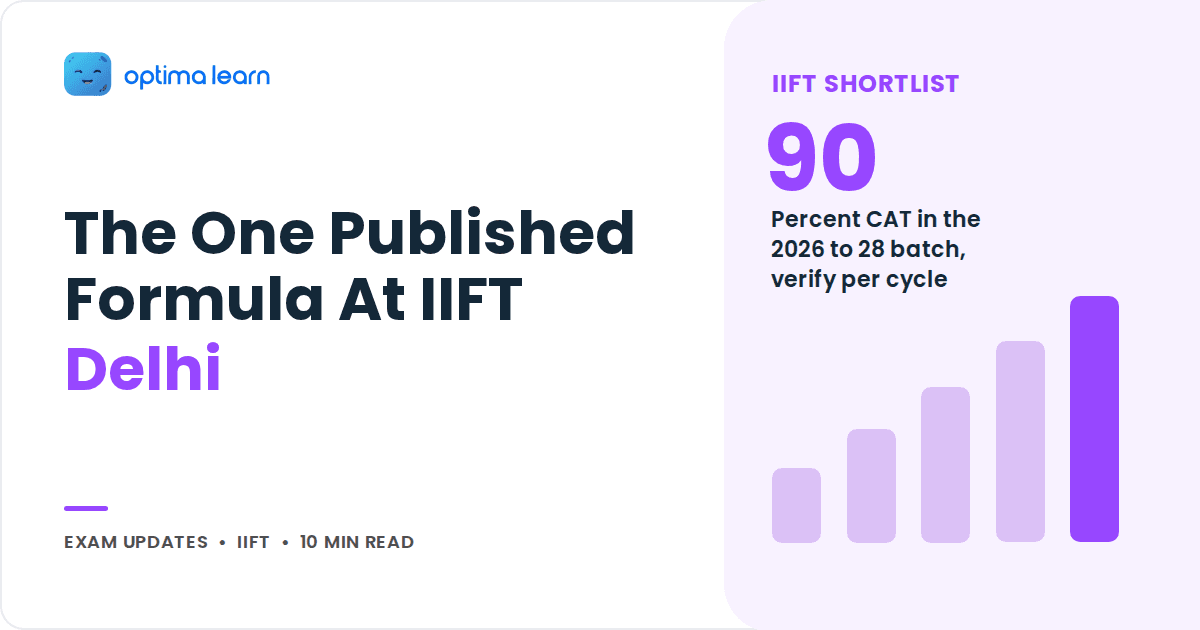
For the 2026 to 2028 batch, the shortlist weighted CAT at 90 percent, work experience at 5 percent and gender diversity at 5 percent. That figure needs re-verifying against the institute's own admission policy for your cycle, because these are published per batch and they change, but as a documented formula it is worth more than any cutoff table.
A 90 percent CAT weighting means the score does most of the work here. The CAT target percentile tool puts that target beside your wider list.
- IIFT's 2026 to 2028 shortlist weighted CAT at 90 percent, work experience at 5 and gender diversity at 5.
- Selection considers CAT performance, academics, work experience and diversity, with a group discussion and personal interview.
- Sectional cutoffs feature alongside the overall score, so a weak section can filter you out.
- The published figure is per batch and must be re-verified for the cycle you are applying in.
- A published weighting is far more useful than a cutoff number, because it tells you where marginal effort pays.
Why a Published Weighting Matters More Than a Cutoff
This is the point worth taking from IIFT even if you never apply there.
A cutoff tells you one number from one cycle, and it is usually a qualifying minimum being misread as a call threshold. A weighting tells you how the decision is constructed, which lets you work out where your marginal effort actually pays.
At 90 percent CAT weighting, an extra percentile point buys a great deal, because almost the whole shortlist decision rests on the score. Work experience at 5 percent is real and small, which means a candidate agonising over whether their eighteen months counts is worrying about a fraction of the decision.
Contrast that with IIT Bombay's SJMSOM, which used 75 percent CAT, 20 percent academics and 5 percent work experience for its 2026 to 2028 personal interview shortlist. Same broad process, materially different allocation, and a candidate with a strong academic record is in a different position at each.
Reading a 90 percent CAT weighting as meaning the rest does not matter. The shortlist and the final selection are separate calculations. Selection considers academics, work experience and diversity alongside the group discussion and interview, so a high weighting at the shortlist stage does not carry through to admission.
The Stages
Knowing the sequence tells you what to prepare and when.
- CAT. Taken in the November window. CAT 2026 is on Sunday 29 November, conducted by IIM Indore.
- Application. Within the institute's own window, published independently of the CAT result date.
- Shortlisting. Against the published weighting for that batch, with sectional cutoffs also featuring.
- Group discussion and personal interview, then final selection. Which considers academics, work experience and diversity alongside the stage performance.
Sectional Cutoffs Are a Separate Filter
This catches candidates with an uneven profile. Sectional requirements operate alongside the overall score, which means a strong composite with one weak section can be filtered out despite clearing the overall bar comfortably. That is the specific risk for quant-strong candidates with a soft VARC section, and it is why treating any section as disposable is dangerous.
The Group Discussion Is a Distinct Skill
A GD tests a behaviour rather than a body of knowledge: contributing substantively without dominating, and building on what others have said. It only improves through practice with actual people, which means it cannot be prepared for alone in the week before the round.
The Written Component Question
Selection stages differ by institute and some schools include a written component alongside the interview. Whether any written or essay stage applies in your cycle, and how it is weighted, is published in the institute's own admission policy, and that is where to check rather than in secondhand summaries. Do not plan around a stage you have not confirmed, in either direction.
| School | Published shortlist weighting | Selection stage |
|---|---|---|
| IIFT | CAT 90, work experience 5, gender diversity 5 (2026 to 2028) | GD and PI |
| IIT Bombay SJMSOM | CAT 75, academics 20, work experience 5 (2026 to 2028) | PI |
| IIM Calcutta | Qualifying CAT 2025 minimums: 80 sectional, 85 overall | WAT and PI |
| FMS Delhi | CAT dominant, published per cycle | Selection and interview process |
| SPJIMR Mumbai | Profile-based or profile-cum-score | Interviews |
What the Diversity Component Actually Is
Five percent for gender diversity is a small, real and frequently misunderstood part of the formula.
Gender diversity means extra consideration for genders underrepresented in that applicant pool. It appears in some institutes' published criteria and not in others, and where it appears it is part of the arithmetic rather than a statement of values.
Academic diversity is a separate thing and it appears elsewhere: extra consideration for backgrounds underrepresented in MBA cohorts, such as humanities, commerce, medicine or law. Candidates from those backgrounds frequently assume their degree is a liability without checking which institutes on their list treat it as an input.
The practical use of knowing this is list shaping. If several schools on your list weight components you do not have, the list is badly shaped for you regardless of how strong it looks, and that is worth discovering in October.
Mentors find that candidates who know one published weighting start asking the right question about every other school on their list, which is how the decision is constructed rather than what number cleared last year. IIFT is useful for that reason beyond its own admissions: it demonstrates that the formula is a knowable thing.
A Weighting Tells You Where Effort Pays
Ninety percent on the score means the score is where December should go, for this school.
Check My Target PercentileWhat to Verify for Your Cycle
The published figure above is for a specific batch, and treating it as permanent is exactly the error this piece warns against elsewhere.
Read the institute's current admission policy and note the shortlisting weighting for your batch, whether sectional requirements are stated and at what level, the application window, and the selection stages including any written component.
Note also whether any figure is described as a qualifying minimum. A published minimum is the floor below which you are not considered, and the score that earns a call sits above it and is usually unpublished. IIM Calcutta's published CAT 2025 general category minimums of 80 sectional and 85 overall show what a qualifying figure looks like.
That is four or five notes, it takes fifteen minutes per school, and it is current in a way that nothing quoted second hand can be.
Applying Before the Results Arrive
School application windows are published independently of the CAT result date and several across the cycle fall before results are out. December is application and interview preparation month rather than a waiting period, and candidates who treat it otherwise lose schools they wanted.
Preparing for a GD From December
Shortlists arrive across January to March with rounds through that window, and final rounds and waitlist movement running to roughly March to May. Group discussion practice needs other people and a few weeks, which makes December the last comfortable moment to start. Our guide on building a realistic preparation plan covers fitting the post-exam stages into the cycle.
How to Use a Weighting Once You Have One
Having the formula is only useful if it changes a decision, and there are three it should change.
The first is where marginal hours go in the final months. At a school weighting the entrance score at 90 percent, the answer is the exam, and a candidate splitting attention toward profile building for that school specifically has misallocated. At a school weighting academics at 20 percent, the academic record is fixed and the conclusion is different: you learn early that a component you cannot change carries real weight, which is an argument for widening the list rather than for any additional effort.
The second is how you read your own chances. A formula lets you see which components you are strong and weak on, rather than reducing everything to whether a number cleared. A candidate with no work experience at a school allocating five percent to it is barely affected; the same candidate at a school allocating more is in a different position.
The third is list shaping. Once you have read three or four formulas, patterns appear across your list, and if every school weights something you lack, that is a finding worth acting on in October rather than discovering in March.
None of those three decisions requires knowing your percentile, which is why the research belongs in the months before the exam rather than in the weeks after it.
It also makes the December application work faster, since a candidate who already understands what each school is looking for writes a better form in less time than one meeting the criteria for the first time under a deadline.
That compounding is the quiet argument for doing the reading early rather than treating it as an administrative task for later.
The Summary
IIFT considers CAT performance, academics, work experience and diversity, runs a group discussion and personal interview, and published a shortlist weighting of 90 percent CAT, 5 percent work experience and 5 percent gender diversity for the 2026 to 2028 batch.
That number is the most useful thing here and it comes with two conditions. It is per batch, so re-verify it for your cycle. And it describes the shortlist rather than the admission, because final selection reweights across academics, work experience, diversity and the stage performance.
The transferable lesson is about what to look for at every school on your list. A weighting tells you how the decision is built and therefore where marginal effort pays. A cutoff tells you one number from one year, usually mislabelled. Spend your research time on the first.
- Have you read the current admission policy rather than a summary of it?
- Do you know whether sectional requirements apply and at what level?
- Have you confirmed which selection stages apply in your cycle?
- Have you practised a group discussion with actual people?
If you have been collecting cutoff numbers rather than reading formulas, this is the school that shows the difference most clearly. A CAT preparation strategy review can pressure test your list, and a personalised CAT preparation plan keeps the exam work moving alongside the applications.
Read Formulas, Not Cutoffs
One published weighting tells you more than a decade of collected threshold numbers.
Build My Weekly PlanFrequently Asked Questions About IIFT Admissions
What is the IIFT shortlist weightage?
For the 2026 to 2028 batch the shortlist weighted CAT at 90 percent, work experience at 5 percent and gender diversity at 5 percent. These are published per batch and change, so re-verify against the institute's own policy for your cycle.
Which entrance exam does IIFT use?
IIFT uses CAT. Its selection considers CAT performance, academics, work experience and diversity, with a group discussion and a personal interview forming the stage after shortlisting.
Do sectional cutoffs apply?
Sectional requirements feature alongside the overall score, which means a strong composite with one weak section can still be filtered out. That is the specific risk for candidates who treat one section as disposable.
Does a 90 percent CAT weighting mean nothing else matters?
No. That figure describes the shortlist. Final selection reweights across academics, work experience and diversity alongside performance in the group discussion and interview, so a call is still a long way from an admission.
Track CAT 2026: never miss a date
Slot booking, admit cards, results, and IIM cutoffs, one timeline.
More from Exam Updates
Continue reading

XLRI Admission Process: The Exam Nobody Ever Checks

Why Do Some CAT DILR Sets Feel Totally Unsolvable?

Why School Level Quant Feels Hard in the CAT Paper

Why Do Non Engineers Struggle in CAT VARC As Well?
Put it into practice