
CAT VARC: How Much of It Is RC vs Verbal Ability Work?
Aspirants ask for this split because it decides where preparation hours go, and the decision is genuinely consequential. If reading comprehension dominates the section, then reading work is the section work, and para jumble technique is a side project. If the two are closer to even, the calculation changes.
CAT publishes no official question-type weightage, so an exact percentage cannot honestly be given. What has held up across papers is clear enough to plan with: reading comprehension consistently carries the majority of VARC, with verbal ability making up the remainder. That single fact settles the preparation question, and the rest of this piece covers what follows from it.
If RC carries the section, RC accuracy is the section score. Build it across timed sets of CAT reading comprehension practice.
- CAT publishes no official type-wise weightage, so exact percentages are inferred rather than stated.
- Reading comprehension has consistently carried the majority of VARC, with verbal ability the remainder.
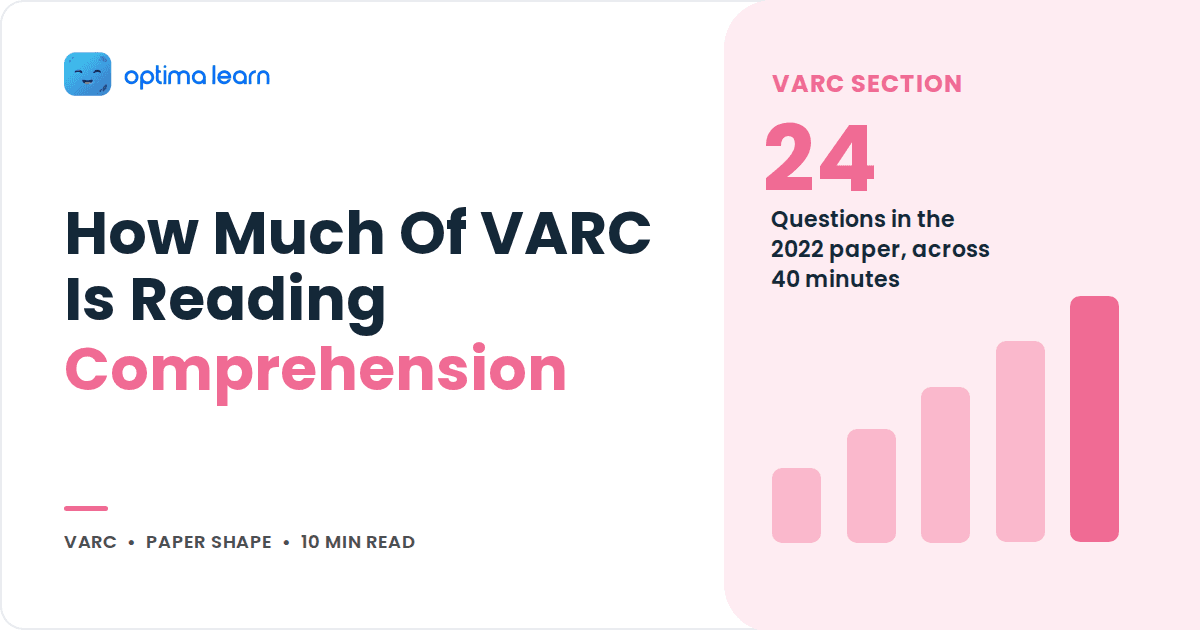
- In the 2022 paper VARC ran 24 questions worth 72 marks with a 40 minute sectional limit.
- Verbal ability questions are individually fast for a practised candidate, which makes them cheap marks per minute.
- The common error is not the split itself but scheduling verbal ability last, where the clock has already gone.
What Each Half Contains
The split only means something once you know what sits on each side of it.
Reading comprehension covers main idea, inference, tone, author's purpose, specific detail, and strengthen or weaken questions. The questions attach to passages, so the unit of work is a passage plus its question cluster rather than an individual question.
Verbal ability covers para summary, para jumbles and odd sentence out. These are standalone questions, each self contained, and each answerable in a minute or two by a candidate who has practised the type.
That structural difference matters more than the percentage. A passage is a large investment with a cluster of returns; a verbal ability question is a small investment with a single return. They should be handled differently within a section, and most aspirants handle them identically.
Reading the split as an instruction to spend proportional time. RC carrying the majority does not mean verbal ability deserves a proportional sliver of your preparation. Those questions respond to a few focused sittings and then stay learned, which is a far better return per hour than the same time added to reading.
What Can Honestly Be Said About the Numbers
Three statements are defensible and everything past them is inference presented as fact.
First, CAT publishes a general syllabus rather than a question-type blueprint. It does not commit to a fixed number of RC or verbal ability questions.
Second, specific past papers have documented shapes. In the 2022 paper VARC carried 24 questions worth 72 marks with a 40 minute sectional limit, alongside DILR at 20 questions and quant at 22.
Third, the paper as a whole has moved. Recent papers have run roughly 66 to 68 questions and 198 to 204 marks, so sectional composition has moved with it.
| Component | Share of VARC | Unit of work | Preparation response |
|---|---|---|---|
| Reading comprehension | Majority | Passage plus question cluster | Sustained, over months |
| Para summary | Smaller | Single question | Focused sittings, then maintenance |
| Para jumbles | Smaller | Single question | Technique driven, learns quickly |
| Odd sentence out | Smallest | Single question | Covered alongside jumbles |
What the Split Should Change About Your Week
The allocation follows from how each half responds to work, not from its share of the section.
- RC gets the sustained hours. It carries the majority and it improves slowly, so it needs continuous contact across months rather than a block.
- Verbal ability gets focused sittings. Two or three concentrated sessions move a candidate from guessing to handling these reliably, and the gain then holds.
- Both get timed practice. Untimed accuracy on either half tells you very little about a section that runs forty minutes.
- Verbal ability gets scheduled early in the section. The share question is less important than the sequencing one.
RC Improves Slowly, Which Is Why It Needs the Calendar
Comprehension is built by volume across months. There is no focused week that fixes it, which is precisely why it should start early and run continuously. An aspirant who defers reading until October has left the one part of the section that cannot be compressed.
Verbal Ability Is the Fastest Available Gain
Para jumbles reward tracking connectives, pronoun reference and logical sequence, which is a learnable technique rather than a general reading ability. A candidate who has never worked them deliberately is guessing at questions that a fortnight of practice would make reliable. That is unusual in CAT preparation, where most gains are slow.
The Sequencing Error Costs More Than the Split
Most aspirants work the section top to bottom, reach the verbal ability questions last, and arrive there with four minutes remaining after the passages have eaten everything. Those were the cheapest marks available and they were allocated the worst minutes in the section. This costs more than any misjudged preparation ratio.
Decide before the section where the verbal ability block sits in your order, and protect the minutes for it. Handling it after two passages rather than after four is a small change that converts a rushed guess into a considered answer on several questions.
Why RC Accuracy Is Effectively Your Section Score
The arithmetic here is worth stating because it settles several other debates.
If RC carries the majority of the questions, then your RC accuracy dominates your sectional total. No amount of skill at para jumbles compensates for weak comprehension, because there are not enough of them to compensate with.
That is why VARC improvement plans built entirely on verbal ability technique disappoint. They address the part of the section that was already fixable and leave the part that decides the score untouched.
It also explains why measuring accuracy per passage matters more than measuring it overall. Four passages at a consistent rate looks identical, in aggregate, to three good passages and one that collapsed, and those are completely different problems.
Mentors reviewing VARC sections see the same signature on a weak score. Not a spread of small errors, but one passage where accuracy fell apart, plus a verbal ability block answered in the last three minutes. Both are structural rather than about reading ability, and both are visible the moment accuracy is recorded per passage.
RC Carries the Section, So RC Carries the Plan
Sustained reading work, plus focused sittings on the verbal ability block. Not proportional time.
Work Through CAT VARC ChaptersHow to Check Your Own Split
The section's composition matters less than where your own marks and losses are concentrated, and that is measurable.
Take your last three VARC sections. Record accuracy per passage, accuracy on the verbal ability questions, and how many minutes remained when you reached them. Those three numbers tell you which half is actually costing you.
If verbal ability accuracy is poor, check whether it is a technique problem or a time problem. Answering those questions untimed will separate the two immediately, and they need completely different work.
If one passage per section keeps collapsing, that is the priority regardless of anything else, because a single failed passage removes a cluster of marks rather than one.
The One Sentence Test
After reading a passage and before looking at the questions, state the author's position in one sentence in your own words. If you cannot, you have not finished reading, and answering from that state is where confident wrong answers come from. Our guide on the three signals that decide your RC attempt order covers choosing between passages once you can see them.
What to Do With the Verbal Ability Block This Month
If you have never worked para jumbles deliberately, two focused sittings this month is among the highest return time available anywhere in your preparation. It is finite work with a durable result, which is rare.
Why the Verbal Ability Block Gets Neglected
Given how quickly these questions respond to practice, it is worth asking why so many candidates arrive at the exam having never worked them properly.
Part of it is that they feel minor. A block described as the smaller share reads as the part you can pick up later, and later never arrives because reading practice expands to fill whatever time exists. The framing does the damage: smaller share gets heard as lower priority, when the relevant comparison is return per hour rather than share of paper.
The other part is that they are unpleasant to practise. A para jumble you get wrong offers very little to learn from if you only check the answer, since the correct order looks obvious in hindsight. The practice only pays if you write down what signal you missed, which connective or pronoun reference should have fixed the sequence, and most candidates skip that step and conclude the questions are arbitrary.
They are not arbitrary. Every jumble has an anchor, usually a sentence that cannot follow anything else, and finding anchors is a habit rather than an intuition. Two sittings spent specifically on locating anchors, with no attempt to order the full sequence, will change how the whole question type feels.
The Answer, and What It Is For
What percentage of CAT VARC is reading comprehension? No official figure exists, and the honest statement is that RC has consistently carried the majority with verbal ability making up the remainder.
That is enough for every decision the question was asked to support. RC dominance means reading work is the section work and has to run continuously from early in your preparation. Verbal ability's smaller share, combined with how quickly it responds to focused practice, means it deserves deliberate attention rather than proportional attention.
The failure worth avoiding is not misjudging the ratio. It is treating the two halves identically inside the section, working top to bottom, and reaching the cheapest questions on the paper with the clock nearly gone.
- Do you measure accuracy per passage rather than overall?
- Have you worked para jumbles and summary questions deliberately?
- How many minutes remain when you reach the verbal ability block?
- Is your reading work continuous or deferred to a later month?
If your VARC score is inconsistent, the cause is usually one collapsed passage or a rushed verbal ability block rather than general reading weakness. A CAT preparation strategy review will locate it, and a personalised CAT preparation plan can keep the reading work continuous.
Allocate by Response, Not by Share
RC needs months of contact. Verbal ability needs a fortnight and then maintenance.
Build My Weekly PlanFrequently Asked Questions About the VARC Split
What percentage of CAT VARC is reading comprehension?
CAT publishes no official type-wise weightage, so an exact percentage cannot be stated. RC has consistently carried the majority of the section, with para summary, para jumbles and odd sentence out making up the remainder.
How many questions does VARC carry?
In the 2022 paper VARC carried 24 questions worth 72 marks with a 40 minute sectional limit. Recent papers have run roughly 66 to 68 questions overall, so that figure describes one paper rather than a fixed structure.
Should I spend time on each half in proportion to its share?
No. RC improves slowly and needs continuous contact across months, while verbal ability responds to a few focused sittings and then holds. Allocate by how each half responds to work rather than by its share of the paper.
Where should the verbal ability block sit in my section order?
Earlier than last. Working top to bottom means reaching the cheapest questions on the paper with a few minutes left, after the passages have consumed the clock. Decide the placement before the section starts.
Practice VARC, chapter by chapter
CAT VARC practice across reading comprehension, para-summary and para-jumbles, each with a worked solution.
More from VARC
Continue reading

Using a Study Journal for CAT Without Overdoing It

How to Stop Comparing Your CAT Prep With Everyone Else

SPJIMR Admission Process: Why the Profile Leads It

How to Solve CAT Quant Faster Without Skipping Steps
Put it into practice