
CAT 2026 Preparation Without Coaching: Self-Study Plan + Resources
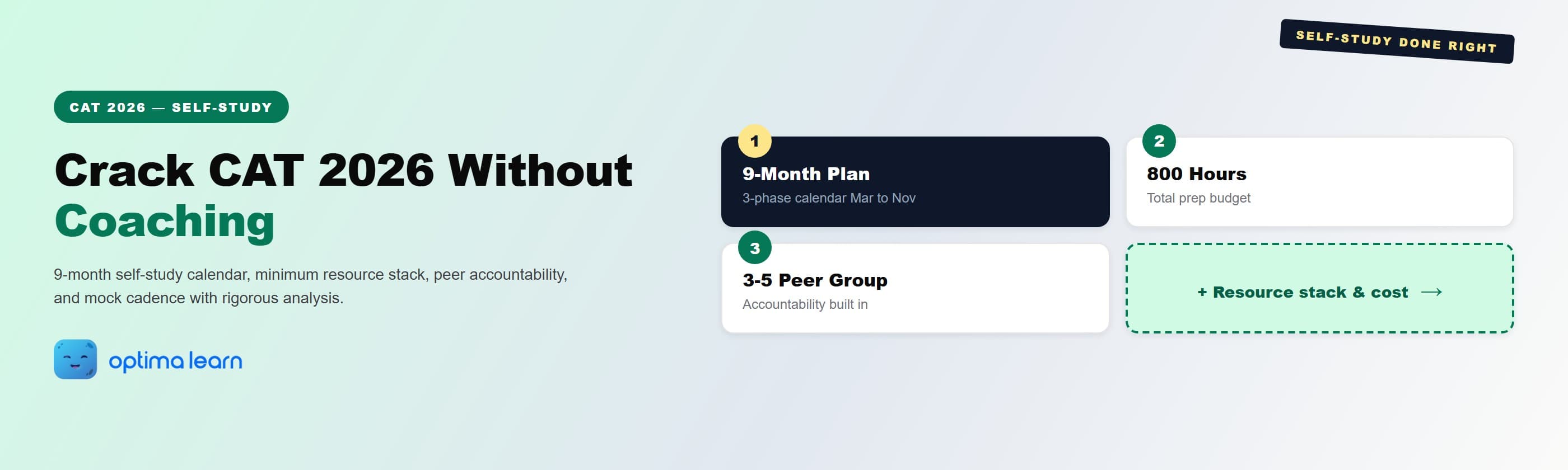
Roughly one in three candidates above the 95 percentile in recent CAT cycles cracked the exam without enrolling in a formal coaching programme. CAT preparation without coaching is not a discount option; it is a deliberate path that swaps the discipline of a classroom for a self-built system. The candidates who succeed have one thing in common: they treat self-study as a project with weekly milestones, not as casual reading.
This guide is the complete execution playbook for CAT preparation without coaching. It covers the 9-month calendar starting in March 2026, the minimum resource stack, the self-built peer accountability system, the mock cadence with error analysis, and the common failure modes that cause self-study candidates to plateau. Pair with the coaching vs self-study comparison blog if you have not yet decided which path fits your profile.
CAT 2026 self-study works in three 3-month phases: foundation (March to May), depth (June to August), and mock-heavy revision (September to November). Daily target: 4 to 5 hours weekdays, 7 to 8 hours weekends, totalling 800 to 900 prep hours. Minimum stack: one QA book, one VARC book, one DILR book, 20 to 25 mocks, an RC reading source plan, and a self-built peer group of 3 to 5 aspirants. Cost: roughly Rs 6,000 to Rs 12,000. Discipline beats prestige; self-imposed structure beats no structure.
The 9-Month CAT 2026 Self-Study Calendar
The plan starts in March 2026 for the November 2026 CAT. Three 3-month phases, each with a distinct emphasis. The earlier the start, the slower the daily pace can be; aspirants starting in June or July compress the same plan into 5 months with higher daily intensity.
Concept Build and Reading Habit
QA: Arithmetic cluster (percentages, ratios, SI/CI, averages, profit and loss, time-work, basic algebra). 60 percent of QA hours.
VARC: Daily 45-minute reading habit on Aeon, Project Syndicate, The Economist. RC practice 2 passages per day.
DILR: Learn set-type identification (arrangement, matrix, routing, optimisation). Practice 1 set per day.
Mock cadence: No full-length mocks; one sectional test per month to track concept absorption.
Cover Remaining Topics, Start Mocks
QA: Geometry (triangles, circles, coordinate geometry, mensuration), number system, functions and graphs, P and C.
VARC: RC accuracy push from 60 to 75 percent. Para-summary and odd-one-out drill 8 questions weekly.
DILR: 3 sets per day across set types. Track time-per-set; target under 12 minutes for ATTEMPT sets.
Mock cadence: One full-length mock every 2 weeks. Mock analysis at 90 minutes per mock; classify errors by topic.
Mock-Heavy, Topic-Targeted Revision
QA: No new topics. Weekly drill of high-priority topics based on mock weakness.
VARC: Continue daily reading; push RC accuracy from 75 to 85 percent. Drill all VARC question types.
DILR: 4-set practice daily; train set selection in the first 90 seconds of mocks.
Mock cadence: Weekly full-length mock. Two-day error analysis after each mock. Final 2 weeks: tapered intensity, no new learning.
Build a single A4 weekly tracker. Top half: Monday-to-Sunday hours by section (QA, VARC, DILR, mock, mock analysis). Bottom half: 3 specific deliverables for the week (e.g., "finish chapter 4 of QA book," "drill 12 RC passages," "complete 1 full mock"). Hit a 90 percent weekly completion rate; self-study fails on consistency, not on plan quality.
The Minimum Resource Stack for CAT 2026 Self-Study
| Category | Recommended source | Cost |
|---|---|---|
| QA book | Arun Sharma How to Prepare for QA or Sarvesh Verma Quantum CAT | Rs 700 to Rs 900 |
| VARC book | Nishit Sinha Pearson Guide to VARC or Arihant series | Rs 500 to Rs 700 |
| DILR book | Arun Sharma DILR or Nishit Sinha DILR | Rs 500 to Rs 700 |
| Mock series | One reputed provider (TIME, IMS, CL, or AIMCAT) | Rs 4,000 to Rs 8,000 |
| RC reading sources | Aeon (free), Project Syndicate (free), The Economist student plan | Rs 0 to Rs 2,000/yr |
| PYQ archive | Past 5 years CAT papers (free online + analysis books) | Rs 0 to Rs 500 |
| YouTube concept channels | 2 channels (one for QA, one for DILR concepts) | Free |
Total minimum cost: roughly Rs 6,000 to Rs 12,000 against Rs 25,000 to Rs 40,000 for a typical full-year coaching programme. The cost saving is roughly 4x; the time saving is 8 to 10 hours per week (commute and class).
Building Self-Study Peer Accountability
The biggest gap between coaching and self-study is not curriculum; it is peer pressure. A self-study candidate must build the equivalent of a classroom peer group manually. The structure that works:
- Group size 3 to 5: small enough for quality discussion, large enough to survive attrition.
- Weekly call (90 minutes): review the week's progress against shared plan, share difficult problems, discuss mock errors.
- Mock comparison system: all members take the same mock on the same day; compare scores and error patterns next day.
- Public commitment: post weekly goals in the group chat; report completion.
- Where to find peers: Reddit r/CATPreparation, Telegram CAT groups, Discord servers built around mock providers, college study groups.
Myth
Self-study is cheaper but produces lower scores than coaching.
Reality
Recent CAT topper data shows roughly 30 to 35 percent of 95 plus percentile scorers used self-study. The success rate depends on consistency and structure, not on the path label. Discipline beats prestige.
Want a self-study plan calibrated to your starting level, available hours, and mock score history?
Build My CAT Self-Study PlanMock Cadence and Self-Diagnosis (Replacing Faculty Feedback)
Coaching institutes provide structured feedback after every mock. Self-study candidates must build this feedback loop themselves. The cadence:
- Mock frequency: months 4 to 6 take 1 mock every 2 weeks (6 mocks); months 7 to 9 take 1 mock weekly (12 mocks); final 2 weeks tapered.
- Mock analysis time: 90 minutes per mock minimum. Classify every wrong answer as concept gap, accuracy slip, time pressure, or wrong question selection.
- Error tracking: maintain a topic-wise error log; the topics with the most concept-gap errors get the next 5 hours of revision.
- Peer comparison: compare your error patterns with 2 to 3 peers from the study group; common error topics suggest blind spots in the resource stack.
Taking mocks without analysis. Self-study candidates who take 12 mocks but spend only 20 minutes per mock on analysis gain less than candidates who take 6 mocks with 90 minutes of analysis each. The analysis is the learning; the mock is just the diagnostic. Always block 90 minutes for post-mock review.
Common Self-Study Failure Modes (and Fixes)
- Resource hopping: switching books or YouTube channels every two weeks. Fix: pick one resource per section and stay for the full 9 months.
- No peer accountability: studying alone with no external pressure. Fix: build the 3 to 5 person group in week 1; do not start phase 1 without it.
- Mock-only learning: skipping concept books and jumping straight to mocks. Fix: phase 1 is non-negotiable; mocks come later.
- Inconsistent weekday rhythm: studying 7 hours on Saturday and 1 hour on Wednesday. Fix: weekday minimum of 4 hours, even on busy days.
- Plateau at 80 to 85 percentile: often a sign that the underlying VARC reading habit is too weak. Fix: review the VARC RC passage sources guide; restructure reading diet.
- Treat self-study as a project with weekly milestones, not as casual reading.
- Pick one resource per section and stay with it for the full 9 months.
- Build a 3 to 5 person peer group in week 1; do not skip the accountability layer.
- Daily target: 4 to 5 hours weekdays, 7 to 8 hours weekends. Total: 800 to 900 hours.
- Phase 1 is concept and reading habit; mocks start in phase 2; phase 3 is mock-heavy revision.
- Mock analysis at 90 minutes per mock minimum; the analysis is the learning.
- Track weekly completion at 90 percent or higher; self-study fails on consistency, not on plan quality.
Self-study is not the absence of structure. It is self-imposed structure with the same discipline a coaching classroom enforces.
Build My CAT 2026 Self-Study Plan
Get a month-by-month self-study calendar calibrated to your start date, available daily hours, and current mock score band. Tracking, peer matching, and mock analysis built in.
Build My Self-Study PlanBuild your CAT 2026 study plan
Personalised daily plan that adapts to your section-wise mock scores.
More from Strategy
Continue reading
XLRI Admission Process: The Exam Nobody Ever Checks
Why Do Some CAT DILR Sets Feel Totally Unsolvable?
Why School Level Quant Feels Hard in the CAT Paper

Why Do Non Engineers Struggle in CAT VARC As Well?
Put it into practice