
Academic Diversity Points at IIMs: Who Earns Them or Not
Ask a group of CAT aspirants whether non-engineers get an advantage at IIMs and you will hear three confident answers. Some say yes, a large one. Some say it is a myth. Some say it depends on the IIM. The third answer is the closest, and even it hides a detail that decides most cases: academic diversity points usually count at a later stage than people assume, and the rules for who earns them are narrower than the phrase suggests.
This post separates what is published from what is repeated. The only source I could read in full that gives a numeric table for the current cycle is the IIM Calcutta admission policy for the batch of 2027 to 2029, which cites CAT 2026. Other IIMs appear in secondary reports that disagree with each other and mostly describe an earlier cycle, so I treat them as signals to check, not as facts to plan on.
A diversity point is one input among many. The CAT percentile predictor can help you see where your percentile sits before you worry about the smaller weights.
- The only numeric academic diversity table read for this post is IIM Calcutta's, and it applies at final selection, not at the PI and WAT shortlist.
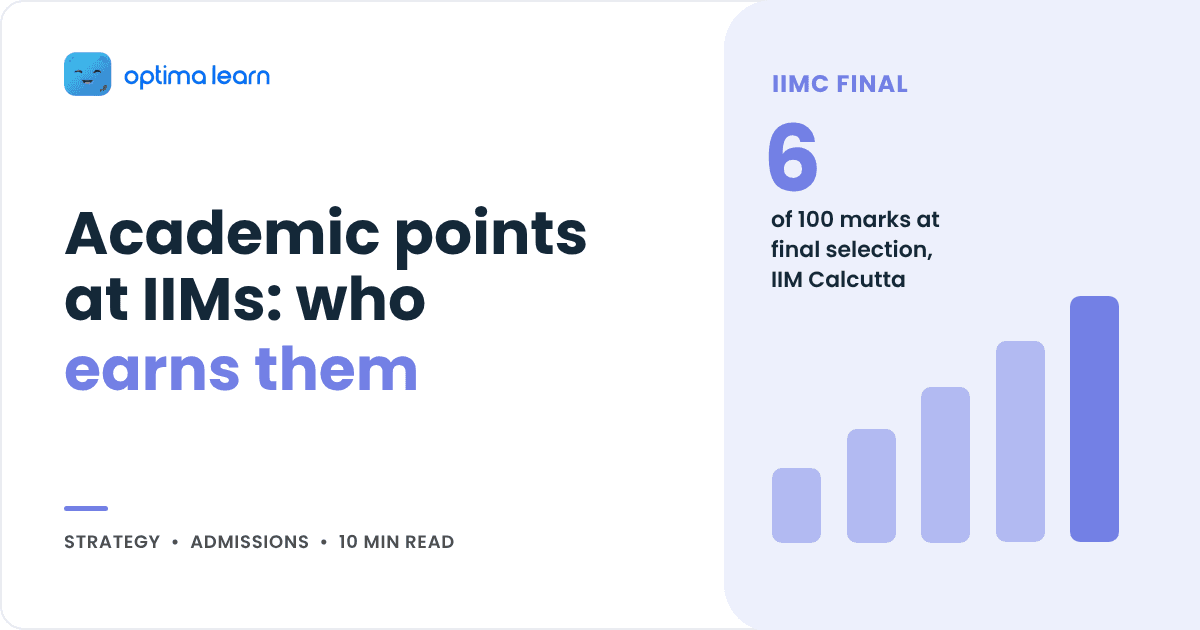
- At IIM Calcutta, academic diversity carries 6 of 100 marks at final selection. Points range from 0 to 6 by degree combination.
- A plain engineering bachelor's earns 0. A non-engineering bachelor's earns 4. A CA, CS or ICWA qualification with a bachelor's earns 6.
- Secondary pages disagree on other IIMs, and their figures may belong to the previous cycle.
- Read the official policy of each IIM you apply to. Do not plan on a number from a summary.
What Academic Diversity Means
Academic diversity is a consideration given to applicants whose degree backgrounds are less common among MBA applicants. In practice that usually means non-engineers, though what counts differs by institute. It is separate from gender diversity, which is a different factor with its own weight.
The word points hides a stage question. A point at the shortlist stage can decide whether you get a call. A point at the final stage matters only after you have been called and interviewed. The same number of points has a very different effect depending on where it is applied.
Shortlist versus final selection
At the shortlist stage an institute decides who gets a written test or interview call. At the final stage it decides who gets an offer. Most of the weight at the shortlist is on CAT and earlier academics. Most of the weight at the final stage is on the interview and written test. Where academic diversity sits in this sequence is the first thing to check.
What IIM Calcutta Publishes
IIM Calcutta's admission policy for the 2027 to 2029 batch is the clearest source I read. It describes three stages. Stage two is the PI and WAT shortlist. It scores out of 85: CAT 56, Class 10 marks 10, Class 12 marks 15 and a gender diversity factor of 4, awarded to female and transgender candidates only. There is no academic diversity row at this stage.
Stage three is final selection, scored out of 100: CAT 30, personal interview 48, written ability test 8, work experience 8 and academic diversity 6. So academic diversity is worth at most 6 marks of 100 at the final stage, and the policy gives a table that sets the points by degree combination.
| Background (IIM Calcutta policy) | Points out of 6 |
|---|---|
| Engineering bachelor's, master's or integrated master's | 0 |
| Non-engineering bachelor's | 4 |
| Law dual degree, such as BA LLB or B.Com LLB | 5 |
| Engineering bachelor's plus non-engineering master's | 2 |
| Non-engineering bachelor's plus non-engineering master's | 5 |
| CA, ICWA, CS or FIAI without a bachelor's | 5 |
| CA, ICWA, CS or FIAI with a bachelor's | 6 |
| Integrated law bachelor's plus non-engineering master's | 6 |
The table has more rows than shown here, including dual and integrated degree cases. The policy also says that some categories need the relevant mark sheet uploaded with the PI application, and that final-year candidates need a certificate by 30 June 2027. Read the full table on the institute's page before you assume a category.
Find your own degree combination in the table before you estimate anything. A person with an engineering degree and a non-engineering master's earns 2, not 0 and not 4. The combination, not the label, decides the points.
What this tells you
A non-engineering bachelor's earns 4 of the 6 points. The rest of the table lifts or lowers that by the second qualification. Because the weight is 6 of 100 and sits after the interview call, the effect is real but small. It cannot rescue a low CAT score, because the call comes before it applies. It can tip a close contest among called candidates.
Assuming that a non-engineering degree gives you a head start in the shortlist. Under the IIM Calcutta policy, the shortlist stage has no academic diversity row. The shortlist weights are CAT, Class 10, Class 12 and the gender factor.
What Secondary Reports Say About Other IIMs
Most aspirants read summaries, not policies. The summaries I read were a Careers360 admission guide updated on 30 November 2025, a Physics Wallah page dated 19 January 2026 and a Careers360 shortlist page updated on 30 March 2026. They describe the earlier admission cycle. They do not agree with each other, and in places they do not agree with the IIM Calcutta policy.
- For IIM Calcutta, the Careers360 guide lists a flat 6 points for a non-engineering degree at the final stage, while the official table runs from 0 to 6 by combination. It also gives the CAT weight at the shortlist as 58, and the official policy gives 56.
- For IIM Indore, the Careers360 guide lists a single diversity factor of 10 percent covering gender and academic diversity at its first stage. The Physics Wallah page gives smaller figures.
- For IIM Lucknow, the Careers360 guide lists a diversity factor of 5 percent at each stage without saying whether it is gender or academic.
- For IIM Ahmedabad, the guide lists academic diversity as a criterion but gives no number.
- For IIM Bangalore and IIM Kozhikode, the guide shows a gender diversity weight of 5 percent and no academic line.
Treat these as a map of what to look up, not as the answer. The most that can be said safely is that several IIMs fold a diversity factor into their shortlist or final scores, that some of those factors combine gender and academic diversity, and that the details differ and change from year to year.
When two websites give different numbers for the same institute, neither is a source. The institute's own admission policy is. Open it, find the table and note the date or the batch it covers before you use a number.
What the Batch Mix Shows
A Careers360 report published on 29 September 2026 gave the share of engineers and non-engineers in the 2026 to 2028 batches at five IIMs. The overall figure for the five was 54.26 percent engineers and 45.74 percent non-engineers, out of 2,418 students. By institute, the non-engineer share was 39.13 percent at IIM Ahmedabad, 45.3 percent at IIM Calcutta, 33.33 percent at IIM Bangalore, 56.91 percent at IIM Kozhikode and 54 percent at IIM Indore.
Separately, Business Today reported on 30 June 2026 that IIM Indore's 2026 to 2028 batch had 487 students, of whom 265 were women, which is 54.4 percent, and described the batch as 54 percent from non-engineering backgrounds. The article credits the director's gender diversity consideration for the women's share, and does not give an academic diversity point scheme.
These numbers describe who was admitted. They do not show that points caused the mix. Non-engineers are a large share at several IIMs for reasons that include the applicant pool, the CAT score distribution and many other factors. The useful reading is modest: non-engineers do get admitted in large numbers, and the shares vary a lot by institute.
Who Earns Points and Who Does Not
Putting the published policy and the cautious reading together gives a practical picture.
- A candidate with an engineering bachelor's and no other qualification earns 0 points under the IIM Calcutta table.
- A candidate with a non-engineering bachelor's earns 4, and a second non-engineering qualification can raise it to 5 or 6.
- A candidate with a CA, CS or ICWA qualification earns 5 or 6, depending on whether a bachelor's is also held.
- A candidate with an engineering bachelor's and a non-engineering master's earns a small number of points, 2 or 1, depending on whether the master's is integrated.
- A candidate who is a final-year student may need a certificate by a stated date, so the timing of the degree matters.
This is the IIM Calcutta policy only. Other IIMs may define the groups differently, may weight them differently, and may apply them at another stage. If you are an engineer, the lack of academic points is a fixed feature, not a penalty, and it is worth less than a few percentile points in CAT. If you are a non-engineer, the points are a small bonus that you should not depend on.
What you can control
You cannot change your degree. You can control the parts of your profile that carry far more weight: your CAT score, your Class 10 and 12 marks where they are counted, and the interview, which carries the most weight at the final stage under the IIM Calcutta policy. A strategy review can help you decide where your preparation time is best spent.
How to Check Your Own Case
- Open the admission policy of each IIM you plan to apply to, for the correct batch.
- Find the shortlist table and the final selection table separately.
- Look for an academic diversity row at each stage and note its weight.
- Find your degree combination in any category table and read its points.
- Note any document you must upload, and the date by which it is due.
- Record the source and the batch for every number you write down.
Do this once, in a single sitting, for every institute on your list, and put the dates on the CAT preparation planner so that no upload deadline is missed. It takes less time than reading three more summaries and gives you numbers that you can rely on. When the official policy has not yet been released for the current cycle, use last year's policy as a rough guide and mark it as such.
- Did I check whether the points apply at the shortlist or the final stage?
- Did I use the institute's own policy, not a summary?
- Did I find my degree combination in the table?
- Did I note the batch or year of the source?
Summary
Academic diversity points are real but smaller and later than most people assume. IIM Calcutta's policy for the 2027 to 2029 batch gives 6 of 100 marks at final selection, with points of 0 to 6 by degree combination, and none at the PI shortlist.
Secondary reports on other IIMs disagree, so read each institute's own policy and keep your attention on the parts of your profile that carry the most weight.
Get Your Strategy Reviewed
See where your preparation time is best spent across CAT scores, profile and interview readiness.
Roast My StrategyFrequently Asked Questions About Academic Diversity at IIMs
Do non-engineers get extra points at IIMs?
Some IIMs give diversity points, but the stage and the size vary. Under IIM Calcutta's policy for the 2027 to 2029 batch, a non-engineering bachelor's earns 4 of 6 points at final selection, and there is no academic diversity row at the PI shortlist.
Do engineers lose marks for academic diversity?
Under the IIM Calcutta table, an engineering bachelor's earns 0 points. That is the absence of a bonus, not a deduction.
Which qualifications earn the most points at IIM Calcutta?
A CA, ICWA, CS or FIAI qualification with a bachelor's earns the full 6, and some combinations with a non-engineering master's or an integrated law degree also reach 5 or 6.
Why do websites give different diversity numbers for the same IIM?
Many describe earlier cycles, combine gender and academic factors, or summarise loosely. Use the institute's own policy for the current batch.
Build your CAT 2026 study plan
Personalised daily plan that adapts to your section-wise mock scores.
More from Strategy
Continue reading

Weak Class 10 or 12 Marks in a PI: A 3 Part Answer

The Last 48 Hours Before CAT: Stop Learning New Topics

Stars and Bars in CAT: Counting Integer Solutions, 3 Steps

Repeated Dilution in CAT: One Formula for Mixture Swaps
Put it into practice