
What If CAT Had No Negative Marking? How Your Strategy Would Completely Change
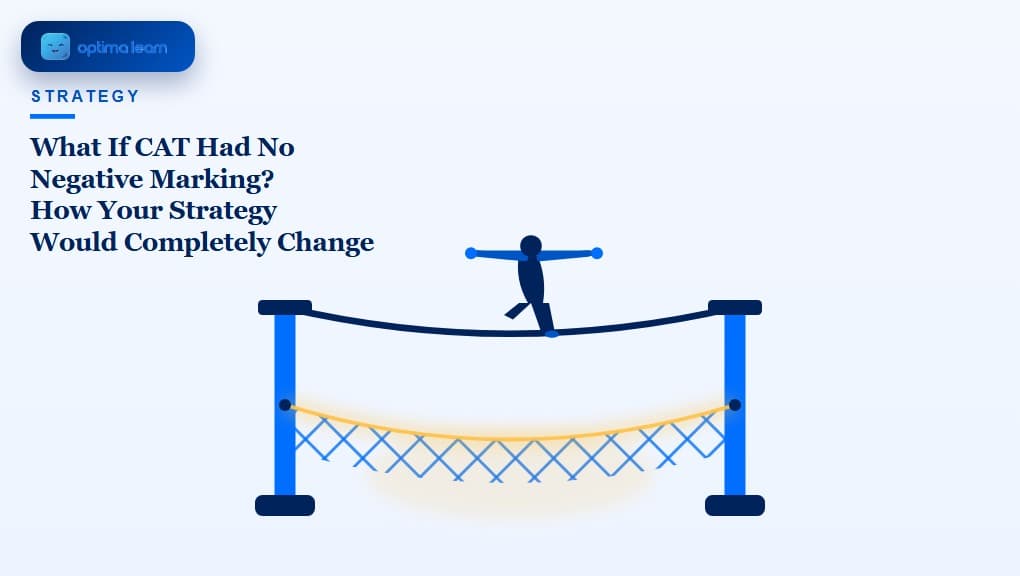
Picture the moment. Two options left, both plausible, forty seconds on the clock, and your finger is hovering over an answer you are maybe sixty percent sure about. Somewhere in the back of your mind sits a number: minus one-third. That's CAT's negative marking, and it has just talked you out of an answer you might have gotten right.
This exact freeze happens to nearly every aspirant at some point, whether it's your first mock or your fifteenth attempt at cracking the exam. What if that number disappeared tomorrow? Not because CAT is actually changing its rules (it isn't), but because running the thought experiment tells you something uncomfortable about how you're guessing right now.
- CAT's real marking scheme deducts one-third of a mark for a wrong MCQ answer, zero for a wrong TITA answer, and zero for anything left blank.
- A blind, four-option guess breaks even at exactly 25% accuracy, the same as random chance, under the current one-third penalty.
- Eliminate even one of four options and a guess's expected value turns positive, since your odds jump to 33%, above the 25% break-even line.
- Without negative marking, question selection, time allocation, and risk tolerance would all shift, but preparation itself would matter just as much.
- Most aspirants already under-guess today because they misjudge where the real break-even point sits, not because guessing itself is unwise.
This applies whether you are three weeks from your very first full-length mock or you have already sat through forty of them and think you have the marking scheme fully memorized. The number below is the part almost nobody actually sits down and works out on paper, first-timer or veteran.
The Break-Even Guess Model: The Math Behind Every Guess You Make
Start with what CAT's marking scheme actually does today, no hypothetical involved. A wrong answer on a multiple-choice question costs one-third of that question's allotted marks. A wrong answer on a TITA (type-in-the-answer) question costs nothing at all, exactly the same as leaving it blank. An unattempted question, MCQ or TITA, also costs nothing. These three facts, not a vague dread of "negative marking," are what should govern every guess you make in the actual exam.
This design is not arbitrary. A one-third penalty on MCQs discourages careless, information-free guessing across a large answer bank, while TITA's zero penalty makes sense given there is no way to "blindly guess" a typed numerical answer the way you can blindly pick option C. The rules are calibrated to the format, not applied as a blanket punishment.
Run the algebra on a standard four-option MCQ. Call the probability of a correct guess "p." A right answer earns one full mark, and a wrong one costs one-third of a mark, an expected loss of (1 minus p) times one-third. Set expected gain equal to expected loss, and you get p equals (1 minus p) divided by three. Solve that, and p lands at exactly 25%, the same odds as randomly picking one of four boxes with zero information about any of them.
Take a real 3-mark MCQ question. Guess blind across four such questions with no elimination at all, and probability says you get one right and three wrong, on average, across enough repetitions. That one right answer earns 3 marks. The three wrong answers cost 1 mark each, exactly 3 marks total. The two numbers cancel, which is exactly what "break-even" means in practice, not in theory.
The Break-Even Guess Model
- 0 options eliminated (a blind guess): 25% chance of being correct. Expected value is exactly zero, the true break-even point under CAT's current one-third penalty.
- 1 option eliminated: your odds rise to 33%, comfortably above the 25% break-even line. Expected value turns positive.
- 2 options eliminated: your odds rise to 50%. Expected value is strongly positive, a genuinely good bet by any honest accounting.
Notice what that 25% line actually means in practice. It is not a warning to avoid guessing. It is a threshold: below it, guessing costs you marks over time, and above it, guessing earns you marks over time. A fully blind guess sits right on that line, doing neither. The moment you can honestly rule out even one option, you are no longer on that line, you are above it.
TITA questions do not have a break-even point in the same sense, because there is no penalty to weigh against the potential gain. Any TITA answer you can produce, even a rough estimate, carries zero downside next to a blank. The 25% line matters only for the four-option MCQ, where a wrong pick actually costs you something.
There is a reason this number feels scarier than it actually is. Loss aversion, a well-documented pattern in how people weigh risk, means a one-third mark penalty registers more sharply in the moment than the marks you quietly forfeit by staying silent. The break-even math exists precisely to correct for that instinct, not to confirm it.
If you want to see how a shift like this would actually move your own score rather than a theoretical one, a CAT score predictor lets you model your real accuracy rate against exactly this kind of scenario. And if "evaluate before you commit" sounds familiar, it should. The CAT Quant Decision Tree applies the same before-you-calculate logic to choosing a solving method, not just to deciding whether to guess.
What Changes Without Negative Marking
Now the actual thought experiment. Strip the one-third penalty out of the exam entirely and watch what moves. Four things shift almost immediately: how often you guess, how you allocate time across a section, the order you choose to attempt questions in, and how much risk you are willing to carry into a single sitting.
| Decision | Under Current Negative Marking | Under the No-Penalty Hypothetical |
|---|---|---|
| Guessing behavior | Guess only once you have eliminated at least one option; a blind guess is break-even at best | Guess on every remaining question, blind or not, since a wrong answer costs nothing |
| Time allocation | Bank a few seconds for verification, since a careless slip carries a real cost beyond the marks lost | Push spare time toward fresh attempts; a rushed wrong answer costs no more than skipping it |
| Question selection order | Attempt high-confidence questions first, save uncertain ones for a calculated pass near the end | Attempt in whatever order maximizes total attempts; confidence matters far less to the sequence |
| Risk tolerance | Calibrated caution; every attempt is weighed against a genuine downside | Near-zero caution; the only real cost of an attempt is the seconds it takes |
Look closely at that table and one thing stands out. Under the hypothetical, the exam stops being a series of individually weighed bets and becomes closer to a straightforward attempts-maximizing race. That is a real difference in what "risk" even means inside the exam room, not just a difference in how many questions you fill in.
Think about what this does to a stuck question with 90 seconds left in the section. Under the current rules, you weigh finishing it against the marks a careless slip might cost elsewhere, so many aspirants deliberately bank a few seconds for one last magnitude check before submitting. Remove the penalty, and that banked time has nowhere better to go than one more fresh attempt, since a wrong final answer costs exactly as much as no answer at all.
This is really a question about risk itself, not just marking rules. Risk, in the formal sense, is the combination of how likely a bad outcome is and how much it costs you if it happens. Negative marking raises the cost side of that equation for MCQs specifically. Take the cost away, and the only variable left is likelihood, which is exactly why the hypothetical exam rewards raw attempts so much more heavily.
That same "evaluate before you commit" instinct already applies to a decision you make constantly under the current rules: which DILR set to even attempt. Our piece on choosing the right DILR sets before solving them walks through sizing up a set's solvability in the first 30 seconds, the same window you would use here to judge whether a question is worth a calculated guess.
None of this changes what preparation actually requires. Even in the hypothetical, you would still need real accuracy on real topics, since attempting a question you cannot solve at all earns you nothing whether or not a penalty exists. What changes is the margin for error on questions you are close to solving, not the value of knowing the material.
Notice, too, what stays constant in both columns of that table: total prep time and topic mastery. What moves is entirely about in-exam decision-making, section by section, question by question, which is exactly why this thought experiment is worth running even though the rule itself will not change before your exam.
Know Your Real Elimination Rate
Reading the math is one thing. Knowing whether you can actually eliminate an option in a few seconds on a real CAT question is another. Optima Learn's practice sets let you test that instinct against real previous year questions, not hypothetical ones.
Practice Real CAT PYQs NowWhat This Thought Experiment Reveals About Your Current Strategy
Running this thought experiment surfaces something uncomfortable. Most aspirants are not guessing too much under the current rules. They are guessing too little, because "negative marking" has become a blanket warning instead of a number anyone actually calculates. Ask a repeat aspirant what the break-even accuracy is, and most cannot tell you, even after a dozen mocks.
Have you ever noticed how the word "guess" feels so much riskier than the word "estimate," even though they can describe the exact same calculated bet? That gap is emotional, not mathematical, and it is costing you marks on questions where you had already done most of the real work.
Expected value is just a formal name for weighing an outcome by how likely it is before deciding if it's worth pursuing, and it applies to far more than guessing. Once you start running it on individual questions instead of trusting a gut feeling about the whole section, the 25% line stops being abstract and starts being a genuine decision rule you can apply in real time.
Picture a DILR set where you have cracked three of four questions in a group and eliminated two of four options on the last one. That is 50% odds against a 25% break-even line, a bet the math says you should take without hesitation. Skip it anyway, out of a generic fear of the penalty, and you have just walked away from marks the math said were yours to take.
The same pattern shows up in VARC. An inference-based RC question often leaves you between two close options, each defensible on a literal reading. If you can articulate even one concrete reason the weaker option contradicts the passage, you have already crossed into positive-EV territory, whether or not you would ever describe what you just did as "guessing."
This gap shows up differently depending on where you are in your prep. A first-time aspirant usually has not thought about the math at all, so the fear is generic and untested. A repeat aspirant has often built a rigid personal rule, such as "never guess," precisely because one bad mock felt like proof, without checking whether that single result actually reflected the odds.
The Mistake This Hypothetical Exposes
The mistake here is not reckless guessing. It is the opposite: a generation of prep advice that says "never guess on CAT" as though every guess were blind. That advice probably came from a good place once, protecting aspirants from wild, uninformed shots in the dark, but it flattens a real distinction that the break-even math draws clearly.
A 25%-odds blind stab and a 50%-odds elimination call are not the same decision, even though both technically count as "guessing" the answer. Treating them identically, and avoiding both with equal caution, costs disciplined, well-prepared aspirants marks they had already earned through the work of elimination.
The hard part is not the math, it is being honest about what you actually eliminated. "I have a feeling it's not A" is not the same as "A gives a negative value, which is impossible here." Only the second kind of reasoning should count toward your elimination total, since the first is just confidence wearing the costume of logic.
Working through CAT Quant previous year questions makes this concrete fast. You will find plenty of four-option questions where you can rule out one option on units or sign alone, one more on a rough magnitude check, and the guess that remains is nothing like the blind stab the "never guess" rule was written to prevent.
This mistake tends to hit calm, disciplined aspirants hardest, ironically. The anxious over-guesser who fills in everything regardless of odds is rare. Far more common is the careful aspirant who has trained themselves so thoroughly to respect the penalty that they now skip positive-EV questions out of sheer habit, long after the caution stopped being useful.
Aspirants who come through our mock review sessions often describe the same regret: they knew, in the moment, that they had ruled out two options, and skipped the question anyway because the word "guess" felt like it violated the discipline they had built. That is not discipline. That is a rule applied past the point where it was ever protecting them.
None of this argues for guessing on everything. A truly blind four-option guess is still, at best, a wash, and doing it forty times across a section will not move your score in expectation. The overcorrection to "guess whenever unsure" is just as wrong as "never guess." The line is elimination, not confidence.
How to Use This Thinking Without Waiting for Rule Changes
You do not need CAT to change a single rule to use any of this. Under the actual, current marking scheme, the only shift required is a habit: before you skip a question you have partially worked through, ask how many options you can honestly eliminate, not whether guessing is allowed in principle.
Start logging this in your next mock. Every time you leave a question blank, write down how many options you had actually ruled out before you gave up on it. After three or four mocks, a pattern usually appears: most aspirants find several questions where they had crossed off two options and still chose silence over a 50% bet.
Building a habit like this into your revision routine, rather than trying to remember it cold under exam pressure, is exactly the kind of detail a personalized CAT study plan should account for, alongside your topic-wise accuracy and section timing.
Do this across five or six mocks, not just one, and a truly useful number emerges: your own personal accuracy rate once you have eliminated exactly one option, versus exactly two. Most aspirants have never measured this about themselves, even after months of practice, which is a strange gap given how much the number actually controls.
If this is your first real attempt at CAT, build the habit early, before "never guess" calcifies into an instinct you will have to unlearn later. If you are on your fourth or fifth attempt, the habit is arguably more urgent, since you have more mocks' worth of data sitting unused, right now, to calibrate against.
Here is the insight worth keeping: negative marking was never really the enemy, vague guessing was. The practical action is simple: count your eliminated options before you decide, starting with your very next mock, first attempt or fiftieth. The mindset shift is harder. Stop treating every uncertain question as a test of discipline, and start treating it as a small, calculable bet you are allowed to take when the odds actually favor you.
Calibrate Your Real Guessing Accuracy
The break-even math only helps once you know your own elimination accuracy, not a theoretical one. Work through real CAT questions under timed conditions and find out exactly how reliable your "informed guesses" actually are.
Start Practicing CAT QuestionsFrequently Asked Questions
Does CAT have negative marking for every question type?
No. CAT deducts marks only for wrong answers on multiple-choice questions, typically one-third of the marks allotted. TITA (type-in-the-answer) questions carry no negative marking, so a wrong TITA answer costs the same as leaving it blank.
What is the mathematical break-even point for guessing on a CAT MCQ?
With four options and a one-third negative mark for a wrong answer, a blind guess is break-even at 25% accuracy, exactly matching random chance. The moment you can eliminate even one option, the odds shift in favor of guessing.
Would removing negative marking really change how toppers prepare?
It would change in-exam decisions more than preparation itself. Question selection, time allocation, and willingness to attempt uncertain questions would all shift, since the downside of a wrong answer would disappear.
Should I guess more on CAT questions given the current negative marking rules?
Only after eliminating at least one option. An uninformed blind guess is break-even at best, but an elimination-adjusted guess, where you have ruled out one or two options, usually has positive expected value even under the current penalty.
Build your CAT 2026 study plan
Personalised daily plan that adapts to your section-wise mock scores.
More from Strategy
Continue reading
Why CAT RC Answer Options Often Feel Equally Correct

How To Study For CAT When You Are Mentally Exhausted
How To Stop Procrastinating On Your Weakest Section
How To Recover From A Wrong Start On A DILR Set Explained
Put it into practice