
The Transfer Principle: How Solving One CAT Question Can Prepare You for Ten More
Solving forty CAT questions in one sitting can teach you less than solving four deeply, because a shallow pass never resolves why a method works, only that it did. The Transfer Principle explains this: real transfer comes from carving one question properly, not from stacking practice volume.
Three weeks ago, you solved a mixture problem in under ninety seconds and moved on without a second thought. Today, a class-average question sits in front of you looking nothing like it, no rice, no cost per kilogram, just students and marks. You stare at it for forty seconds before something clicks: this is the same question. You solved it before. You just didn't recognize it wearing a different coat.
That gap, between solving a question and recognizing it later in a different costume, is the entire subject of this piece. Most CAT preparation advice treats practice volume as the goal: more PYQs, more mocks, more hours logged. Almost none of it asks whether what you solved yesterday actually transferred to what you're solving today.
This blog already has two companion pieces explaining why CAT repeats itself at all, why the exam keeps recycling a narrow set of ideas under new numbers and new wording. This piece starts from a different place: not why CAT repeats itself, but what you personally need to do while studying so that repetition actually works in your favor.
- Solving more CAT questions doesn't automatically mean learning more; a shallow pass through many questions transfers less than a deep pass through few.
- The Woodblock Principle names three linked ideas: the Carving, the deep first pass; the Ink, recognizing the same pattern under a new coat; and the Print, the fast solve that follows.
- CAT repeats a narrow set of underlying ideas across hundreds of differently worded questions, which is exactly why depth on one question transfers to many.
- If a "print" takes as long as the original carving did, the question was never actually finished the first time.
- Depth is checkable: try re-deriving a solved question's method after a break, without looking at your original working.
This piece is for anyone who already has a stack of solved PYQs behind them but still feels shaky when a familiar idea shows up wearing new numbers. It assumes you've been putting in the hours. The question it asks is narrower and more useful: are those hours actually compounding, or are you solving the same handful of ideas over and over without noticing?
Why Does Solving More CAT Questions Not Always Raise Your Score?
Volume alone rarely moves a CAT percentile, because your brain doesn't grade practice by how many questions you touched, it grades by how deeply each one got resolved. An aspirant who carves ten questions properly will out-transfer someone who raced through fifty questions at a shallow level of understanding.
Most aspirants track preparation the way they'd track a step count: a running tally of PYQs solved, mocks attempted, hours logged. The tally feels honest because it's measurable, and measurable things feel like progress. But a tally counts completions, not comprehension, and a question you rushed through still adds one to the total even if nothing about it actually stuck.
This is exactly why depth on a smaller stack of previous year questions beats a shallow pass through a much larger one. Set aside an hour to practice CAT previous year questions the deep way: resolving ten of them until you can explain the reasoning out loud builds more transfer than clicking through fifty and filing each one away unexamined, because transfer depends on resolution, not on the number of times you hit submit.
Have you ever finished a study session feeling productive purely because the tally went up, without being able to say what specifically you now understand better than you did that morning?
The Woodblock Principle: What Actually Transfers From One Carved Question
Real transfer follows a specific mechanism, not a vague sense of "getting better": a question studied deeply enough gets carved into a reusable pattern, and every differently worded version of that same idea afterward becomes a fast, near-effortless print. The Woodblock Principle names this mechanism directly, in three linked parts.
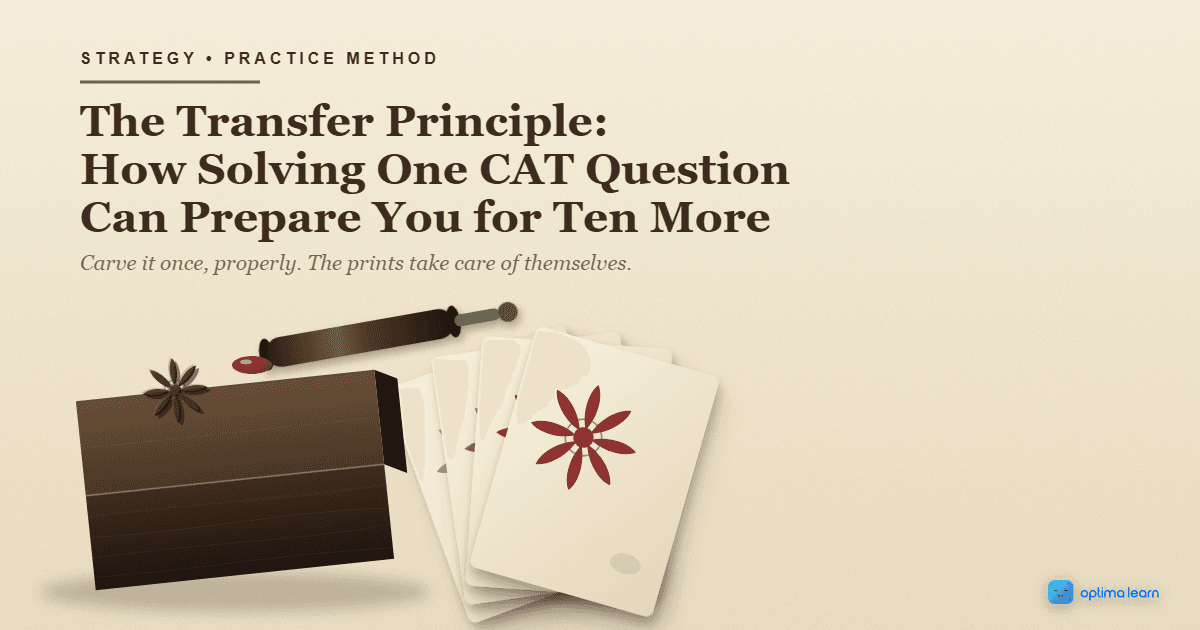
Think of a printmaker who spends an afternoon gouging a single wooden block, line by line, until the carving is exact. Once that block is finished, every print it produces afterward takes seconds, not hours, and looks identical to the one before it.
The Woodblock Principle
Carve it once, properly. The prints take care of themselves.
- The Carving: the deep, slow first pass where you actually resolve why a question's method works, not just that it works. This is the only part that legitimately takes real time.
- The Ink: recognizing the same carved pattern under a new coat: a differently worded, differently numbered question that is structurally the same carve underneath.
- The Print: the fast, almost effortless solve that follows once the block is truly carved. If a "print" takes as long as the original carving did, the block was never actually finished.
Notice the shape of that middle part, the Ink. This goes beyond memorizing that a class-average question and a mixture question are "similar" in some abstract sense; it means seeing that they are the identical carve wearing two different coats of paint, down to the arithmetic.
How Does CAT Disguise the Same Idea Across Hundreds of Questions?
CAT doesn't invent a new idea for every question; it recycles a narrow set of underlying concepts and dresses each one in new numbers, new context, and new wording. That's why a question about mixing rice and a question about class averages can be, underneath, the exact same carve.
Two companion pieces on this blog explore exactly why this happens, from the exam's own side rather than the student's. The Hidden Architecture of CAT Quant shows how hundreds of quant questions are built from the same handful of ideas, and The Compression Principle explains why CAT keeps repeating those same ideas in different disguises year after year. Both are worth reading in full if you want the exam-design half of this argument.
This piece assumes both of those are true and asks the question they don't: given that CAT repeats itself, what does your own studying need to look like for that repetition to actually help you? Knowing the exam repeats ideas is only useful if your practice habit is built to catch the repetition when it shows up, three weeks later, wearing a different coat.
Carving a Question Properly: A Worked Example From CAT Quant
Carving a question properly means resolving why its method works, not just confirming that your answer matched the key. Take a mixture problem solved through alligation: the carve is understanding that the ratio comes from balancing distances from a mean, not the ratio itself, a structure that resurfaces in problems that look nothing like mixtures.
Question A: a trader mixes rice costing Rs 40 per kg with rice costing Rs 60 per kg to get a blend that costs Rs 52 per kg. In what ratio does he mix them? By alligation, the ratio of the cheaper to the dearer variety equals (dearer minus mean) to (mean minus cheaper): (60 minus 52) to (52 minus 40), which is 8 to 12, or 2 to 3. The cheaper rice and the dearer rice combine in a 2:3 ratio.
The why matters more than the ratio itself: alligation works because the mean is a weighted balance point, and the distance of each price from that balance point tells you exactly how much weight sits on the other side, the same way a seesaw balances a heavier person closer to the pivot. Once you see that, the specific numbers stop mattering.
Question B, three weeks later, in a different mock: a class has boys averaging 40 marks and girls averaging 60 marks, and the overall class average is 52. Find the ratio of boys to girls. There's no rice, no cost per kilogram, nothing that looks related. But the structure is identical: (60 minus 52) to (52 minus 40), which is 8 to 12, or 2 to 3. Boys to girls, 2:3, the exact same carve, printed in a new coat.
For more structured Quant practice organized by underlying idea rather than chapter label, the CAT Quant practice section groups previous year questions the same way this framework does.
| Moment | Panic Move | Pro Move |
|---|---|---|
| You solve the mixture question in ninety seconds | Move to the next question immediately and mentally file it as done | Spend one more minute asking why the alligation ratio worked, not just that it did |
| A later question about class averages looks unfamiliar | Start over from scratch, re-deriving the relationship between averages and headcounts | Recognize the same weighted-average carve under new labels and reapply the same setup |
| The "print" takes over two minutes to solve | Assume you are just having a slow day | Treat the slow print as a signal that the block was not fully carved the first time |
| You have solved forty PYQs this week | Feel confident because the count is high | Check how many of the forty you could re-derive without looking at your notes |
Turn One Question Into Ten Solved Ones
Stop measuring prep by how many PYQs you clicked through. Spend real time carving fewer questions properly, and let the transfer do the rest.
Explore the CAT Question BankThe Bottom Line: Are You Carving Questions or Just Collecting Prints?
The real measure of a good practice session has little to do with how many questions got touched, and everything to do with how many of them you could still solve, unaided, a week later. If a question doesn't survive that test, it wasn't carved, and it will not transfer when CAT hands you the same idea in a new coat.
The Woodblock Principle, Recapped
Carve it once, properly. The prints take care of themselves.
- The Carving: resolve why the method works, not just that it does.
- The Ink: recognize the same carve under a new coat.
- The Print: the fast solve that follows once the carve is real.
Somewhere in the next month, a question is going to show up wearing a coat you don't recognize at first glance. Whether you solve it fast or start from zero again was decided earlier, not in that moment, but in how deeply you carved the version of it you already solved.
Carve Fewer, Transfer More
Stop chasing a bigger number of questions solved. Start carving fewer of them properly, and let each one transfer to the ten that resemble it later.
Practice CAT PYQsFrequently Asked Questions
Does solving more CAT questions always improve my score?
Only if each question is fully carved before you move to the next one. Racing through ten questions at a shallow level of understanding transfers less than deeply resolving one question and recognizing its underlying method, since CAT repeats reasoning patterns far more than it repeats specific numbers or wording.
How do I know if I've actually understood a question or just remembered the answer?
Cover the solution and try to re-derive the method from scratch after a break, not immediately after seeing it. If you can only recall the final number but not reconstruct why each step followed from the last, the question was memorized, not carved, and it will not transfer to a differently worded version.
How many previous year questions should I revisit using this approach?
Depth matters more than volume here. Ten previous year questions studied until you can explain the reasoning to someone else transfer further than fifty questions solved once and filed away, though both practices matter at different stages of preparation.
Does the Transfer Principle work the same way in Quant, VARC, and DILR?
The underlying idea holds across all three sections, though the carve looks different each time: in Quant it is a solving method, in DILR it is a way of structuring constraints, in VARC it is a way of reading for the author's actual claim rather than surface detail.
Build your CAT 2026 study plan
Personalised daily plan that adapts to your section-wise mock scores.
More from Strategy
Continue reading
Why Word Problems Feel Harder in CAT Quant Than School

Why High Scorers Skip an Entire CAT RC Passage Fully

Why DILR Sets Take Longer to Understand Than Solve

Do Mocks in a Noisy Environment Help or Hurt CAT Prep?
Put it into practice