
The Most Ignored Clues Hidden Inside CAT Quant Questions
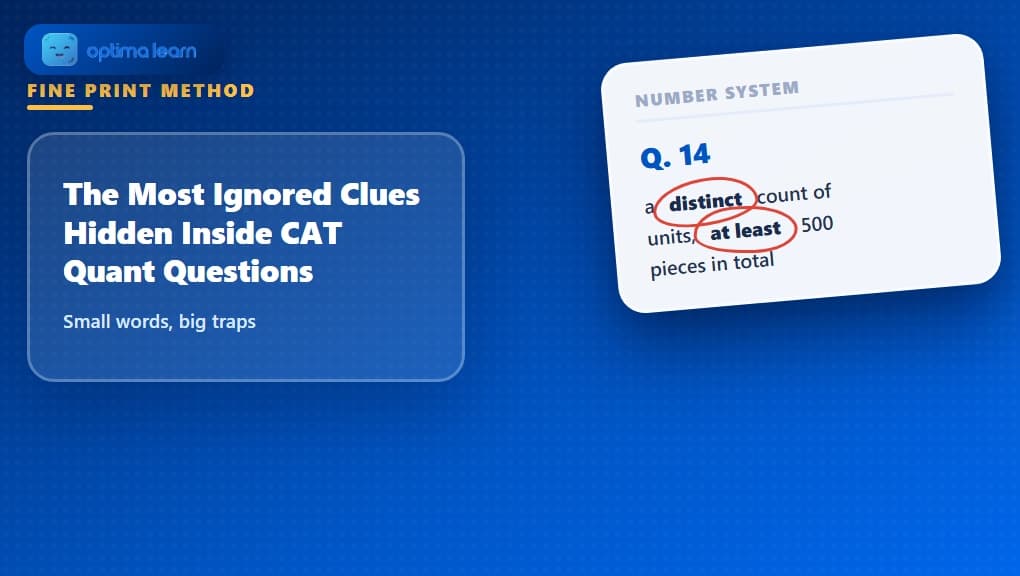
You solve the question in ninety seconds. The method is right, the arithmetic is clean, and you move on feeling good about it. Then the answer key disagrees with you. The algebra was never the issue; you simply never noticed the question asked for distinct values.
This is the strange, quiet way CAT quant questions punish smart solvers: they hide a constraint in the question wording you read too fast to catch, then charge you a mark for missing it. Every year, a set of otherwise easy quant questions costs percentile, and the concept is rarely the unfamiliar part. One small word just never got read for what it meant.
- The Fine Print Method treats words like distinct, at least, at most, positive integer, and stated units as constraints, not decoration.
- Skipping past a single constraint word is one of the most common reasons a technically correct method still lands on the wrong final answer.
- Distinct and positive integer change which values even count as valid answers, often shrinking a solution set dramatically.
- At least and at most decide whether a boundary value is included or excluded, and mixing them up flips your entire range.
- Reading for constraint words has to happen on the first read of a question, not while you are checking your final answer.
The stakes are highest for aspirants who already know the concept cold and still lose marks to something that has nothing to do with the math itself. If your formulas are solid but your quant accuracy still dips on questions that looked simple, more practice is rarely the fix. Reading the question itself more carefully, before you touch a single number, usually is.
The pattern repeats often enough that it is worth checking directly. Work through a stretch of CAT quant previous year questions and count how many you would have answered differently on a first careless read versus a second, slower one.
Why Does One Small Word Turn a Correct Method Into a Wrong Answer?
A single constraint word can turn a perfectly executed method into a wrong answer, because it silently redefines which values the question is even asking about. What CAT quant tests is whether you read closely enough to apply the right formula to the right set of numbers, not whether you know the formula at all.
Take a question built around five ordinary words: distinct, positive integers, at least, at most, and a stated unit. Read it at a normal pace, and it feels like a routine algebra problem. Skip past even one of those five words, and you are solving a different question than the one printed on the page.
If x and y are distinct positive integers such that x + y is at least 15 and at most 20, and the shop sells the item at Rs. 40 per unit, find the maximum possible value of xy.
The per-unit price is exactly the kind of detail the unit check exists for: the question asks only for the maximum value of xy, a plain number, not a rupee amount, so the price never enters this calculation at all. Confirm that, then turn to the sum condition. The question asks for distinct positive integers, not just any positive integers, with a sum falling somewhere between 15 and 20, inclusive on both ends.
Since a product is maximized by taking the largest allowed sum and splitting it as evenly as possible, the answer will come from sum = 20. Miss "distinct," and the fastest path to a maximum product is x = y = 10, giving 100.
Respect "distinct," and 10 and 10 is no longer a valid pair, since the two values cannot be equal. The closest split of a sum of 20 that keeps x and y different is 9 and 11, giving a maximum product of 99, a single integer away from the answer a careless first read produces, and enough to cost you the full mark in a question format with no partial credit.
This is not a hard question. It never was. Have you ever noticed how confident you feel right before an answer key proves you wrong on something like this? The habit that gets punished here is reading for the numbers and skimming past the words that decide which numbers are even allowed to compete for the answer.
What Is the Fine Print Method for Catching CAT Quant Clues?
The Fine Print Method is a short, five-word checklist read before you solve, not after: distinct, at least, at most, positive integer, and units. Each word is a constraint hiding in plain sight, and the method's entire job is making sure you notice it on the first read, not the second.
The Fine Print Method
The question already told you the constraint. Most aspirants just didn't read for it. Before you solve, scan the question once for these five words and flag what each one is quietly ruling out.
- Distinct: the values cannot repeat. Equal-value answers, however convenient, are no longer valid.
- At least: the boundary value is included, not excluded. "At least 5" means 5 counts.
- At most: the upper boundary is included too. "At most 12" means 12 counts, not just values below it.
- Positive integer: whole numbers starting from 1. Zero, negatives, and fractions are automatically out.
- Units: a number without its stated unit is not an answer yet. Mismatched units silently create a different question.
None of these five ideas is difficult on its own. Every CAT aspirant already knows what "distinct" means and what a positive integer is. The method exists because knowing a word's meaning and actually reading for it under exam pressure are two separate skills, and only one of them shows up automatically.
It is entirely possible to solve a question by sound logic and still be marked wrong, because the setter's logic was narrower than yours. That gap is exactly what the next two words control.
Practice Spotting the Fine Print
Reading about the Fine Print Method is one thing. Catching these five words in a live question, under a two-minute clock, is what moves your accuracy.
practice topic-wise CAT PYQsDistinct and Positive Integer: The Two Words That Shrink Your Answer Set
Distinct and positive integer are the two words most likely to shrink a solution set without you noticing, because each one quietly removes an entire category of otherwise valid values. Together, they can cut a solution set by half or more, and most of that cutting happens invisibly if you don't read for it.
Consider a simple case: how many ordered pairs of positive integers (x, y) satisfy x + y = 10? Every value of x from 1 to 9 gives a valid y, so there are nine such pairs. Now add one word: distinct. The pair (5, 5) is the only one where x equals y, and "distinct" removes exactly that pair, leaving eight.
| Wording | Valid Pairs Where x + y = 10 | Count |
|---|---|---|
| Positive integers | (1,9), (2,8), (3,7), (4,6), (5,5), (6,4), (7,3), (8,2), (9,1) | 9 |
| Distinct positive integers | Same list, minus (5,5) | 8 |
One word, one pair removed here, and do not mistake that for a small effect. Stack "distinct" across three variables instead of two, or pair it with another constraint in the same question, and an entire cluster of valid-looking combinations can vanish at once, every one of them a wrong answer waiting to be chosen with full confidence.
Positive integer is the quieter of the two words, but it works the same way: beyond naming the kind of number you are looking for, it actively disqualifies zero, negative values, and non-integers, all of which can look like reasonable trial values if you are solving quickly and not reading closely.
This specific habit is easy to underestimate until you measure it across a full mock, not just in isolated practice questions. Run your last attempt through a CAT score calculator and see how many marks came from questions where the method was right but a constraint word wasn't.
At Least vs At Most: The Boundary Words That Flip Your Range
At least and at most decide whether a boundary value is included or excluded, and mixing up the two flips your entire counting range. "At least 5" includes 5 itself. "More than 5" does not, and that single difference changes how many valid values exist.
This distinction matters most in counting questions, where the whole answer is a count of how many integers satisfy a condition. Miscount the boundary by one, and your final answer is off by exactly one value, in a question type where TITA answers get no partial credit for being close.
| Phrase | Meaning | Boundary Included? |
|---|---|---|
| At least n | x is greater than or equal to n | Yes |
| More than n | x is strictly greater than n | No |
| At most n | x is less than or equal to n | Yes |
| Less than n | x is strictly less than n | No |
Aspirants who mix these up rarely do it out of ignorance. It happens because "at least 15" and "more than 15" sound close enough in a fast read that the brain fills in whichever version it saw more recently in practice, not the one printed in front of it.
A wrong-by-one answer on a counting question is rarely a careless arithmetic slip. More often, it traces back to a boundary word read too quickly to register which side of the line it drew.
Where Do Units Quietly Wreck an Otherwise Correct Calculation?
A unit mismatch wrecks a calculation when the question states one unit and expects an answer in another, because a mathematically correct number in the wrong unit still scores zero. Speed problems mixing hours and minutes, and Data Interpretation sets with an unread footnote, are the two most common places this happens.
Picture a question giving a train's speed in kilometers per hour but asking how many minutes it takes to cross a platform. The calculation can be entirely correct and still produce a wrong final number if the answer stays in hours instead of converting to minutes at the last step.
Data Interpretation carries its own version of this problem, usually in a single line that is easy to skip: "figures in lakhs unless otherwise stated," or an axis label in thousands that never gets rechecked once you start reading the bars or the table. Skip that line, and an entire caselet's scale is wrong before you answer a single question.
Building a habit like this does not happen inside a single study session. It needs to sit inside a routine you follow, which is exactly what a CAT study planner is for: scheduling this kind of deliberate, slow-reading practice alongside your regular topic revision.
None of this means slowing down your overall solving speed. It means spending one extra second on the sentence before you spend two minutes on the numbers, since that one second is what decides whether the two minutes were spent on the right question at all.
At its core, the Fine Print Method treats a CAT quant question as a contract: every word in it, not just the numbers, is a term you agreed to the moment you started solving.
Starting tomorrow, read every quant question once for the numbers and once for these five words before you write anything down. It adds seconds, not minutes, and it is the cheapest accuracy gain available to anyone who already knows the concepts.
The aspirants who gain the most from this are rarely the ones struggling with the math. They are the ones who are strong enough at the math to have stopped reading the question as carefully as they once did. Fine print doesn't punish weak concepts. It punishes confidence that stopped double-checking itself.
Turn This Into a Weekly Habit
The fastest way to make the Fine Print Method automatic is to practice it on real exam-style questions, not simplified textbook ones.
start solving topic-wise CAT PYQsFrequently Asked Questions
What kind of clues do CAT quant questions hide in their wording?
Words like distinct, at least, at most, positive integer, and specified units are constraints, not decoration. Skipping past them is one of the most common reasons a technically correct method still produces the wrong final answer.
Why do these small words matter so much on a quant question?
Because they silently change which values are even valid answers. A question asking for distinct positive integers has a completely different, usually smaller, solution set than one asking for positive integers, and solving the wrong version wastes the full two minutes on a technically right method.
How can I train myself to catch these clues faster?
Underline or mentally flag every constraint word the first time you read a question, before you start solving, rather than while you check your answer. Making this a fixed first step, not an afterthought, is what turns it into a habit under exam pressure.
Does this fine print problem show up in Data Interpretation too?
Yes, frequently in the form of footnotes, axis units, or a single qualifying line like figures in lakhs unless stated otherwise, which aspirants under time pressure often skip entirely and then misread an entire caselet's scale.
Practice these Quant concepts, chapter by chapter
Thousands of CAT Quant practice questions by chapter and difficulty, each with a worked solution.
More from Quant
Continue reading

Why CAT RC Answer Options Often Feel Equally Correct

How To Study For CAT When You Are Mentally Exhausted

How To Stop Procrastinating On Your Weakest Section

How To Recover From A Wrong Start On A DILR Set Explained
Put it into practice