
The First Five Minutes of Every CAT DILR Set Decide Whether You'll Solve It or Skip It
On This Page
Two aspirants open the same CAT DILR set in the same mock. One picks up the pen within ten seconds and starts filling in a grid. The other spends five minutes just reading, writing nothing at all. On the results page, the second aspirant scores higher, not because they know more, but because they know whether the set is worth attempting before committing to it.
That five-minute pause before the first number goes into any CAT DILR set is not procrastination. It is the single decision point where accuracy, time, and confidence for the rest of the section actually get decided.
- The first five minutes before you write anything decide whether a CAT DILR set is worth solving, more than any skill you apply once you start.
- Run four checks, in any order, before committing a number to the grid: variable count, whether the information is fixed or conditional, how many questions a partial grid can answer, and whether the structure is symmetric or scattered.
- Delay or skip a set once it crosses five interacting variables with no fixed anchor, or when every question needs the full grid solved before you can answer even one.
- Attempt sets first where a partial grid can already answer two or more questions, since these convert effort into marks the fastest.
- Running this check across all four sets in the section's first few minutes protects the other twenty-five from being spent recovering instead of solving.
Why Do Most CAT DILR Mistakes Start Before You Write Anything?
Most DILR errors are decided before the first entry goes into the grid, not during the solving itself. An aspirant sees a table of numbers, assumes it looks familiar, and starts writing, only to discover midway that a key condition is buried in the third line of the caselet. The set is never impossible. It is misread from the start.
Take a typical distribution puzzle: eight items split across four categories, with three or four clues linking them. Read it in ten seconds and it looks like any other grid problem. Read it against the four checks below, and you notice within moments whether those eight items interact through fixed counts or through clues that only narrow possibilities gradually.
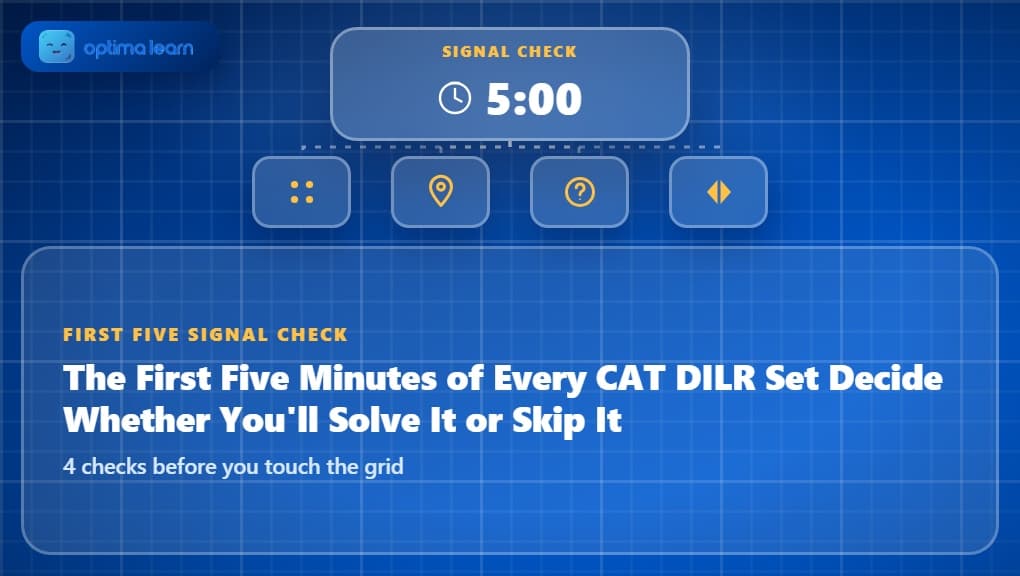
Read differently, not slower: a fixed set of checks, run before your pen decides anything for you. That's the entire logic behind The First Five Signal Check: four quick reads before you commit a single number to the grid, run in whatever order the set invites, not a sequence you follow start to finish.
Have you noticed how the sets you eventually abandon are rarely the ones you couldn't solve? They're usually the ones you should never have opened first. A DILR section rewards sets finished cleanly far more than sets started everywhere and finished nowhere.
What Is the First Five Signal Check?
The First Five Signal Check is four independent reads, not four sequential steps, that decide whether a DILR set deserves your next fifteen minutes: how many variables it involves, whether its information is fixed or conditional, how many questions you could answer without a full grid, and whether its structure is symmetric or scattered.
Run these four in whichever order the set invites, not necessarily the order listed here. A dense caselet might reveal its variable count first. A seating arrangement might reveal its symmetry first. What matters is that all four get checked before a single value goes into the grid, not that you check them in sequence.
None of these four checks outranks the others, and none has to come first. A set can pass the variable-count check easily and still fail badly on symmetry, which is exactly why checking only one or two of the four gives you a false sense of security.
This triage instinct isn't unique to DILR. Aspirants who scan CAT Quant previous year questions before committing to a method build a similar habit, reading the shape of a problem before choosing how to attack it, and DILR rewards that same patience even more.
The First Five Signal Check at a glance:
| Check | What You're Actually Reading | Proceed If | Delay or Skip If |
|---|---|---|---|
| Variable Count | How many people, items, categories, or dimensions the set involves | Five or fewer interacting variables, or one clear anchor point | More than five variables with no fixed anchor to build from |
| Fixed vs. Conditional Info | Whether the data is stated directly or buried in if-then clues needing deduction | At least some fixed, stated values to start from | Almost everything is conditional, with no fixed starting point |
| Question Skimmability | How many questions you could answer from a partial grid, without solving the whole set | Two or more questions answerable from partial information | Every question needs the complete grid solved first |
| Structural Symmetry | Whether the arrangement is clean and evenly patterned or has scattered exceptions | A clean, symmetric structure with consistent rules | Numerous exceptions, irregular splits, or conditions that apply "sometimes" |
These four checks require no solving at all. They ask you to read with a specific question in mind for each one, a different skill from reading for comprehension, and one most aspirants have never practiced on purpose.
Practice the Signal Check on Real Sets
Reading about four checks is one thing. Running them against a genuine, timed CAT DILR set before you write a single number is what actually builds the habit.
Practice CAT DILR Sets NowHow Does This Play Out on a Real CAT DILR Set?
Frameworks are easiest to trust once you've watched them work on an actual set, not just a description of four checks in the abstract. Here's what the signal check looks like against a caselet built the way CAT typically builds this kind of set.
Picture a caselet describing seven employees split across three project teams, with performance ratings given only through comparative clues rather than a stated table. Running the signal check here takes under a minute and tells you immediately whether this is a fifteen-minute set worth attempting or a five-minute trap worth delaying.
Seven employees, three teams, and an unstated number of rating tiers already push this well past a comfortable five-variable count before a single question gets read, past the point where a clean grid comes together quickly.
None of the clues state a rating directly either. Every one compares two employees to each other, which means the entire set rests on relative positions with no fixed value to build outward from. That's the second check flashing red before the first one is even finished.
A glance at the four questions shows that three of them ask for exact rating values, the kind of question that needs the whole arrangement solved first, and only one asks a simpler either-or comparison.
The team sizes are uneven too: two, two, and three, which means there's no clean repeating pattern to lean on the way an even three-three-three split would allow.
Signal Check Applied to This Caselet
| Variable Count | High: well above 5, across 7 employees, 3 teams, and unstated rating tiers |
| Fixed vs. Conditional Info | Conditional only, no directly stated rating |
| Question Skimmability | 1 of 4 questions answerable without the full grid |
| Structural Symmetry | Uneven: team split of 2, 2, and 3 |
Verdict: Delay this set. Attempt it only after your more symmetric, fixed-anchor sets are done.
Four checks, under a minute, and the picture is already clear: high variable count, no fixed anchor, mostly grid-dependent questions, and an uneven structure. That combination describes a set to delay, not necessarily abandon, but one you shouldn't open first. Would you have known that in the first sixty seconds, or only after ten minutes of half-filled cells?
What Happens When Aspirants Skip the Signal Check?
Skipping this check risks more than one bad set: it risks the twenty-five minutes after it too, since a half-filled grid abandoned at minute twelve carries confusion and lost time into whatever set you open next. The real cost of rushing in shows up later in the section, not immediately.
There's a specific frustration that comes from exactly this mistake: watching the clock cross the ten-minute mark on a set you can't finish, knowing three more sets are still waiting, and feeling your confidence for the rest of the section drop before you've even opened the next one.
This spillover effect is what actually damages a percentile, more than any single hard set does. Many aspirants walk into DILR fine and walk out rattled, carrying that feeling straight into VARC or Quant if DILR is scheduled first, which quietly costs marks in a section that had nothing to do with the original mistake.
The pull to keep going is strongest exactly when you should stop. Three minutes into a set with no fixed anchor, most aspirants reason they've already invested effort, so they push on rather than let go. That's sunk-cost thinking, not strategy, and DILR punishes it harder than any other section, because time lost here rarely gets recovered from Quant or VARC later.
This is exactly the kind of pattern a personalized CAT study plan should track across your mocks: not just which topics you're weak in, but which sets you keep abandoning after committing to them too early.
Where Does This Fit Into Your Broader CAT DILR Time Management?
The First Five Signal Check only earns its place in your process if it changes what you do next: attempt, delay, or skip. Treated as an isolated reading habit, it's just extra effort. Treated as the opening move in a section-level plan, an order of attack across all four sets, it becomes the difference between finishing three sets cleanly and starting four sets partially.
A sample four-set ranking from one mock, built entirely from the signal check:
- Set A, attempt first: fixed data table, symmetric groups, three of four questions skimmable
- Set B, attempt second: mostly fixed data, minor conditional clues, two questions skimmable
- Set C, delay: mixed fixed and conditional data, uneven grouping, one question skimmable
- Set D, skip for now: fully conditional clues, no fixed anchor, zero questions skimmable early
Knowing your realistic ceiling on DILR also shapes how aggressively you chase a borderline set. Running your mock responses through a target percentile calculator shows whether three clean attempts already meet your target, or whether you genuinely need a fourth, partial one to get there.
There's a real mindset shift buried in all this: an unsolved set isn't always a knowledge gap; sometimes it's a set you were right to leave, and recognizing that in real time is its own skill, one most aspirants never get taught directly.
The bottom line: a DILR set isn't solved by how fast your pen moves. It's solved by how accurately you judge it before the pen moves at all. Four quick reads, no writing, decide more about your outcome than the next fifteen minutes of calculation ever will.
Practically, that means building five minutes of triage into every DILR set you practice from today, not only on test day, until running The First Five Signal Check feels as automatic as opening the caselet itself. That empty grid in the first five minutes buys back far more than it costs: it's what lets the other twenty-five minutes go toward solving instead of recovering.
Turn This Into a Repeatable Habit
The signal check only pays off once it becomes automatic, and that only happens with real sets under a real clock.
Start Timed CAT DILR PracticeFrequently Asked Questions
What should I check in the first five minutes of a CAT DILR set?
Count the variables and entities involved, check whether the information given is fixed or conditional, skim the questions to see how many you could answer without a full grid, and check whether the set has a symmetric, clean structure or a messy one with scattered exceptions. All four together tell you whether this is a solvable set within your remaining time.
How do I decide whether to attempt or skip a DILR set?
Skip or delay a set if the first five minutes reveal more than five interacting variables with no fixed anchor point, or if the questions require the full grid solved before you can answer even one of them. Attempt sets where a partial grid can already answer two or more questions.
Isn't spending five minutes just reading a waste of exam time?
No, it isn't a waste. It feels that way in the moment, but the alternative, jumping straight into filling a grid on a set you eventually abandon, wastes far more time and often damages confidence for the sets that follow. Five minutes of triage is what protects the other 25.
Does this approach work for both LR sets and DI caselets?
Yes, with minor adjustment. LR sets lean more on checking variable count and constraint type, while DI caselets lean more on checking whether the data given is enough to answer questions directly versus requiring derived calculations first, but the underlying triage instinct is the same for both.
Practice DILR sets, chapter by chapter
CAT DILR practice across LR puzzles and DI sets, each with a worked solution.
More from DILR
Continue reading

Why CAT RC Answer Options Often Feel Equally Correct

How To Study For CAT When You Are Mentally Exhausted

How To Stop Procrastinating On Your Weakest Section
How To Recover From A Wrong Start On A DILR Set Explained
Put it into practice