
Stop Solving, Start Eliminating: How CAT Rewards Smart Thinkers Over Fast Calculators
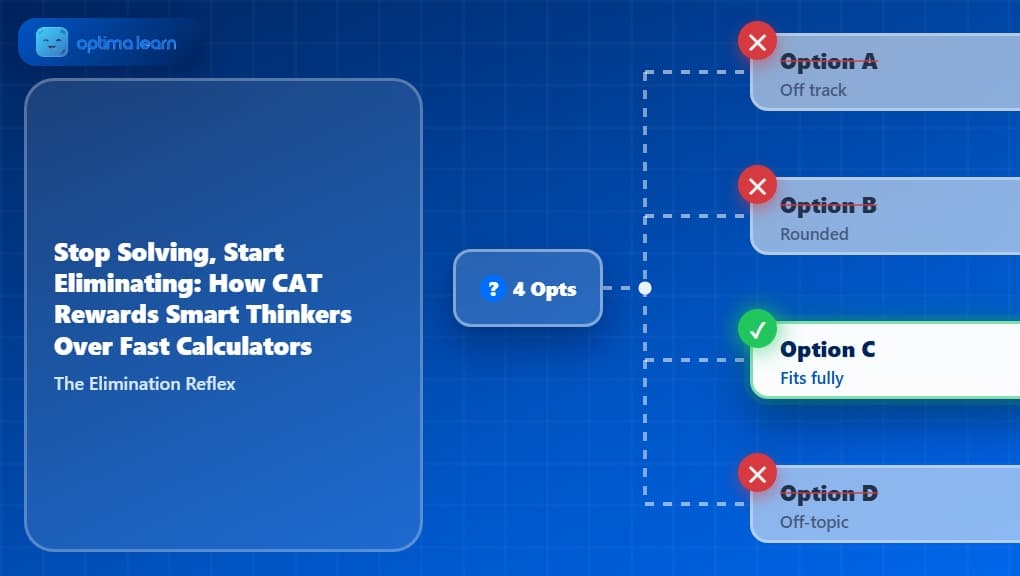
Picture a CAT quant question with four options: 210, 480, 900, and 1650. Most aspirants do exactly what years of school math trained them to do: set up the equation, solve it fully, then check the options only to confirm.
Ninety seconds later, they reach the right answer, having never actually risked picking wrong from a rough guess. That habit, chasing the exact number before trusting a fast judgment call, is one of the quietest score-killers in CAT quant strategy. CAT does not grade your working. It grades the option you filled in, in the time you had left, and elimination is simply the faster route to that same bubble.
- CAT quant scores the option you select, never the method used to reach it, so elimination counts as a legitimate strategy rather than a shortcut for weaker students.
- The Elimination Reflex asks one question before you solve anything: are the four options far apart or close together?
- When options are far apart, approximation eliminates three of four answers almost as reliably as full calculation, in a fraction of the time.
- When options sit close together, a rough estimate cannot separate them safely, and calculating precisely is the faster path overall.
- Reviewing your mocks for missed elimination opportunities builds this judgment faster than trying to notice it live under exam pressure.
This is for aspirants who solve CAT quant questions correctly in practice but still run out of time in the actual 40-minute slot, or who quietly suspect they are over-solving without knowing how to stop. If your untimed accuracy looks strong but your CAT quant speed in mocks doesn't match it, the fix is rarely more formulas. It is usually this one habit.
Why Does CAT Quant Elimination Beat Calculation?
CAT quant rewards elimination because the exam is not actually asking you to find a value. It is asking you to identify which of four already-known values is correct, and those are different tasks that happen to look identical on paper. Full calculation answers the first task. Elimination answers the second one directly, and usually faster.
Most aspirants never separate these two tasks in their head, because school math trained a different instinct for a decade before CAT ever entered the picture. Board exams and most engineering entrance tests reward shown work and exact derivation. CAT quant, scored purely on the bubble you fill or the number you type into a TITA box, does not care whether you derived the answer or ruled out three wrong ones and kept the last.
Have you noticed how confident you feel walking out of a mock where every question was fully solved, even the ones you got wrong? That confidence is about process, not accuracy. Run your recent mock responses through our CAT score calculator and check how many extra correct answers came from questions you spent under 40 seconds on versus over 90.
| What Most Aspirants Optimize For | What CAT Quant Actually Scores |
|---|---|
| A complete, defensible derivation of the exact value | Which one of four options you selected |
| The confidence that comes from full working | Correct answers, however they were reached |
| Treating every question as solve for x | Treating every question as which of these four is it |
None of this means calculation is wrong or elimination is always right. It means the two are tools for different situations, and CAT quant is built in a way that makes recognizing which situation you're in the actual skill being tested.
The Elimination Reflex: One Question Before You Solve Anything
The Elimination Reflex is a single fork you check before writing anything: are these four options far apart, or are they close enough together that a rough guess could confuse two of them? Everything else, method, time spent, and how much you calculate, follows from that one answer.
The Elimination Reflex
"When the options are far apart, you don't need the exact answer. You need the right direction."
Before any calculation, scan the four options and ask how far apart they actually are. A rule of thumb: if the largest option is at least 1.5 times the smallest, treat them as far apart. If they sit within a narrow band of each other, treat them as close together.
That single scan takes three to five seconds, and it turns into the backbone of a genuine CAT quant strategy rather than a one-off trick for one odd question. Here is what the fork looks like in practice.
A rough estimate can't reliably separate them. Do the real math.
A ballpark figure rules out three of four in seconds.
A rule this simple still takes practice to apply under real pressure, because exam-day anxiety pushes you straight back into solve-for-x mode, the same reflex school math built for years. The Elimination Reflex only becomes automatic once you have deliberately overridden that older habit often enough in low-stakes practice.
See the Elimination Reflex on Real Questions
A rule of thumb is easy to agree with and hard to apply live. The fastest way to make it automatic is to run it against CAT-style questions that actually vary in how far apart their options are.
Explore Topic-wise CAT PYQsWhen Should You Eliminate Instead of Calculate?
Eliminate instead of calculate whenever the four options are spread wide enough that an estimate lands clearly closer to one than the other three. A question asking for a percentage change, a total cost, or a distance with options like 210, 480, 900, and 1650 rarely needs an exact derivation, since a rough figure already tells you which option survives.
Worked example: a shopkeeper buys goods worth Rs. 8,400, marks them up by 25%, then sells at a further discount of 12% during a clearance sale. What is the final selling price? With options of Rs. 4,620, Rs. 6,930, Rs. 9,240, and Rs. 11,550, you do not need the exact multiplication. Roughly, 8,400 times 1.25 works out to 10,500, and taking off about 12% brings that down to about 9,240, ruling out the other three immediately.
Gaps this wide mean an estimate within 10-15% of the true value still points to only one option.
The reason this works reliably is that CAT quant options are rarely placed at random. When they are spread this wide, the question setter is testing whether you understand the size and direction of the answer, not whether you can execute five lines of arithmetic without a slip. Recognizing that intent is most of the skill.
To see how often this pattern actually shows up, pull a mixed set of CAT Quant previous year questions and sort them by how far apart their options sit. You will likely notice more than a third qualify for elimination before you even set up an equation.
When Does Calculation Beat Elimination?
Calculation beats elimination whenever the four options sit close enough together that an estimate could plausibly land on more than one of them. Options like 212, 224, 236, and 248 differ by just 12 each, a gap small enough that a rough approximation, or a small arithmetic slip, could easily point you to the wrong neighbor instead of the right one.
Gaps this narrow mean even a small rounding error can point you to the wrong option.
Worked example: five numbers form an arithmetic progression with a common difference of 12, and their average is 224. What is the largest number? The options above sit close enough that estimating somewhere around 230 to 240 is not good enough. Setting up the five terms properly, and solving for the middle term before adding twice the common difference, is the safer and, in this case, still fast route to exactly 248.
This is also where a rushed elimination attempt actively costs marks instead of saving time. Committing to an estimate on tightly clustered options is a coin flip dressed up as a shortcut, and a wrong CAT MCQ answer costs a full negative mark on top of the one you didn't earn.
Isn't it strange that the same instinct, trusting a quick estimate, is a strength in one scenario and a liability in the very next question? That is exactly why the Elimination Reflex asks you to check the options first, every time, rather than defaulting to one method out of habit.
Where Does the Elimination Reflex Break Down?
The Elimination Reflex breaks down most often when aspirants apply it out of habit rather than judgment, eliminating on tightly clustered options where it doesn't belong, or calculating in full when the options were wide open from the start. Both mistakes come from skipping the three-second scan, not from a gap in content knowledge.
| Panic Move | Pro Move |
|---|---|
| Estimating on tightly clustered options because elimination felt faster | Checking the option spread first, then calculating if the gaps are narrow |
| Solving every question in full, regardless of how wide the options are | Scanning for a 1.5x-or-greater spread before committing to a full derivation |
| Treating elimination as guessing rather than a judgment based on option spread | Treating elimination as a deliberate method with its own rule for when it applies |
| Never reviewing mocks for questions that could have been eliminated faster | Logging missed elimination opportunities the same way you log wrong answers |
The Reflex also breaks down when it becomes an excuse to avoid learning a concept properly. Elimination works because you understand the direction and size of an answer well enough to estimate it. It cannot rescue a topic you don't understand at all, and treating it that way just delays a gap that will show up elsewhere.
Building this judgment into a regular habit, not just a one-time read, is what makes it hold up on exam day. Folding option-spread checks into whatever revision routine you already follow, alongside a CAT study planner that tracks which topics still need full calculation practice versus which ones you've mastered the shortcuts for, keeps the skill from fading between mocks.
The Elimination Reflex doesn't ask you to abandon calculation. It asks you to stop defaulting to it. Three seconds spent checking how far apart four options sit tells you more about the fastest path to the right answer than any amount of algebra fluency ever will.
The next time you open a mock, notice how often your hand starts writing before your eyes have actually checked the options. That gap, between reading and reacting, is exactly where this habit either saves you a minute or costs you one.
Here is the insight worth carrying forward: elimination earns its place on questions you could already solve; it just gets you there faster than the textbook derivation ever would. The practical action is simple: scan the option spread for three seconds before you write anything. The mindset shift is harder: trust a fast, reasoned estimate as much as you trust a slow, exact one, because CAT has never once asked to see your working.
Turn the Elimination Reflex Into a Habit
Reading about option spread is one thing. Noticing it automatically inside a 40-minute quant section under real time pressure is another, and that only comes from repetition on real questions.
Browse CAT Quant PYQs by TopicFrequently Asked Questions
When should I eliminate options instead of solving a CAT quant question fully?
Whenever the four options are spread far apart in value, or when the question asks for a range, a comparison, or which statement is true rather than an exact figure. Wide-spread options mean an approximation or a quick boundary check can rule out three of them without a full calculation.
Isn't elimination riskier than solving the question properly?
Not when the option spread supports it. Elimination is risky only when options are numerically close together, since a rough estimate cannot reliably separate them. The skill is recognizing which situation you're in before you commit to a method, not choosing elimination by default.
How do I practice the Elimination Reflex specifically?
After solving a quant question the normal way, go back and ask whether the options alone, without full calculation, could have ruled out three of them in under 20 seconds. Doing this as a review habit trains the pattern recognition faster than trying to spot it live under exam pressure.
Does elimination work for Data Interpretation questions too?
Yes, often even more so, since DI options are frequently derived from the same base data with small variations, which makes boundary checks and rough proportional reasoning unusually effective at ruling out wrong options quickly.
Practice these Quant concepts, chapter by chapter
Thousands of CAT Quant practice questions by chapter and difficulty, each with a worked solution.
More from Quant
Continue reading

Why CAT RC Answer Options Often Feel Equally Correct

How To Study For CAT When You Are Mentally Exhausted

How To Stop Procrastinating On Your Weakest Section

How To Recover From A Wrong Start On A DILR Set Explained
Put it into practice