
TISS Admissions Now Run Through CUET PG, Not TISSNET
Search for TISSNET 2026 and you will find registration dates, an exam pattern, a marking scheme and a countdown. Several of those pages rank well. All of them describe a test that TISS stopped conducting after 2023.
Admission to TISS postgraduate programmes now runs through CUET-PG, with three management programmes admitting on CAT instead. This is the second major entrance exam in two years to be absorbed into a centralised test while its old pattern pages carried on ranking, and for an aspirant the cost of not noticing is an entire application cycle.
Whichever route your programme uses, the aptitude underneath is shared. Keep it moving with CAT practice questions across chapters while you sort out the administrative half.
- TISSNET was discontinued. TISS admits through CUET-PG, and through CAT for three management programmes.
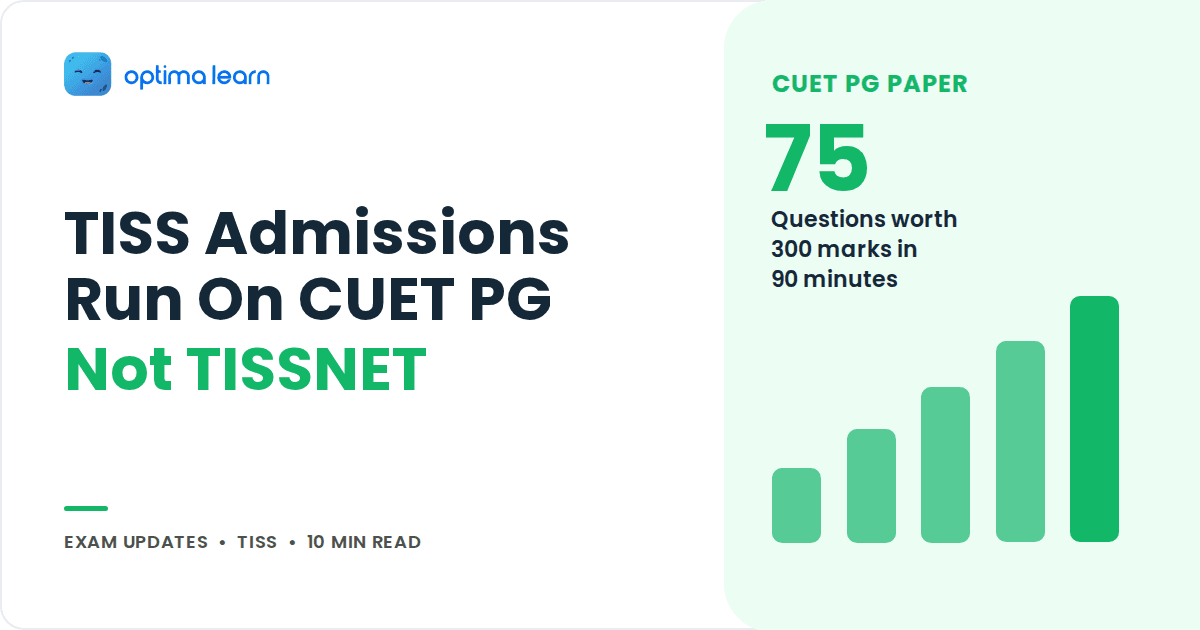
- CUET-PG runs 75 questions worth 300 marks in 90 minutes, with plus 4 correct and minus 1 wrong.
- TISS publishes the specific subject codes its applicants should sit, spanning both general and domain papers.
- There are two separate registrations: CUET-PG with NTA, then a TISS application after results are declared.
- The next CUET-PG cycle had not been announced at the time of writing, so treat any circulating dates as extrapolation.
Which Exam Your Programme Actually Uses
The first thing to establish is which of two routes applies to you, because they share nothing beyond the institute at the end.
TISS states that admission to its master's degree programmes is based on CUET-PG scores. The exceptions are three management programmes, in human resources and labour relations, in organisation development change and leadership, and the hospital administration programme, which admit on CAT.
If your target sits in that second group, your preparation is CAT preparation and nothing about CUET-PG concerns you. If it does not, CUET-PG is the exam and CAT is irrelevant to your TISS application, whatever else it may be doing for you elsewhere.
Preparing for the wrong exam entirely because a study plan was built from an aggregator page rather than the institute's own admissions site. This is not a small misallocation of study hours. It is a full cycle lost, and it is happening to real candidates right now on the strength of pages that look current.
The CUET-PG Route in Full
For the majority of TISS programmes, this is the process end to end.
| Stage | What happens |
|---|---|
| Choose the subject code | TISS publishes the codes it accepts, general and domain |
| Register with NTA | CUET-PG registration through the NTA portal |
| Sit the exam | 75 questions, 300 marks, 90 minutes |
| Results | NTA declares CUET-PG scores |
| Apply to TISS | A separate TISS registration, opening after results |
The last row is the one that catches people. Registering for CUET-PG and performing well does not put you in front of TISS. A separate application on the TISS admissions portal follows once scores are out, and in the completed 2026 cycle that window ran in May, roughly a month after results.
Candidates may typically apply to a limited number of programmes across the TISS campuses at Mumbai, Hyderabad, Guwahati and Tuljapur, with a fee per programme. Confirm the current figures on the TISS portal, since reported fee details vary across secondary sources and at least one contradicts TISS's own process description.
The Cycle That Just Completed
The 2026 cycle gives you the shape of the calendar, which is the most useful thing available while the next cycle is unannounced.
- CUET-PG registration: opened in mid December 2025 and closed in late January 2026.
- Exams: conducted across a window in March 2026.
- Results: declared in late April 2026.
- TISS application window: opened in mid May 2026 and was subsequently extended.
Two things follow from that shape. The exam sits in March, well clear of the November to January crush of CAT, XAT and the other management papers, which makes it easier to accommodate than it first appears. And the gap between exam and TISS application is long enough that people forget the second step exists.
The next cycle had not been announced at the time of writing. Pages currently publishing dates for it are extrapolating from this one, which may prove roughly right and is not a notification.
Set a calendar reminder for the TISS application window as soon as you sit the exam, not when results arrive. The gap is around a month and it falls after the stress of the exam has passed, which is exactly when an administrative deadline is easiest to lose track of.
The Two Step Audit: 3 Things to Confirm Early
Each of these takes minutes and each can invalidate a plan built without it.
- Route. CUET-PG or CAT, decided by which programme you are targeting. Everything else follows from this.
- Code. Which subject code you sit, and therefore whether your paper is domain content or a general mix.
- Deadlines. Both of them. The NTA registration and the later TISS application are separate events with separate windows.
The Code Decides What You Study
CUET-PG papers are either domain papers, which are entirely subject content, or general papers, which mix language, reasoning and awareness components. NTA removed the old general Part A that used to sit on top of every paper, so a domain candidate now answers subject questions exclusively.
That means the answer to "how much English should I prepare" is either a reasonable amount or none at all, and the code is what tells you which.
The Marking Scheme Shapes Your Attempt Rate
Plus 4 for a correct answer and minus 1 for a wrong one is a four to one ratio, more generous than CAT's three to one. With 75 questions in 90 minutes you have around 72 seconds each, which does not allow deliberating your way to certainty. Eliminate two options and attempt.
The Mop-Up Test Is Not TISSNET
TISS has run a small non-CUET online proctored test for vacant seats after the main cycle. It covers a limited set of programmes and campuses and is not a national exam with a published pattern. It is worth knowing about as a late option, and it is not a replacement route to plan around.
Mentors handling TISS applicants now spend the first session on paperwork rather than preparation: which exam, which code, which two deadlines. It feels like a poor use of mentoring time and it prevents the most common failure in this process, which has nothing to do with how well anyone can answer a question.
Keep the Aptitude Base While You Sort the Route
Reading and reasoning under time serve every route into TISS, whether your programme runs on CUET-PG or on CAT.
Work Through CAT Practice ChaptersWhat Changes If You Had Planned for TISSNET
If your preparation was built around the old test, it is worth being specific about what survives the change and what does not, because the answer is not simply that everything is wasted.
The general aptitude work survives in altered form. Reading under time, reasoning and basic quantitative ability all still appear if your code puts you on a general paper, and they remain useful habits regardless.
What does not survive is anything built around the old section structure. TISSNET's English section, its general awareness component and its particular weightings described a specific paper, and no current exam reproduces them. Study plans allocating hours by those weightings are allocating against a shape that no longer exists.
The bigger change is one of emphasis rather than content. TISSNET was a general aptitude test. CUET-PG domain papers are subject examinations. For a candidate on a domain paper the centre of gravity moves from aptitude to discipline knowledge, which is a different kind of preparation entirely and usually a more familiar one for anyone coming straight from an undergraduate degree.
The Advantage Hidden in the New Calendar
Most coverage of this change treats it as a loss, and for anyone who had prepared for TISSNET it is. There is a scheduling upside worth naming, though.
TISSNET ran in the same congested window as the management entrance exams. CUET-PG sits in March, after CAT, XAT, SNAP, NMAT and CMAT have all been and gone.
For a candidate pursuing both a management route and a TISS social sciences route, that separation is genuinely valuable. The two preparations no longer compete for the same weeks. You can run the management season to its conclusion in January and then turn to CUET-PG with a clear calendar and no divided attention.
It also means a disappointing management season does not automatically compromise the TISS application, because the preparation for it has barely started when the other results arrive. That is a more forgiving structure than the old one, even if it arrived by accident rather than design.
Why Entrance Exams Keep Disappearing
TISSNET is the second significant entrance test to vanish in recent cycles, following IIFT's move onto CAT scores. The pattern is worth understanding because it is unlikely to be the last.
Running a national entrance exam is expensive and administratively heavy. Where a centralised alternative already exists and is already being sat by the same pool of candidates, the case for maintaining a separate test weakens. CAT has absorbed one institute's exam this way and CUET-PG has absorbed another's.
What makes this hazardous for aspirants is the asymmetry in how the information travels. The institute publishes a notice once. The aggregator pages built around the old exam keep ranking, keep getting date-stamped with the current year, and keep being found by people building study plans.
The defence is a habit rather than knowledge. Once a cycle, open the admissions page of every institute on your list and confirm the exam it actually uses. An hour spent that way is the cheapest insurance available in this process.
Building a Plan Around the TISS Route
Once the route is settled the planning is straightforward, and it differs by which route you are on.
If Your Programme Uses CAT
Nothing about your preparation changes. You are preparing for CAT as you would anyway, and TISS becomes one more institute reading the same score. The work is in the application rather than the exam.
If Your Programme Uses CUET-PG
Your preparation is dominated by your subject content if you are on a domain paper. The March exam date gives you a genuine advantage: it sits after the November to January exam season, so preparation can follow rather than compete with the management papers.
If You Are Doing Both
Some candidates target a CAT-route programme and a CUET-PG-route programme at the same institute. That is two exams with two syllabuses and two sets of deadlines. A personalised CAT preparation plan keeps the CAT half structured while the CUET-PG work runs in the months after, and our guide on sequencing multiple papers in one season covers how to stop one crowding out the other.
- Have you confirmed whether your programme admits on CUET-PG or on CAT?
- Do you know your subject code and whether it is a domain or general paper?
- Are both deadlines in your calendar, including the TISS application after results?
- Is anything in your current plan still built on a TISSNET pattern?
If your shortlist spans several institutes with different entrance routes, it is worth having the whole thing checked rather than each piece separately. A CAT preparation strategy review will surface where your plan is preparing for something that no longer applies.
Verify the Route, Then Build the Plan
An hour confirming which exam each institute actually uses is worth more than a month of preparation aimed at the wrong one.
Build My Weekly PlanFrequently Asked Questions About TISS Admissions
Is TISSNET still conducted?
No. TISS discontinued its own entrance test and admits to postgraduate programmes through CUET-PG, with three management programmes using CAT. Pages publishing a current TISSNET exam pattern are describing a test that has not been held since 2023.
Which TISS programmes use CAT?
Three management programmes: human resources management and labour relations, organisation development change and leadership, and hospital administration. Every other master's programme admits on CUET-PG scores, so the route depends entirely on your target programme.
What is the CUET-PG exam pattern?
Seventy-five questions carrying 300 marks in 90 minutes, with 4 marks for a correct answer, minus 1 for a wrong one and nothing for an unattempted question. Domain papers are entirely subject content since NTA removed the old general Part A section.
Do I apply to TISS separately after CUET-PG?
Yes. Registering with NTA and sitting CUET-PG is the first step only. A separate TISS application opens after results are declared, and missing it means a good score does not translate into an application.
Track CAT 2026: never miss a date
Slot booking, admit cards, results, and IIM cutoffs, one timeline.
More from Exam Updates
Continue reading

Will CAT 2026 Be Tougher Than 2025? What Trends Show

Why You Cannot Solve DILR Sets Under Time Pressure

Why Is Your CAT VARC Score Low With Good Attempts?
What Is a Good CAT Score for a First Time Test Taker?
Put it into practice