
MBA Loan ROI 2026: Is 26 Lakh for an IIM Worth It?
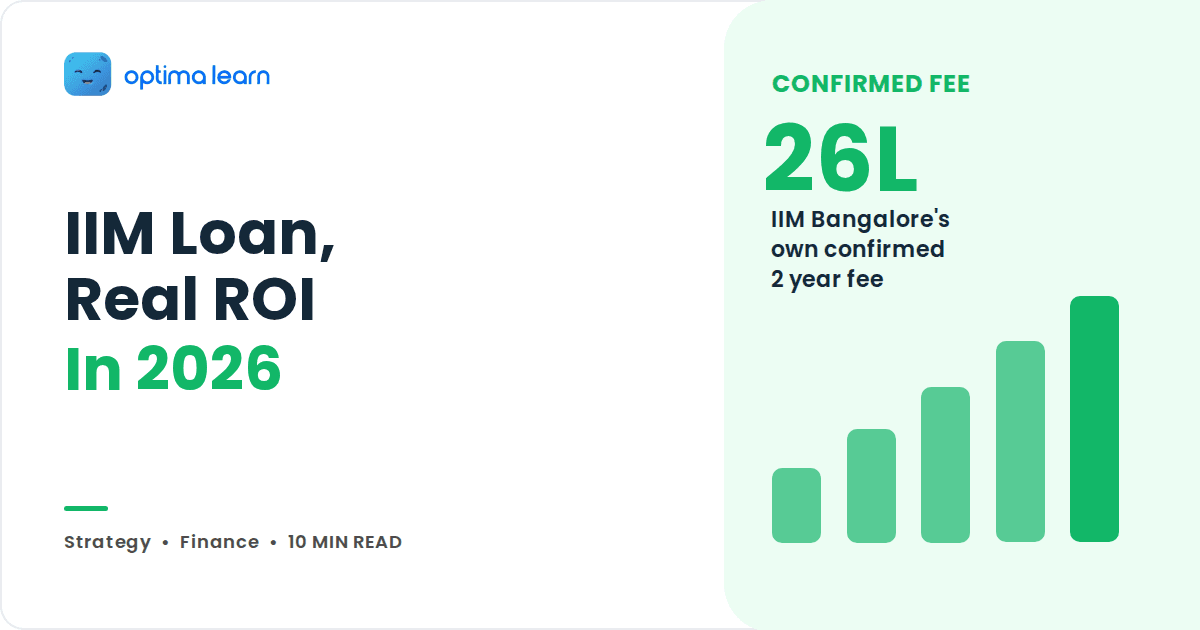
Twenty six lakh rupees. That is the officially confirmed domestic fee IIM Bangalore lists for its 2026 to 2028 two year PGP batch, on the institute's own website, before hostel and living costs even enter the picture. For a lot of families that number alone decides whether an application even gets submitted.
The honest answer depends on numbers most aspirants never write down. Not the brand, not the campus photos, the total cost against a realistic placement range for the tier of school you can actually get into. This piece runs that math with real, sourced figures, the same discipline a solid CAT preparation strategy already asks of you.
Before you run any ROI math, it helps to know which tier of school your CAT profile is actually competitive for. Get your CAT preparation strategy reviewed for free and find out where you realistically stand.
- IIM Bangalore's 2026-28 domestic fee is officially confirmed at 26 lakh rupees for two years, plus a small deposit and mess advance.
- Other IIM fees in this piece come from an aggregator, not the institute, so treat them as a wide range, not a precise number.
- Loan collateral thresholds, tenure and interest rates change often and vary by lender, so confirm current terms directly before applying.
- The 3 Number ROI Gut Check compares total cost, a realistic placement range, and a breakeven timeline, not brand name alone.
- Official placement reports from IIM Ahmedabad, Lucknow and Indore give real, batch labelled outcome anchors to run this math against.
The Loan Number Everyone Asks About First
Optima Learn does not run an interactive ROI or loan calculator, and this piece will not pretend otherwise. What follows instead is a back of envelope framework you can run yourself with a calculator app and three real numbers, which is honestly more useful than a black box tool that hides its assumptions from you.
The reason this question gets searched constantly is not curiosity. It is genuine fear of a debt that outlives the degree. That fear deserves real numbers, not a reassuring paragraph about "investing in yourself" that never once mentions a rupee figure.
What an IIM Actually Costs: The One Confirmed Anchor
IIM Bangalore's own site lists its 2026-28 domestic PGP fee at 26 lakh rupees for the full two years, plus a one time 30,000 rupee caution deposit and a 30,000 rupee mess advance each term. The institute also runs financial aid for students from households earning under 8 lakh rupees a year, with merit and need based scholarships ranging from 48,000 to 1.75 lakh rupees.
That is a genuinely confirmed, institute stated figure, and it anchors the cost side of this article. Nothing else in this piece carries quite that level of certainty, which is exactly why it deserves to be named separately from the rest.
Fees at other IIMs are harder to pin down with the same confidence. An aggregator table compiled by Careers360 puts the range roughly between 17 and 18 lakh at newer IIMs such as Kashipur and Rohtak, up to roughly 26 to 28 lakh at the older, more established IIMs, for the full two year programme.
Treat that as an illustrative range, not a precise number for any one institute, since it came from a third party compilation rather than each school's own page.
Two aggregator figures for IIM Calcutta specifically conflicted with each other during this research, one lower and one noticeably higher that may actually belong to a different executive programme. This piece does not state a specific number for IIM Ahmedabad or IIM Calcutta for that reason.
| Institute or tier | Approximate 2 year fee | Source and confidence |
|---|---|---|
| IIM Bangalore | 26 lakh rupees | Institute confirmed, official site |
| Newer IIMs (e.g. Kashipur, Rohtak) | Roughly 17 to 18 lakh | Aggregator range, illustrative only |
| Established IIMs, general range | Roughly 26 to 28 lakh | Aggregator range, illustrative only |
| IIM Ahmedabad, IIM Calcutta | Not stated here | Conflicting aggregator figures, unconfirmed |
What a Loan Actually Costs You: Collateral, Tenure, Rates
Education loan terms shift often enough that quoting a specific interest rate in an article like this would be dishonest. Multiple sources checked for this piece gave different figures for the same public sector bank, ranging from under 7 percent to over 10 percent depending on where the number came from, which tells you how unreliable a single quoted rate really is right now.
What does hold reasonably steady as general market shape, illustrative only and not a quote from any one lender, is this: collateral free loans from major Indian lenders commonly sit in the roughly 40 to 50 lakh range, and tenures commonly run up to 15 years once you add a moratorium of the course length plus 6 months.
Rates themselves vary by lender, your profile and the month you apply. A public sector bank and a specialised lender such as HDFC Credila both offer education loans for IIM admissions, mentioned here only as examples of the kind of lender active in this market, not as a rate quote you should rely on.
Confirm the current interest rate, processing fee and collateral requirement directly with the lender before you apply, not from any article, including this one. Rates move often enough that a number quoted in August can be stale by November.
Before you sign anything, ask the lender these four questions directly rather than trusting a rate you saw quoted somewhere online:
- What is the current interest rate for my specific profile, not the advertised headline rate?
- Is the loan collateral free at this amount, or does it need a guarantor or property?
- What exactly counts as the moratorium period, and when does actual repayment begin?
- Are there processing fees or prepayment penalties not mentioned in the initial quote?
The 3 Number ROI Gut Check
Instead of a single scary loan figure, run three numbers side by side. None of them alone tells you anything useful, and that is exactly why most aspirants skip this step and go with a gut feeling instead.
Total Cost, Including What You Give Up
Add the programme fee to two years of living costs in that city, then add roughly two years of the salary you would have earned had you kept working instead. That opportunity cost is real money, even though it never shows up on a fee receipt.
Realistic Placement Outcome Range
Use an official, batch labelled placement report from a similarly ranked institute, not a rumoured number from a forum. Build a low and high estimate, not a single hopeful figure pulled from the best outcome in the report.
Breakeven Timeline
Divide total cost by the gap between your realistic post MBA salary and what you would likely earn without the degree. That answer, in years, is the real return on investment question, not the brand name on the degree.
Running the Math: A Worked Example
To make this concrete, anchor the cost side on IIM Bangalore's institute confirmed 26 lakh fee plus a rough 4 to 5 lakh for two years of hostel and living costs, so roughly 30 to 31 lakh in direct cost before any opportunity cost is added.
For the outcome side, use officially published, batch labelled placement figures from similarly ranked IIMs rather than guessing at IIM Bangalore's own number, which this piece does not have confirmed. IIM Ahmedabad's batch 2025 report states an average CTC of 29.84 lakh and a median of 29.30 lakh. IIM Lucknow's batch 2024-25 report states an average of 32.3 lakh and a median of 31 lakh.
IIM Indore's batch 2023-25 report adds an average of 29.57 lakh and a median of 27 lakh. This is an illustrative pairing across institutes, not a claim about what IIM Bangalore specifically pays its own graduates.
Set those numbers against a direct cost of roughly 30 to 31 lakh, add two years of foregone salary on top, and most similarly tiered outcomes clear that cost within the first two to three years of a post MBA salary, before counting any raises. That is the actual shape of the return, not a single headline number.
Notice what this example deliberately does not do. It does not promise that admission into IIM Bangalore itself produces any specific salary, because that figure is not something this piece has confirmed from the institute. It pairs one institute's confirmed cost with a separately sourced, honestly labelled outcome range from comparable institutes, which is the most responsible way to run this math without a single placement number for every school involved.
Mentors who have watched cohorts graduate say the ROI conversation breaks down for one specific reason: aspirants compare the fee at their target school against the placement average of a much higher ranked one. Compare a school's own cost against its own placement report, not a mismatched pair.
When the Math Says Wait, or Says Go
A loan is worth taking when your realistic placement range, for the actual tier of school your profile can reach, clears the breakeven timeline within roughly three to four years. It is worth pausing on when the honest placement range for your realistic tier sits close to or below what you already earn today.
If the math says wait, spend that year raising your actual score instead of your anxiety, ideally with a structured daily and weekly CAT preparation plan built around your specific weak areas rather than a generic repeat of last year's routine.
Running this entire calculation against a dream school's placement report while budgeting for a lower tier school's fee, or the reverse. The ROI math only works when both numbers come from the same institute's own reporting.
- Have you used an institute's own confirmed fee, not a rumoured number from a forum?
- Have you added two years of foregone salary to the cost side, not just the fee?
- Is your placement estimate matched to the actual tier of school you can realistically get into?
- Have you confirmed current loan rates with the lender directly, not from an old article?
The single biggest variable in this whole framework is not the loan. It is which tier of school your CAT score and profile can actually reach, because that decides which placement report you should even be reading. This is the same myth versus reality check worth applying to a tough CAT question, just applied to a target list instead of a single question.
A CAT mentor who has been through this exact decision themselves can help you read your own profile honestly before you run the numbers on a school that was never realistically in range. If you would rather talk it through first, a free CAT 2026 mentorship call with IIM and FMS alumni covers exactly this kind of target list sanity check, alongside your actual CAT preparation plan.
Find Out Which Tier Changes Your 3 Number Gut Check
Get a free, honest read on which IIM tier your current CAT preparation is actually competitive for, so your ROI math is built on a realistic placement report instead of a hopeful guess.
Get My Honest Tier ReadFrequently Asked Questions About IIM Loan ROI
Is 26 lakh rupees the fee at every IIM?
No. That figure is IIM Bangalore's own confirmed 2026-28 domestic fee. Other IIMs range roughly from 17 to 18 lakh at newer institutes up to around 26 to 28 lakh at established ones, based on aggregator data, so always check the specific institute's own page before budgeting.
Does Optima Learn have an ROI or loan calculator tool?
No. This article is a manual, back of envelope framework you run yourself with your own numbers. There is no interactive calculator on the platform for loan or ROI math specifically.
What interest rate should I expect on an education loan for an IIM?
Rates vary by lender, your profile and the month you apply, and sources checked for this piece gave meaningfully different figures for the same bank. Treat any number you read, including in this article, as illustrative only, and confirm the current rate directly with the lender before applying.
How do I know if the loan is actually worth it for me?
Run the 3 Number ROI Gut Check: total cost including two years of foregone salary, a realistic placement range from an official report at your actual target tier, and the breakeven timeline that gap produces. If that timeline sits within three to four years, the math generally supports going ahead.
Build your CAT 2026 study plan
Personalised daily plan that adapts to your section-wise mock scores.
More from Strategy
Continue reading
Why CAT RC Answer Options Often Feel Equally Correct

How To Study For CAT When You Are Mentally Exhausted

How To Stop Procrastinating On Your Weakest Section
How To Recover From A Wrong Start On A DILR Set Explained
Put it into practice