
IIM Indore and CAT 2026: What the Conducting IIM Could Mean for This Year's Exam
The notification email lands. You scroll down to the line that says conducting institute: IIM Indore, and something in your stomach tightens. Group chats start buzzing within minutes. Someone claims quant just got harder. Someone else swears DILR will now carry five sets instead of four. None of it is confirmed, and most of it is guesswork dressed up as inside information.
IIM Indore is conducting CAT 2026, and the honest answer is that this changes far less than the panic suggests. What shifts are the edges: timing, ratios, moderation style. What CAT 2026 actually tests, quant, VARC, DILR, at their core, has stayed remarkably steady for years.
Quick Answer
- IIM Indore conducting CAT 2026 changes surface details only: sectional time limits, the MCQ-to-TITA ratio, and moderation style.
- The exam's core never moves: three sections (VARC, DILR, Quant), the same skill areas, and the same scoring pattern, three marks for a correct MCQ, a one-mark penalty for a wrong one, no penalty on TITA answers.
- IIM Indore's past papers have leaned toward layered, multi-step quant and denser DILR sets, a tendency worth noting, not a locked-in guarantee for this year.
- Adjust your CAT 2026 prep at the margins only. Keep your core plan intact and wait for the official mock or sample paper before changing anything major.
The stakes are real, but not in the way the group chat frames them. Aspirants who chase every rumor about a new conducting IIM tend to lose weeks reshuffling their prep, while the ones who stay anchored to fundamentals walk in just as ready as anyone else. That gap is worth understanding before the panic sets the agenda for your next month of study.
What Does It Mean When IIM Indore Conducts CAT 2026?
A conducting IIM runs the logistics and paper-setting process for that year's CAT, not the exam's underlying design. IIM Indore conducting CAT 2026 means the institute forms the core team, sets question difficulty within existing norms, and moderates the paper, while the exam's structure, sections, and scoring pattern remain governed by conventions built over more than a decade.
Every IIM in the rotation appoints its own convener and core team, but they inherit a decades-old blueprint, not a blank page. Quant, VARC, and DILR have anchored the exam since long before this rotation cycle began, and no single conducting institute has ever rewritten that foundation on its own.
CAT itself rotates its conducting institute among IIMs on a cycle, and in recent years alone it has been run by several different member institutes, each bringing its own convener and paper-setting committee. That handoff can feel like a reset, but the exam's syllabus and testing philosophy predate any single one of these tenures by years.
Have you ever noticed how the loudest predictions come out within hours of the notification, long before anyone outside the paper-setting committee could possibly know anything? That timing alone should tell you how much of it is guesswork.
This is exactly why obsessing over who is conducting CAT 2026 wastes energy better spent elsewhere. Track your results on the target percentile calculator against your actual accuracy by section instead of against a rumor about next year's paper, since that number moves regardless of which IIM sets the questions.
The Continuity Signature
What a conducting IIM actually changes, and what it never touches. Every CAT year leaves a signature: small, surface-level adjustments layered over a core that has proven remarkably resistant to change. Learning to tell the two apart is most of what adjusting for a new conducting IIM comes down to.
Keep that signature metaphor handy. It is the lens the rest of this piece uses to separate real change from noise every time a new conducting IIM is announced.
The Continuity Signature: What Actually Changes When the Host Changes
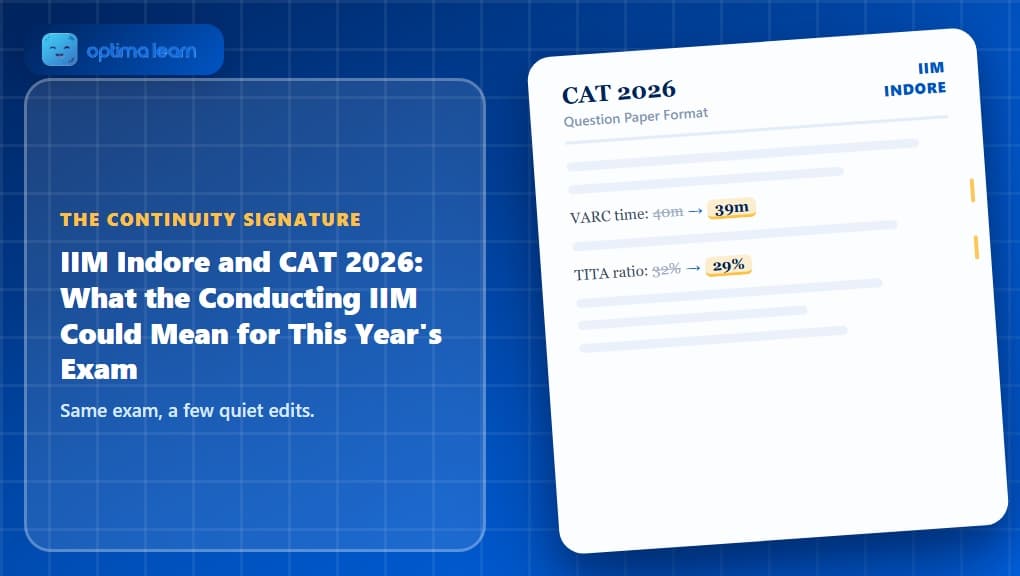
The surface layer is where a new conducting IIM leaves its fingerprints, and it usually shows up in four places: sectional time limits, the ratio of MCQs to TITA questions, moderation style, and how tightly quant and DILR are calibrated for difficulty. None of these touch what the exam is testing, only how it is delivered.
Sectional time allocation has moved before, roughly forty to sixty minutes per section across recent years, and each change reshuffles pacing strategy without touching what quant or verbal ability demands of you. A time limit is a container, not the content inside it.
The same goes for the MCQ-to-TITA split. A conducting IIM can lean toward more type-in-the-answer questions in one section and pull back the next year, but the underlying skill, whether it is solving a quadratic or reading a data set, demands the same competence either way.
Moderation style is the quietest change of all. It shows up in how tightly a paper is checked for ambiguous wording or unintended multiple correct answers, not as a different kind of question altogether. Difficulty calibration works the same way, nudging quant or DILR half a notch harder or easier, never redesigning what is being asked.
Why do these particular things move instead of others? Because a new convener and committee inherit control over execution, not architecture. They can tighten a time limit or adjust how many TITA questions appear, but redesigning what quant or DILR fundamentally measures would require years of advance validation that a single year's committee simply does not have.
Stop Guessing, Start Practicing the Constant Core
Whatever moderation style IIM Indore brings to CAT 2026, your quant, VARC, and DILR fundamentals are what actually decide your percentile.
get a personalized CAT study planThe Constant Core: What Never Changes No Matter Who Sets the Paper
The core layer is what the Continuity Signature protects: the quant, VARC, and DILR fundamentals that have anchored CAT through every conducting IIM in recent memory. Sectional weightage, the scoring pattern, and the three-part exam structure have held steady regardless of who ran the paper-setting process that year.
| Tends to Change (Surface Layer) | Never Changes (Core Layer) |
|---|---|
| Sectional time limits, which have varied roughly between forty and sixty minutes per section in recent years | Three-section structure: VARC, DILR, and Quant |
| Ratio of MCQs to TITA questions within a section | Core skill areas tested: reading and verbal reasoning, data interpretation and logical reasoning, quantitative ability |
| Moderation style and how tightly ambiguous wording gets filtered out | Scoring pattern: plus three for a correct answer, minus one for a wrong MCQ |
| Difficulty calibration of quant and DILR, nudged half a notch harder or easier | No negative marking on TITA-style answers |
| Small logistical choices: number of slots, city list, exact exam-day timing | The underlying reasoning, calculation, and reading skills a strong scorer needs, year after year |
Notice what sits in the right-hand column. None of it is about a specific IIM's preferences. It is the exam's actual identity, the thing that has made a strong CAT quant score transferable across all these different hosting years without aspirants needing to relearn what the section rewards.
This scoring pattern (three marks for a correct MCQ, a one-mark penalty for a wrong one, and no penalty on TITA answers) has held since long before this current rotation cycle, and no conducting IIM has proposed altering it in recent memory.
Take a concrete case. A profit-and-loss quant question that combines a percentage markup with a later discount tests the exact same layered-calculation skill whether it appears in a paper set by one IIM or another. Only the surrounding time pressure and option spacing might differ from year to year, not the arithmetic reasoning the question demands.
The same logic holds for VARC. If your reading comprehension accuracy dips regardless of which year's passage you attempt, the fix usually lives in pacing, not in guessing next year's passage topics. We break that down fully in The VARC Time Allocation Blueprint for CAT 2026.
The fastest way to see this for yourself is to solve papers from different conducting years back to back. Work through a stretch of CAT previous year questions spanning at least three different conducting IIMs, and you will notice the core skill demand barely moves even as small formatting details do.
Does IIM Indore's Own CAT History Hint at a Particular Style?
IIM Indore has been part of the CAT conducting rotation before, and its papers have generally leaned toward layered, multi-step quant questions and denser DILR sets rather than pure calculation-heavy ones. This is a tendency worth noting, not a locked-in guarantee for CAT 2026.
Does that mean every quant question this year will demand three steps instead of one? Not necessarily, since moderation committees change even within the same conducting institute, and a single past tendency is a pattern, not a rule carved in stone.
IIM Indore's Historical Tendency
- Quant: a preference for questions built in layers, where step one feeds directly into step two, rather than single-formula plug-ins.
- DILR: denser sets with more interacting variables, rewarding patient set selection over speed alone.
- Caveat: paper-setting committees and moderators can differ within the same institute across different years, so this is a lean, not a lock.
Picture two versions of a similar DILR set: one asking a direct question answerable from a single given data point, another requiring you to combine three separate clues before answering anything. IIM Indore's past papers have tilted toward the second kind more often, rewarding patience over speed in the opening minutes of a set.
Weight your DILR practice toward that second kind, the same way you would weight quant revision toward a topic that shows up often in past papers.
So How Should This Change Your CAT 2026 Prep?
At the margins, not at the core. If you are already strong across the syllabus, spend slightly more time on IIM Indore's typical layered-question style, but never abandon a working, broad-based plan for a narrow bet on pattern prediction, since moderation varies even within one conducting institute.
The margin matters because overcorrecting carries its own risk. An aspirant who rebuilds an entire prep plan around one institute's tendency can end up weaker on the large majority of the exam that never changes at all.
A Sane Way to Adjust for CAT 2026
- Keep your core prep plan for quant, VARC, and DILR fundamentals exactly as it was before the notification.
- Add extra reps on multi-step, layered quant questions if your accuracy there is already decent.
- Practice denser DILR sets with more interacting variables, since that has been a recurring lean.
- Ignore any claim of a totally new section structure until the official mock or sample paper confirms it.
If you want to test this lean directly, work through CAT Quant previous year questions and flag which ones needed two or three linked steps versus a single formula. That ratio tells you more about where to spend your next few weeks than any notification-day rumor ever could.
If your scores have plateaued regardless of who conducted last year's paper, that plateau almost never traces back to the conducting institute. It usually traces back to revision habits, covered in more depth in The CAT Plateau Guide, which is worth revisiting before you touch your prep plan at all.
The Bottom Line
Whoever conducts CAT 2026, the exam is still testing the same reading, reasoning, and quantitative skills it always has. Chase the fundamentals hard, treat conducting-IIM patterns as a minor tilt rather than a new blueprint, and let the actual notification and sample paper, not the group chat, decide what changes.
The next time a notification names a new conducting IIM, notice the urge to rewrite your whole plan, then resist it. Add the small, sensible adjustments this piece covers, keep the fundamentals exactly where they were, and treat the rest of the noise as exactly that: noise.
Prep for the Core, Not the Rumor
CAT 2026's conducting IIM will shape the edges of the paper. Your quant, VARC, and DILR fundamentals still decide the score, so lock in a study plan built on them before the rumor mill sets the agenda instead.
build your CAT plan for CAT 2026Frequently Asked Questions
Does the conducting IIM change the CAT syllabus?
No. The syllabus, which is really just the underlying skill areas of quant, verbal ability, and data interpretation and logical reasoning, has stayed the same regardless of which IIM has conducted CAT in recent years. What shifts are smaller things like sectional time limits, the ratio of MCQs to TITA questions, or moderation choices, not the core skills being tested.
Has IIM Indore conducted CAT before, and what does its style tend to look like?
IIM Indore has been part of the CAT conducting rotation in the past, and its papers have generally leaned toward layered, multi-step quant questions and denser DILR sets rather than pure calculation-heavy ones. This is a tendency, not a guarantee, so it should inform practice emphasis, not replace full-syllabus preparation.
Should I change my CAT 2026 preparation because of who is conducting it?
Only at the margins. Spend slightly more time on the conducting IIM's typical question style if you are already strong across the syllabus, but do not abandon a working, broad-based preparation plan for a narrow bet on pattern prediction, since moderation and paper-setting committees vary even within the same conducting institute.
Where can I find the confirmed CAT 2026 exam updates?
Always confirm details like exam date, application window, and any format changes directly through the official CAT website once the notification is released, and treat pattern-based predictions from past papers as directional guidance rather than confirmed fact until the mock/sample paper for the year is out.
Track CAT 2026: never miss a date
Slot booking, admit cards, results, and IIM cutoffs, one timeline.
More from Exam Updates
Continue reading

Why CAT RC Answer Options Often Feel Equally Correct

How To Study For CAT When You Are Mentally Exhausted

How To Stop Procrastinating On Your Weakest Section

How To Recover From A Wrong Start On A DILR Set Explained
Put it into practice