
CAT Score to IIM Interview Call: How Convert Ratios Work
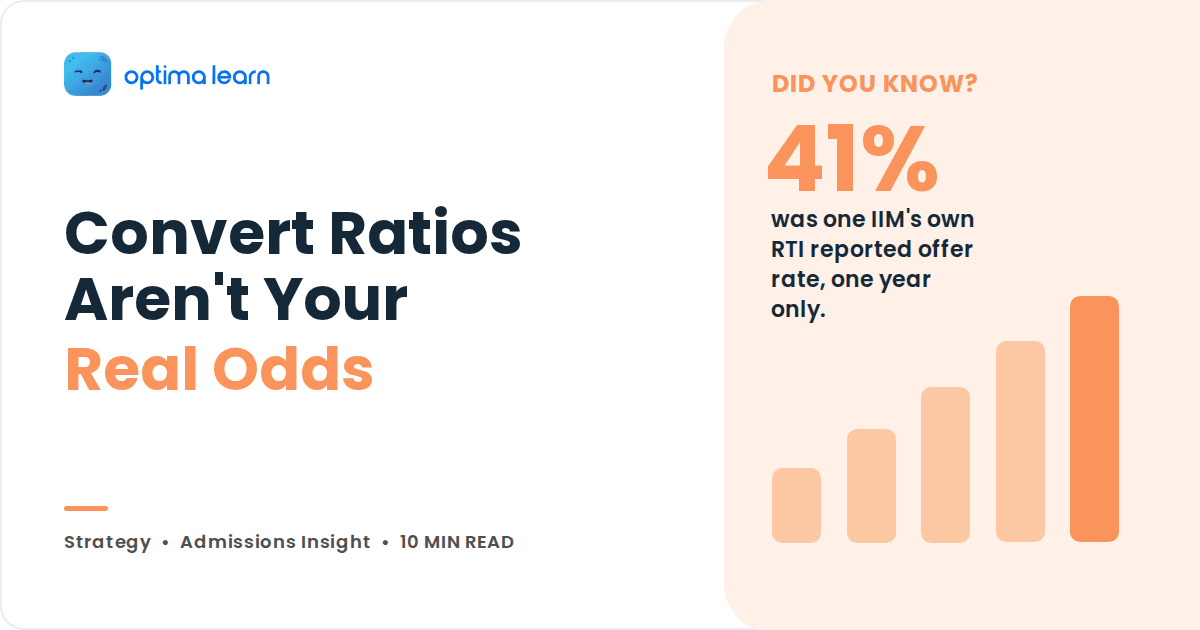
Only about four in ten candidates who sat for an interview at one IIM actually walked away with an offer, according to figures an education portal reported from an RTI request. That single number gets forwarded in aspirant group chats every admission season, usually stripped of every caveat that made it meaningful in the first place.
The real question is not whether that number is accurate. It probably was, for that one institute, in that one year. The real question is why aspirants keep treating a historical, single-institute snapshot as a personal odds calculator, when the inputs that actually decide their own outcome are sitting in front of them, still fully controllable.
Before you spend more time hunting for convert ratio numbers you cannot act on anyway, check the parts of your application you actually can control. Get your CAT preparation strategy reviewed and see where your profile and prep genuinely stand.
- Convert ratio in IIM admissions usually means call-to-admit conversion, the share of interviewed candidates who receive an offer, and it comes from RTI requests, not official IIM publication.
- The one credible figure available, roughly 41 percent overall offer rate at one IIM, is a single institute's single-year historical snapshot, not a live or universal statistic.
- No reliable source confirms that older, more established IIMs convert candidates at systematically higher rates than newer ones. Treat that claim as plausible reasoning, not a verified pattern.
- The same CAT percentile can produce very different outcomes for two candidates, because WAT-PI performance and application answers are not held constant.
- The one productive use of any convert ratio number is understanding why it exists, then redirecting that attention to profile presentation, WAT-PI preparation and your own application answers.
What a Convert Ratio Actually Means
The phrase gets used loosely, which is most of the problem. In IIM admissions, "convert ratio" or "conversion rate" most commonly refers to call-to-admit conversion: of the candidates who receive an interview call, what fraction end up with an actual admission offer.
IIMs officially publish percentile-based cutoffs for shortlisting. They do not officially publish conversion or yield ratios themselves. Whatever convert ratio number you encounter online almost certainly traces back to a Right to Information request, not an institute's own admissions page.
It is also worth being precise about which stage a given number describes. Call-to-admit conversion covers only the interview-to-offer step. It says nothing about how many applicants sat for CAT in the first place, how many cleared the shortlisting cutoff, or how many of those who received an offer actually accepted it. Conflating these different stages is a second, quieter way the same 41 percent figure gets misread.
Why This Comes From RTI, Not an Official IIM Report
The Right to Information Act lets a citizen request specific data from a public institution, and IIMs, as publicly funded bodies, are subject to it. An education portal or an aggregator files the request, receives a specific year's figures, and reports them. That is a legitimate data source, but it is a one-time disclosure, not an ongoing public dashboard you can check every admission cycle.
The One Real Number We Have, and Its Limits
The most commonly cited figure, reported by an education portal from an RTI-based analysis, shows one IIM's own reported numbers landing at an overall offer rate of roughly 41 percent of those interviewed. That figure also varied meaningfully by category: a little under half for general category, and lower for some other categories.
Read that number for what it is: one institute's data, from one specific year, disclosed once. It is not a live figure that updates each admission cycle, and it says nothing about any other IIM, this year's applicant pool, or your own chances specifically. Treating it as "your odds" is the exact misuse this piece is arguing against.
Mentors who sit through mock WAT-PI sessions every season notice the same thing every year. Candidates who ask "what's the convert ratio" are almost always more anxious about a number they cannot influence than about the interview performance they absolutely can.
The Convert Ratio Reality Check: 4 Myths vs Realities
Run these four checks against whatever convert ratio claim you encounter next, before you let it change how you feel about your own chances. Most of the anxiety around this topic collapses once the myth and the reality are separated cleanly, and the remaining four sections show exactly where that separation belongs.
The Convert Ratio Reality Check is four myth versus reality pairs, built from exactly the claims that circulate most often.
Myth 1: A Convert Ratio Predicts Your Personal Odds
A convert ratio describes what happened to a past cohort at one institute, not what will happen to you. Your own outcome depends on your specific profile, your specific WAT-PI performance and this year's specific applicant pool, none of which the old number captures.
Myth 2: Older IIMs Convert Better Than Newer Ones
This sounds plausible and gets repeated often, the logic being that a longer track record and a bigger alumni network should translate into a smoother admissions process. No reliable, publicly reported data actually confirms it, though. Treat it as reasoning worth considering, never as a confirmed fact you should base a school preference on.
Myth 3: A Convert Ratio Is Official IIM Data
IIMs publish shortlisting cutoffs, not conversion statistics, and that distinction matters more than it looks. Every convert ratio figure in circulation traces back to an RTI disclosure or a third-party report built on one, never an institute's own admissions page or an official annual report.
Myth 4: A High Percentile Guarantees Conversion
Percentile gets you the interview call. It does not sit in the room with you. Two candidates with an identical percentile can walk out with opposite outcomes, because the interview panel is scoring what happens after the shortlist, not the percentile itself.
Reverse engineering your odds from an old, single-institute convert ratio and adjusting your prep intensity based on it wastes energy on a number you cannot move. Whatever that historical ratio was, it will not change because you studied it harder.
Why the Same Percentile Produces Different Outcomes
Once you accept that a convert ratio is historical and not a personal prediction, the more useful question becomes why two similarly percentiled candidates end up in different piles. The honest answer is that a shortlist filters on percentile, but a final offer weighs the whole application, not just the number that got you into the room.
A candidate with the same percentile as another can present a stronger academic and professional narrative, answer WAT-PI questions with more clarity under pressure, or simply articulate their goals in a way that reads as more thought through. None of that shows up in a convert ratio. All of it is visible to the panel scoring the actual interview.
This is also why comparing your percentile against last year's convert ratio, or against a friend's outcome from a different cycle, rarely tells you anything useful. Every cohort is scored against its own applicant pool, its own panel composition that year, and its own set of institute priorities for that admission cycle. A ratio calculated from a different pool answers a different question than the one you are actually asking about your own chances.
If you already know your CAT percentile and want a sense of where it places you against past cutoffs, Optima Learn's CAT percentile predictor is useful for setting realistic expectations about the shortlist stage specifically. The interview stage is where everything after that gets decided.
What You Can Actually Control
Since a convert ratio is unofficial, historical and entirely outside your influence, the only productive move is redirecting that attention toward the inputs that are still yours to shape before results day. Three of those inputs matter more than the rest, and none of them require access to a number no one can give you anyway.
Profile Presentation
How you frame your academic record, work experience and extracurriculars in the application itself is something you control completely, right up until submission. A flat, generic presentation of a genuinely interesting background is a common, avoidable loss, and it is one a careful second pass through your own answers usually catches.
WAT-PI Preparation
This is the single biggest lever available after the shortlist stage. Structured mock WAT-PI sessions, reviewed honestly, do more for your actual outcome than any amount of convert ratio research ever will. A written ability test answer that stays organised under a strict time limit is a trainable skill. So is a personal interview answer that stays calm under a follow up question. Neither is a fixed trait you either have or do not.
Keep your current-affairs reading current too, since WAT prompts and PI questions both draw on it regularly. A candidate who can only discuss a topic in vague terms tends to stand out for the wrong reason. A few specific habits separate the candidates who walk in prepared from those who are guessing at the topic on the day:
- Reading one long-form news analysis a week on a business or policy topic, not just headlines.
- Writing a timed WAT response and reviewing it against a structure, not just a word count.
- Recording a mock PI answer and listening back for filler words and rushed reasoning.
- Preparing a genuine, specific answer for "why this IIM" instead of a generic one reused across every application.
- Reviewing your own resume line by line for questions a panel is likely to ask about it.
Optima Learn's free CAT formula sheets and prep materials are a useful supplement while you build this routine, particularly for keeping your quant and DILR sharp so WAT-PI preparation is not competing with basic revision for your remaining time before the interview season actually starts.
How You Answer for Your Own Application
Panels notice when an answer is rehearsed and generic versus specific to the candidate's own story, and they ask a follow up question precisely to test which one they are hearing. Practising your reasoning out loud, not just your facts, is what separates a flat answer from a memorable one when that follow up comes.
- Can you name the specific institute and year behind any convert ratio number you have seen, or is it a vague, unsourced claim?
- Have you practised a full mock WAT-PI session in the last two weeks?
- Can you explain your own career and academic choices without sounding rehearsed?
- Are you spending more time researching odds than preparing for the interview itself?
| Term | What It Actually Means |
|---|---|
| Convert ratio | Call-to-admit conversion, from an RTI disclosure, not an official IIM figure |
| Shortlisting cutoff | The only conversion-adjacent figure IIMs officially publish |
| WAT-PI stage | Where a shortlisted candidate's actual outcome gets decided |
| Historical snapshot | One institute, one year, not a live or repeating statistic |
Stop Researching Odds. Start Practising the Interview.
A convert ratio from a past cycle at a different institute will not change your outcome. A structured, personalised WAT-PI preparation plan can.
Build My WAT-PI Prep PlanNone of the four myths in the Convert Ratio Reality Check are complicated once you see them written down, but they are surprisingly persistent because forums and group chats repeat convert ratio numbers without ever naming the source or the year. If you want to practise the parts of the process that genuinely respond to preparation, our CAT exam practice questions keep the shortlisting stage moving in the right direction. Work on the interview stage separately, since it rewards a different kind of preparation entirely.
A mentor who has sat on the other side of enough WAT-PI panels can also tell you, honestly, where your own application currently reads as generic versus specific. Optima Learn's CAT mentor coaching from verified toppers is built for exactly that kind of direct, panel-eye feedback.
Get Your Strategy Reviewed Before Interview Season
Running the Convert Ratio Reality Check against your own plan is only useful if you act on what it reveals. Have your full CAT preparation strategy reviewed and find out what is actually in your control.
Roast My CAT StrategyFrequently Asked Questions About CAT Convert Ratios
Where do IIM convert ratio numbers actually come from?
Almost always from a Right to Information request filed with a specific institute, reported by an education portal or aggregator for that one year. IIMs do not officially publish conversion or yield statistics themselves, only percentile-based shortlisting cutoffs, so any number circulating beyond that is secondhand by definition.
Is a 41 percent convert ratio true for every IIM?
No. That figure was reported for one specific institute in one specific year, based on an RTI disclosure. It is not a confirmed, current figure for any other IIM, and it should not be treated as a general benchmark across the CAT admissions system.
Do older IIMs really convert candidates at a higher rate?
This is not confirmed by reliable, publicly reported data anywhere the piece could find. It is a plausible line of reasoning that gets repeated often. Treating it as fact rather than speculation is not supported by what is actually available, so it stays a reasonable guess rather than a planning input.
What should I actually do instead of researching convert ratios?
Focus on the inputs you control: how you present your profile, how well you prepare for WAT-PI specifically, and how clearly you can explain your own choices under panel questioning. These genuinely move your outcome. A historical ratio from a different cohort does not, no matter how many times it gets shared in a group chat.
Build your CAT 2026 study plan
Personalised daily plan that adapts to your section-wise mock scores.
More from Strategy
Continue reading

Why CAT RC Answer Options Often Feel Equally Correct

How To Study For CAT When You Are Mentally Exhausted

How To Stop Procrastinating On Your Weakest Section

How To Recover From A Wrong Start On A DILR Set Explained
Put it into practice