
CAT Revision Strategy: The Memory Science That Works
Most students revise for CAT by rereading notes and rewatching recorded lectures, and it feels like real work. You recognize the concept, the page looks familiar, and confidence rises. That feeling is misleading. A CAT revision strategy built entirely on rereading is one of the least effective ways to make information stick, according to decades of memory research. Retrieval-based methods, actually testing yourself instead of scanning old material, produce far stronger long-term recall. This matters most in the final months before CAT 2026, when the syllabus you covered in April needs to survive intact until exam day in November, not just feel familiar during a Sunday revision session.
Want to see how memory science shows up in real practice? Build your revision reps against real CAT-style questions using Optima Learn's practice question bank and treat every attempt as a retrieval workout, not a formality.
Why Does Rereading Feel Productive When It Isn't?
A meta-analysis of 317 experiments found that distributed, active practice beats massed, passive review for long-term retention (Cepeda, Pashler, Vul, Wixted and Rohrer, 2006, Psychological Bulletin). Rereading is passive review. It creates familiarity your brain mistakes for mastery, which is why it feels productive while doing little for recall weeks later.
The problem is not effort. Most aspirants who rely on rereading are disciplined and put in real hours. The issue is that recognition memory, seeing something and knowing you have seen it before, is weaker than recall memory, producing an answer from scratch under pressure. CAT never tests recognition. It always tests recall.
This gap between feeling ready and recalling correctly under pressure shows up constantly in mocks. We cover this in why you're slow in quant even when you know the concepts, where familiarity with a method does not translate into speed once the exam changes the wrapper around it.
Two signs you are relying on recognition instead of recall:
- You follow a worked solution easily but freeze on a blank-page version of it.
- You feel confident right after reading a chapter, then blank on it three days later in a mock.
What Is the Forgetting Curve, Told Honestly?
Hermann Ebbinghaus ran self-experiments in 1885, memorizing nonsense syllables and timing how fast he forgot them, publishing the results in Über das Gedächtnis (German for "On Memory"). His data showed retention dropping sharply at first, then leveling off with repetition. The oft-repeated claim that we forget "50 percent in 30 minutes, 70 to 80 percent in 24 hours" is a popular paraphrase, not his precise figure.
That distinction matters. Treating a rounded internet statistic as gospel can make you distrust real memory science when the exact numbers do not match what you read somewhere. What Ebbinghaus reliably demonstrated is the shape of the curve: fast initial decay, then a flattening that repetition stretches out further each time.
Ebbinghaus also never prescribed spaced repetition as the fix. That idea came later, from researchers asking a practical question: if forgetting is inevitable, what review pattern slows it down the most? The answer, confirmed across decades of follow-up research, is spacing review sessions apart rather than repeating them close together.
Three things worth remembering about the curve itself:
- Forgetting is fastest right after learning something new, not weeks later.
- Each well-timed review flattens the curve further than the last one.
- The curve describes forgetting. It does not prescribe a fix, that came from later research.
What Actually Beats Rereading for CAT Preparation?
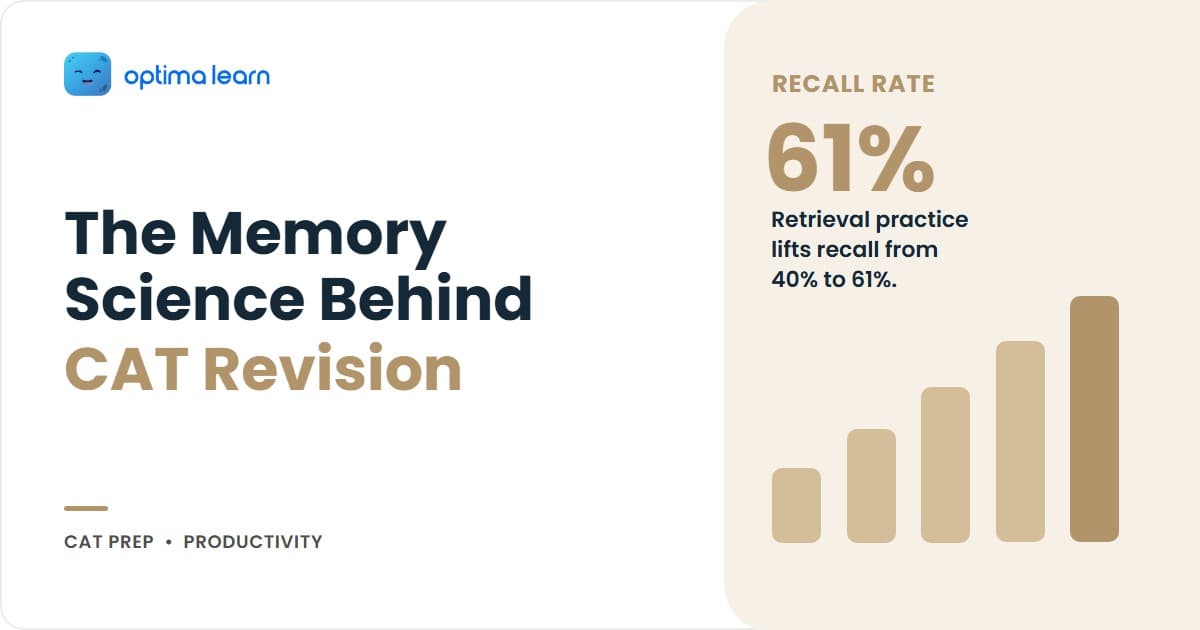
Students who tested themselves on a passage remembered 61 percent of it a week later, compared to 40 percent for students who simply reread the same passage repeatedly (Roediger and Karpicke, 2006, Psychological Science). That 21-point gap is the single strongest piece of evidence that active recall, not rereading, drives durable memory for CAT preparation.
Here is the counter-intuitive part. On a test given minutes after studying, the reread group looked better, because fluency and recent exposure inflate short-term confidence. The retrieval-practice advantage only appears after a delay of days or weeks, which is precisely the timeline that matters for an exam months away.
Retrieval practice for CAT means closing your notes and solving a fresh problem cold, then checking your work, rather than rereading a worked solution. It also means self-testing on formulas and DILR set patterns instead of scanning them. Building daily reps against real CAT exam practice questions makes this a habit, not a one-off effort.
Turn retrieval practice into a weekly habit
Optima Learn's planner blocks out spaced, interleaved revision slots automatically, so you are not rebuilding your CAT revision strategy from scratch every week.
Build My Revision PlannerWhy Does Mixing Topics Beat Marathon Revision Sessions?
Interleaved math practice, mixing problem types instead of drilling one topic for hours, hurt same-day scores but doubled performance on a test given one day later (Rohrer and Taylor, 2007, Instructional Science). Marathon single-topic sessions feel efficient in the moment and quietly cost you the retention that shows up when it counts on exam day.
A follow-up classroom study confirmed the effect holds outside the lab. Interleaved practice beat blocked practice on both a next-day test and a test given 30 days later (Rohrer, Dedrick and Stershic, 2015, Journal of Educational Psychology). The protection against forgetting was not a short-term fluke.
For CAT specifically, this argues against spending an entire weekend only on Quant, then another entire weekend only on VARC. A smarter revision block mixes a Quant topic, a DILR set type, and a VARC passage type in one sitting, the structure behind our quant revision system that actually works.
A simple interleaving pattern to try this week:
- Monday: 20 minutes Quant, 20 minutes DILR, 20 minutes VARC, each a different sub-topic.
- Wednesday: repeat with a fresh sub-topic in each section, same 20-20-20 split.
- Friday: one timed mixed set pulling from both Monday and Wednesday together.
CAT Revision Strategy: The SPACE Method for Retention
A CAT revision strategy that works combines three research threads: retrieval practice, spaced review, and interleaved topics, each validated across hundreds of studies (Cepeda et al., 2006; Roediger and Karpicke, 2006; Rohrer and Taylor, 2007). We organized these into a five-step system, the SPACE Method, built for CAT's three-section, mock-heavy preparation cycle.
Each letter in SPACE maps to one habit you repeat every revision cycle, not a one-time setup task. None of the five steps require new tools, only a change in how you structure the time you already spend on CAT preparation each week.
The SPACE Method
A five-step CAT revision strategy built on retrieval practice, spacing, and interleaving instead of rereading.
Sort
Sort every mock mistake into a log, tagged as conceptual, silly, or time-pressure.
Practice
Practice active recall: solve fresh problems cold instead of rereading your notes.
Add
Add increasing review intervals, Leitner-style: mastered items get reviewed further apart than shaky ones.
Cycle
Cycle through Quant, DILR, and VARC in one session instead of blocking a whole session to one section.
Evaluate
Evaluate with a fresh, unseen question before moving an item to the mastered tier.
How Do You Build a CAT Error Log That Actually Works?
Kunal Bohra, who scored 99.26 percentile in CAT 2025, said it plainly: "A significant portion of my time went into analysing mock tests, identifying recurring mistakes, and prioritising areas that needed improvement" (Careers360 topper interview). His error log was a dedicated notebook of formulas, common question types, and topic-wise approaches.
Structure your log with a Leitner-style tiering system, originally a physical flashcard box built by Sebastian Leitner in 1972. Every fresh mistake starts in a "Recent" tier, reviewed every two to three days. Solve it cleanly and it moves to "Shaky," reviewed weekly, then to "Mastered," reviewed only before full mocks.
If a tiered notebook feels manual, the same logic runs the scheduler inside apps like Anki, based on Piotr Wozniak's 1987 SM-2 algorithm, which adjusts each item's next review date based on how easily you recalled it. You do not need software, only the discipline to move items between tiers honestly.
Kunal Bohra put it simply: "Instead of chasing scores, I focused on understanding my mistakes and refining my strategy." That principle drives our guide on how to build your DILR notebook, paired with running mock data through the CAT score predictor to see which error tier costs the most percentile.
| Tier | Review frequency | Moves up when | Moves back when |
|---|---|---|---|
| Recent | Every 2 to 3 days | Solved correctly, unaided, twice | Never, this is the entry tier |
| Shaky | Weekly | Solved under mock conditions | Missed again, even once |
| Mastered | Before full mocks only | Stays here | Missed in a full mock |
Common Mistakes When Trying to Revise Smarter
Students who reread scored 40 percent on delayed recall versus 61 percent for those using retrieval practice (Roediger and Karpicke, 2006), yet most aspirants abandon retrieval practice within a week because it feels harder and slower than rereading. That discomfort is the method working, not a sign to quit.
A second common mistake is interleaving too early, before any single topic reaches basic fluency. Mixing three weak topics at once produces three types of confusion instead of one, so build a baseline with focused practice first, then interleave once each topic feels stable.
A third mistake is logging every mistake with equal weight. A silly arithmetic slip and a genuine conceptual gap need different fixes; treating them the same wastes review time on things you already know. This triage discipline runs through our guide on why CAT toppers skip more questions than you think.
| Panic Move | Pro Move |
|---|---|
| Rereading notes the night before a mock | Solving fresh problems cold, then checking your work |
| Quitting retrieval practice after a few hard sessions | Expecting the first two weeks to feel slower |
| Interleaving topics with no basic fluency yet | Building single-topic fluency first, then interleaving |
| Logging every mistake in one undifferentiated list | Tagging each mistake as conceptual, silly, or time-pressure first |
If your log feels overwhelming in the first week, that reaction is normal and temporary. Book a free CAT 2026 strategy call to get help prioritizing which tier to attack first, instead of trying to fix every mistake at once.
Frequently Asked Questions
What is the most effective way to revise for CAT?
The most effective method combines retrieval practice, spaced review, and interleaved topics rather than rereading notes. Retrieval practice yielded 61 percent retention after a week versus 40 percent for rereading (Roediger and Karpicke, 2006). A tiered error log makes this habit repeatable across your CAT preparation timeline.
Does spaced repetition actually work for CAT preparation?
Yes. A meta-analysis of 317 experiments confirmed distributed practice beats massed cramming for long-term retention, with optimal spacing scaling to how long you need to remember it (Cepeda, Pashler, Vul, Wixted and Rohrer, 2006). For CAT, review a topic days or weeks apart, not the night before a mock.
Should I revise CAT topics one at a time or mixed together?
Mixed, once each topic has basic fluency. Interleaved math practice hurt same-day scores but doubled performance on a test given one day later, versus blocked practice (Rohrer and Taylor, 2007). A follow-up classroom study found the same benefit held after 30 days (Rohrer, Dedrick and Stershic, 2015).
How do I build an effective CAT error log?
Tag every mock mistake as conceptual, silly, or time-pressure, then tier it Leitner-style: Recent, Shaky, or Mastered, reviewed at increasing intervals. Kunal Bohra, who scored 99.26 percentile in CAT 2025, credited a dedicated mistake notebook and topic-wise approach log as central to his preparation (Careers360 topper interview).
Bottom Line
Rereading feels productive because it is easy and familiar, not because it holds up under exam pressure. The memory science is consistent across decades of independent research: retrieval beats rereading, spacing beats cramming, and interleaving beats single-topic marathon sessions before the exam.
Three things to carry into your next revision cycle:
- Close the notes and self-test before you decide a topic is learned.
- Tier every mock mistake, Recent, Shaky, Mastered, and review at increasing intervals.
- Mix Quant, DILR, and VARC in the same session instead of blocking by section.
See which mistakes are really costing you percentile
Run your mock attempt sheet through Optima Learn's CAT score predictor and find out whether conceptual gaps, silly slips, or time pressure are dragging your score down most.
Analyze My Mock Test DataMake this routine stick
Daily tasks, focus blocks, and weekly debriefs, wired into one planner.
More from Productivity
Continue reading

Why CAT RC Answer Options Often Feel Equally Correct

How To Study For CAT When You Are Mentally Exhausted

How To Stop Procrastinating On Your Weakest Section

How To Recover From A Wrong Start On A DILR Set Explained
Put it into practice