
How Many Mocks for CAT? The 8-15-12-5 Mock Pyramid
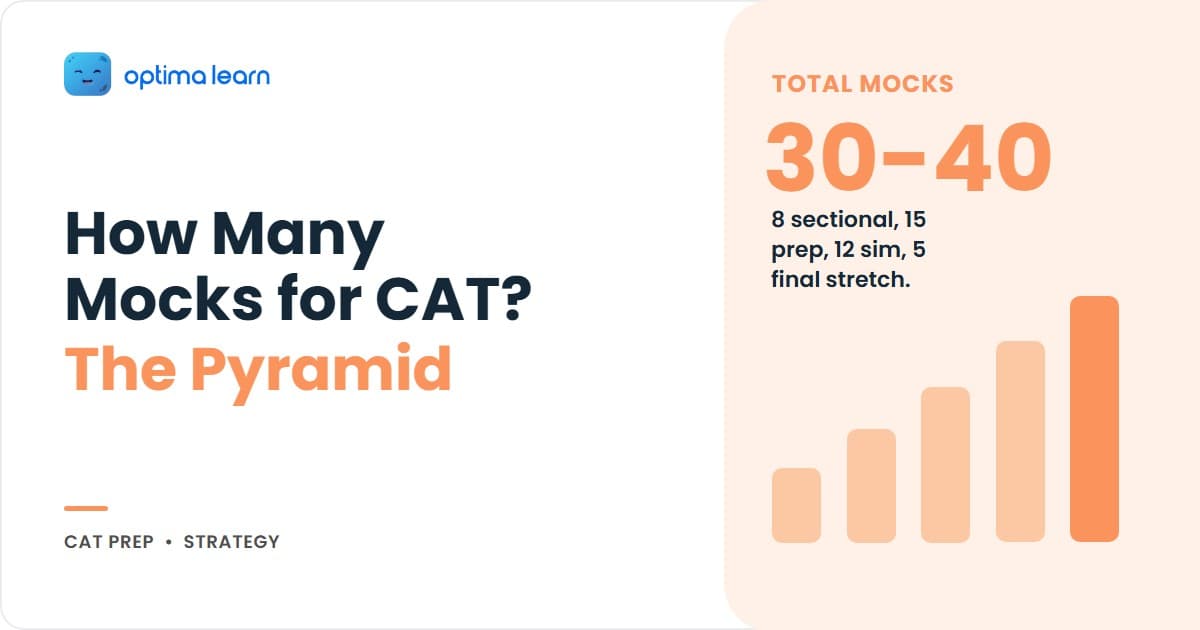
Forty mocks in seven months sounds like a lot. It is not. Spread across May to November, that is roughly six per month, one and a half per week, exactly what 99-percentilers run and exactly what mid-prep aspirants undershoot. The question is not whether forty is too many; it is whether twenty is enough. Across cohort data, aspirants who hit the 99-plus band almost always sit between 30 and 40 deeply-reviewed mocks, while sub-90 stalls cluster around the 16 to 22 range with shallow review notes.
How many mocks for CAT is one of the most-searched and most-misanswered questions in CAT 2026 prep. The honest band is 30 to 40 for serious aspirants, with some toppers running 25 and some pushing 50. This is the dedicated mock volume strategy: count, frequency, source mix, review-time budget, and the cadence calendar that makes the number work. For the broader plan this volume slots into, see the CAT preparation roadmap.
The mock count obsession hides the real problem. Aspirants chasing "more is better" hit 50 mocks at half-review depth and plateau. Aspirants chasing "less is fine" hit 18 mocks and run out of selection-skill data. The middle band, 30 to 40 with full review, is where the percentile actually moves.
- Tier 1 (Sectional Phase): 8 sectional mocks in June-July.
- Tier 2 (Prep Mock Phase): 15 full-length mocks in August-September.
- Tier 3 (Simulation Mock Phase): 12 slot-time mocks across October.
- Tier 4 (Final-Stretch Phase): 5 taper mocks in November.
- Total: 40 mocks. Drop to 30 by removing 5 from Tier 2 and 5 from Tier 3.
- Weekly cadence climbs 0 -> 3 -> 1 -> 2 -> 2 -> 1 across the seven months.
Why Fewer Mocks Plateaus You
Aspirants asking "is 15 mocks enough" usually mean "can I get away with the minimum." The answer hinges on three skills mocks build that nothing else does: selection skill, time-pressure habituation, and anxiety calibration. All three need volume.
Selection skill comes from seeing enough question shapes that your eye learns which DILR set to skip in 30 seconds, which RC passage to attack first, which QA arithmetic angle is a trap. The curve is steep up to mock 12, flat from 12 to 25, then steep again from 25 to 40 as edge cases appear. Stopping at 15 captures the first climb and misses the second.
Time-pressure habituation lets you sustain 40-minute focus blocks without second-half decay. Below 20 mocks, exam stress hits a system with only 20 timed runs. Above 30, the pressure feels like a familiar Tuesday.
Engineering aspirants in particular tend to under-mock because brute-force solving feels productive, but their actual leak is selection volume; the CAT 2026 for engineers plan covers why engineer cohorts need to push closer to the 35-mock band, not the 20-mock floor.
Anxiety calibration is the slowest-growing of the three. It only builds across mocks where the score genuinely matters, which is why October simulation mocks weight heaviest. The CAT mock scores not improving guide covers why scores plateau when one of these skills is undertrained.
The 8-15-12-5 Mock Pyramid: Four Phases
The pyramid has four tiers, each tied to a phase of the seven-month preparation arc. Each tier has a goal, a weekly cadence, and a review-time budget. Mocks taken without the matching review block are excluded from the count.
Tier 1 Sectional Phase: 8 Sectional Mocks
Goal: Test sectional fluency, not full-length stamina. Each mock targets one section under the standard 40-minute clock.
Sectional mocks build the selection-skill foundation under section-only pressure. Full-length mocks on weak sectional fluency produce noisy data; sectional first, full-length in August, is the discipline that holds the pyramid. The CAT 2026 prep timeline May to November plan covers the broader phase rhythm.
Tier 2 Prep Mock Phase: 15 Full-Length Mocks
Goal: Open full-length cadence. Build the mistake-pattern log. Test all three sections in one 2-hour sitting under fatigue.
Tier 2 is where the pyramid earns its weight. Fifteen prep mocks at full review depth produce roughly 60 hours of review, which is the volume that turns a mistake-pattern log into behaviour change. Fifteen prep mocks at full review almost always outperform 25 at half review. Volume without depth is mock dumping.
Tier 3 Simulation Mock Phase: 12 Slot-Time Mocks
Goal: Calibration. Mocks at exam slot time, with maximum review depth. October is the highest-leverage month in the pyramid.
Twelve simulation mocks compress a full prep month into a calibration sprint. Cadence rises from two per week in September to three per week in October because volume is now in service of accuracy, not exposure. Aspirants who treat October like August miss the calibration window; the Tier 3 review block should also fold in the DILR set selection drill twice weekly.
Want a mock calendar that maps the 8-15-12-5 Pyramid to your weekly availability, source budget, and review-time block?
Anchor My Mock CalendarTier 4 Final-Stretch Phase: 5 Taper Mocks
Goal: Taper into exam day. Hold mock rhythm at lower volume. Protect sleep, slot timing, and exam-day pacing instincts.
Five taper mocks keep the nervous system tuned without burning the well. Six or seven correlate with worse outcomes; tired brains lose accuracy faster than rested ones gain content. The CAT mock test analysis framework covers the 90-minute taper review protocol. Repeaters running a second-attempt rebuild push higher than first-timers in the final eight weeks; the CAT 2026 comeback after below 80 percentile guide covers the 12-mock re-attack cadence specific to repeater nervous-system patterns.
The Mock Cadence Calendar: Weekly Mocks by Month
Mock count without a cadence calendar is decoration. The pyramid translates 30 to 40 mocks into a weekly schedule matching the four phases, engineered backward from the November exam, not stacked forward from May.
| Month | Tier | Sectional / Week | Full-Length / Week | Cumulative |
|---|---|---|---|---|
| May | Foundation | None | None | 0 |
| June (last 9d) | Tier 1 | 3 / week | None | 3 |
| July | Tier 1 | 1-2 / week | None | 8 |
| August | Tier 2 | 2 / week | 1 / week | 12 |
| September | Tier 2 | 1 / week | 2 / week | 23 |
| October | Tier 3 | 1 / week | 3 / week | 35 |
| November | Tier 4 | None | 1 / week | 40 |
The cadence has two shape rules that hold the pyramid together:
- Rule 1 (peak shape): Full-length count rises 0, 1, 2, 3, 1, peaking in October and dropping sharply in November.
- Rule 2 (no overlap): Sectional volume falls as full-length volume rises; the two never compete for the same weekend.
- Failure mode: Aspirants who add a Sunday sectional drill after a Saturday full-length mock burn their review window.
Mock-Source Mix: TIME, IMS, Career Launcher, Official IIM
Source mix matters more than most aspirants assume. Single-source mocks calibrate to one author's style and miss CAT's actual variance. The pyramid splits 40 mocks across three to four sources to capture set-shape diversity.
Free mock series are useful for sectional volume but unreliable for percentile signal because the test-taker pool is non-representative. The full-length mock pool should split roughly 60 percent paid simulator, 25 percent PYQ, and 15 percent alternate. Aspirants targeting 99-plus should pair the source mix with the discipline detailed in the how to score 99 percentile in CAT guide.
Anchor the simulation phase mocks on the official IIM PYQ set wherever possible. Slot-time PYQ mocks give the cleanest percentile read because the question difficulty is identical to the actual paper. Save 4 to 5 of the most recent PYQ mocks for October and November to calibrate your final percentile band against the real distribution.
Anxiety Arc: How Mocks Calibrate Exam-Day Stress
Mock volume is not just a content drill. The deeper purpose of the simulation phase is rewriting the nervous system's relationship with the exam clock. Each tier of the pyramid handles a different anxiety stage.
Analysis-Time Per Mock Budget
Every mock above zero counts only when the review block is locked in alongside it. The pyramid is engineered around an explicit review budget: roughly 90 minutes for a sectional, three to four hours for a prep mock, and a full four hours for a simulation mock. Five taper mocks need 90 minutes each.
Across 40 mocks, that is 12 hours for sectionals, 60 for prep, 48 for simulation, 7.5 for taper. Roughly 128 hours of review across seven months. Mocks without the review block are exposure events, not learning events.
Aspirants who run 25 mocks by end of September and then collapse in October are peaking too early. The pyramid is shaped to peak in October-November, not August-September. If you find yourself at 23 mocks by August 31, you are running Tier 2 at Tier 3 cadence and you will burn out before the simulation phase. Cut weekly mocks back to 1 in August and protect the pyramid shape.
Four Mistakes That Break the Mock Pyramid
Most broken mock plans fail at one of four points. Each mistake has a specific fix; together they account for the gap between aspirants who hit 99-plus on a 30-mock plan and aspirants who hit 88 on a 50-mock plan.
Running 4 mocks per week for the volume thrill, then reviewing only the score, not the questions. The mistake-pattern log goes empty. Three weeks later the same mistakes show up at the same rate. Mock dumping is the most expensive failure mode in CAT prep because it consumes the mock pool and produces nothing.
Running all 40 mocks from one provider's series. Selection skill calibrates to that provider's set patterns and breaks on exam day when the IIM-set DILR sets follow a different shape distribution. Use three to four sources minimum.
Skipping sectional mocks in June-July to "save mocks for August." The 8 sectional mocks build the selection-skill foundation that Tier 2 sits on. Skipping Tier 1 produces noisy August data and a mistake-pattern log that confuses sectional gaps with full-length pacing issues.
Running 23 mocks by August 31 because "more is always more." The pyramid shape collapses, simulation mocks land on a fatigued nervous system, and the taper window opens with the brain already burnt. Peaking too early is the silent killer of late-October percentile climbs.
FAQ: How Many Mocks for CAT 2026
Plan for 30 to 40 mocks across seven months for CAT 2026. The 8-15-12-5 Mock Pyramid breaks that into 8 sectional mocks in the foundation phase, 15 prep mocks during the build phase, 12 simulation mocks in the calibration phase, and 5 final-stretch mocks in the taper. Some 99-percentilers attempt 25, some 50; the band that consistently produces serious outcomes is 30 to 40. Below 25 you run out of selection-skill data; above 50 you usually skip review. The right number is a calibrated range, not a magic figure, and review depth matters more than raw count.
The 8-15-12-5 Mock Pyramid is a four-phase mock volume strategy for CAT preparation. Phase 1 runs 8 sectional mocks during June and July to test sectional fluency. Phase 2 runs 15 prep mocks across August and September with one rising to two full-length mocks per week. Phase 3 runs 12 simulation mocks in October at slot-time with maximum review depth. Phase 4 runs 5 final-stretch mocks in November at reduced volume to taper into exam day. Each tier has a defined goal, cadence, and review-time budget.
The ideal weekly mock count is one full-length mock per week in August, two per week in September and October, and one per week in November. In June and July sectional mocks run at three per week. Three full-length mocks in a single week is the failure threshold because review time falls below the four-hour minimum and mistake patterns stop being trackable. The weekly mock plan for CAT scales review with cadence, not volume; mocks without review are noise.
Twenty mocks is on the lower edge of the practical band. Aspirants who run 20 mocks with deep review can hit 95-plus percentile, but they need exceptional review discipline because each mock carries more weight. The risk with 20 is insufficient selection-skill data: you do not see enough DILR set-shapes, enough QA arithmetic angles, or enough VARC passage families to build pattern intuition. Twenty works for advanced repeaters; first-timers should plan for 30 to 40 to compensate for the missing pattern library.
Fifty mocks is at the upper edge and usually breaks review discipline. The 90-minute review minimum per mock means 50 mocks demand 75 hours of review across the prep arc, which most aspirants compress into 30 hours by skipping the slow review steps. The result is 50 mocks at low review depth, which produces flat percentile trends. Fifty works only for aspirants who built buffer time into the schedule and protect the four-hour review block per simulation mock. Most aspirants get better outcomes from 35 mocks at full review depth than 50 at half depth.
Use a mix of three to four sources across the 30 to 40 mock plan. A common mix is the official IIM PYQ set, two paid simulator series such as TIME and IMS, and one alternate source such as Career Launcher or a free mock series for variety. Single-source mocks calibrate to one author's style and miss CAT's actual variance in difficulty patterns. Mixed-source mocks capture more set-selection variety and surface weaknesses that single-source mocks would hide. Treat the official PYQ set as the most reliable signal and weight it accordingly in the simulation phase.
The Mock Pyramid Bottom Line
- Play 1The honest band is 30 to 40 mocks. Below 25 you lose selection-skill data; above 50 you usually lose review depth.
- Play 2Run the 8-15-12-5 shape. Sectional first, then prep mocks, then simulation peak, then taper.
- Play 3Cadence climbs 0, 3, 1, 2, 3, 1 across the last six months. October is the peak, not September.
- Play 4Lock the review block before adding the mock. 128 hours of review across the arc, 90 minutes to 4 hours per mock.
- Play 5Source mix three to four providers. PYQ for calibration, two simulator series for spine, one variety source.
- Play 6Volume in service of accuracy, not exposure. A mock without review is not a mock; it is a Saturday afternoon.
Anchor your CAT mock calendar to the 8-15-12-5 Pyramid
A mock volume plan mapped to your start window, weekly availability, source budget, and 128-hour review block.
Anchor My Mock CalendarBuild your CAT 2026 study plan
Personalised daily plan that adapts to your section-wise mock scores.
More from Strategy
Continue reading
XLRI Admission Process: The Exam Nobody Ever Checks

Why Do Some CAT DILR Sets Feel Totally Unsolvable?

Why School Level Quant Feels Hard in the CAT Paper

Why Do Non Engineers Struggle in CAT VARC As Well?
Put it into practice